You know how the saying goes — one person’s trash is another’s treasure.
In this case, gas created by trash at the Prima Deshecha Landfill could be turned into renewable energy to help power the Doheny Ocean Desalination Project in south Orange County.
The Orange County Board of Supervisors, earlier this month, approved a memorandum of understanding between OC Waste & Recycling and South Coast Water District to explore delivering renewable electricity to the project, which hopes to create a locally-controlled drinking water supply for south Orange County in the coming years.
The county’s MOU allows for the formation of a task force to explore and evaluate technology, grid delivery, funding, governance and a schedule for the collaboration.
The ability to use electricity generated from landfill gas at Prima Deshecha using modern energy-recovery technology could help reduce costs, as the price for the project faces increases due to inflation, chain supply challenges and tariffs, as well as rising energy costs, said South Coast Water District General Manager Rick Shintaku.

When the project was first approved by the state Coastal Commission in 2022, cost estimates were $140 million, and current estimates are pegged at about $237 million — though negotiations are still happening that could change that figure, Shintaku said.
“In theory, that cost should go down. That’s what we’re working on,” Shintaku said. “It’s too early to tell how much it will go down; we will work on additional studies with the county.”
Several state and federal grants are being used for a portion of the project — an estimated $40 million allocated so far — and by next spring, they expect a 60% design report, which will give a guaranteed maximum price to build and operate. It’s at that point that decision makers will discuss whether it makes sense to move forward with the project, with a final decision expected by summer.
“That’s what everyone’s waiting for,” Shintaku said. “We will take that back and run our rate models, and agencies will determine if that’s reasonable.”
Managing waste as a resource and creating renewable energy to supply the innovative desalination project to make potable water is “extremely exciting,” said OC Waste & Recycling Director Tom Koutroulis.


Once organic waste is buried, it creates “landfill gas” that is a combination of methane and CO2, a natural byproduct when the waste is buried.
It’s the agency’s responsibility to collect that gas and destroy it using a “flare,” Koutroulis said. But rather than destroy it, the gas can be put through an engine and a turbine to convert it to renewable energy.
It then creates electricity to be put through the grid and sent to the desalination plant to be used.
Not all landfills have this in place, and Prima Deshecha’s system is still in the planning stage. It is expected to be built through 2026 and 2027.
But the county manages two other landfills, one in Irvine and the other in Brea, that are currently using the system to help power the Anaheim Public Utilities. That agreement was put in place back in 2016, he said.
“It’s something we’ve done before, but the technology today is much better,” Koutroulis said. “We can create a lot more energy with the gas that we collect today.”
Many people think they put their trash on the curb, and it’s gone forever, but the reality is it needs to be kept in perpetuity and managed, Koutroulis said. While it slowly decomposes over time, the goal is to use it for the greater benefit of serving the region.
The idea is to “maximize what we can do and offer with the facilities that we own and operate,” he said.
Excess landfill gas that can’t be turned into energy is converted into renewable natural gas, he said.
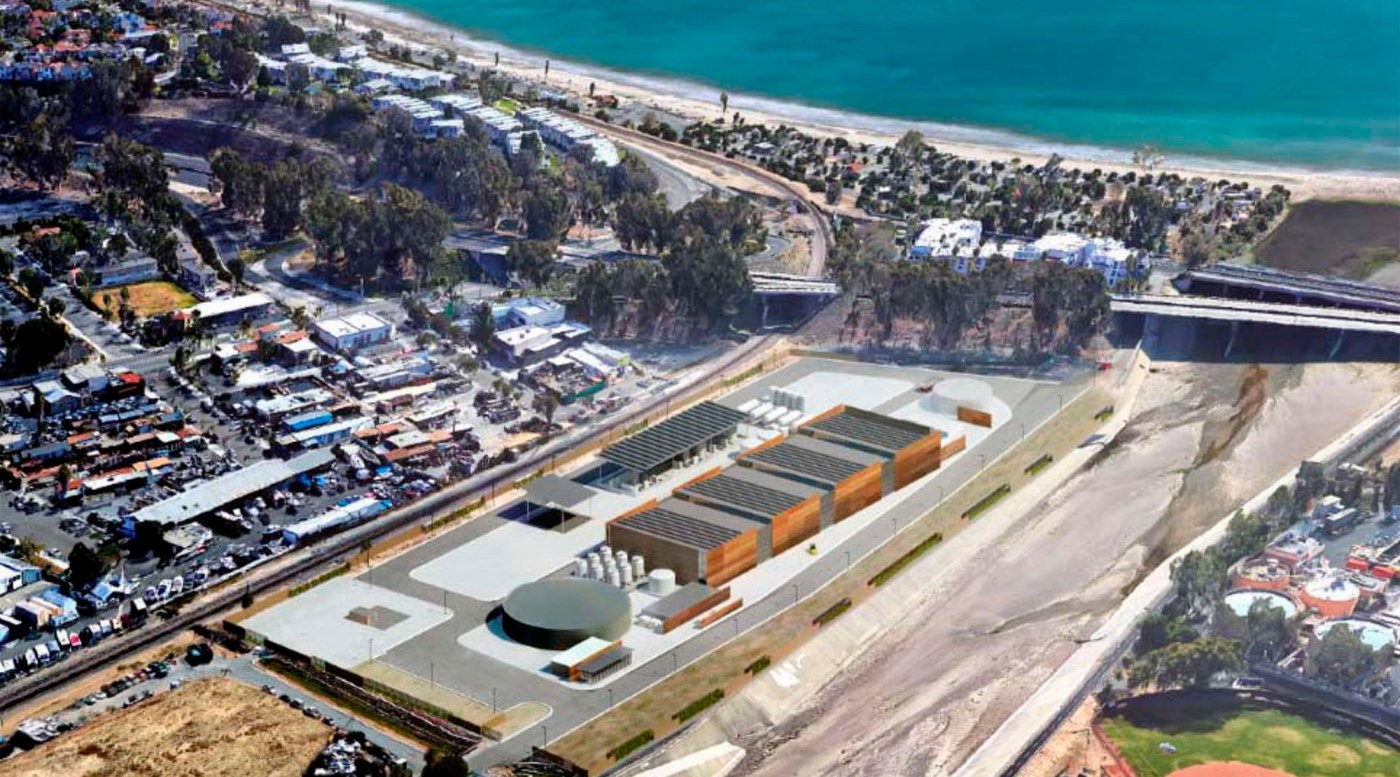
The Doheny Ocean Desalination Project would sit at Pacific Coast Highway and Stonehill Drive, next to San Juan Creek, within 100 yards of existing regional water transmission lines. SCWD will build the facility on property it owns, with much of the infrastructure already in place.
The project dates back to 2004, when the Municipal Water District of Orange County explored ideas for desalination. South Coast Water District, based in Laguna Beach, took over the project in 2015.
The Doheny Project, when completed, would produce 5 million gallons per day of drinking water as part of SCWD’s Integrated Water Resources Plan, aimed at diversifying and securing water resources, particularly during critical need periods such as drought and natural disasters.
Underground pipelines will run from Doheny State Beach, with some under the Doheny campgrounds, which, through the project build, will get a much-needed upgrade, with plans for better drainage to combat the flooding issues the area experiences during rains and high tide events, Shintaku said.

“It was a win-win in that the State Parks had it in their general plan to upgrade,” he said. “The improvements are going to be excellent and provide benefits for decades to come.”
The campground remodel is expected to take up to two years to build, during which the popular beachfront amenity will be closed.
The restroom near the lifeguard headquarters will also get an upgrade, with the building being eyed as the location for subsurface slant wells.
Using the pipelines buried under the ocean floor is the preferred method because it has little impact on marine life. Brine, the saltwater left over from the desalination process, will be mixed with treated wastewater in an existing outfall pipe and discharged two miles out into the ocean.
The Doheny plant would be the first commercial-scale desalination project to use slant wells designed to collect ocean water from beneath the seafloor and pull it through sand, which eliminates risks to most sea life.
The project would give South Orange County residents a locally-controlled source of water, which gives more reliability and an assurance of a continuous supply, he said.
Ninety percent of South Orange County’s water is imported from the metropolitan area, from the Colorado Basin and Northern California, treated at a facility in Yorba Linda.
If the pipelines that run to the area were to rupture or become out of service, it would have enough emergency supply to last 10 days. With locally-sourced water, the area would have a 60-day supply, he said.
“Nearly 90% of South County’s water comes from imported water supply. If that supply faced interruption due to a natural disaster, the region would only have 10-20 days of potable water supply available,” said Fifth District Supervisor and Vice Chair Katrina Foley.
“This partnership allows us to turn excess landfill gas into clean energy to power the Doheny Desalination Plant, addressing two environmental challenges with one solution,” said Fifth District Supervisor Katrina Foley. “It strengthens our local water supply, reduces dependence on imported water, and builds regional resilience during emergencies.”
If the project gets the green light to move forward next summer, it is expected to be online by 2029.