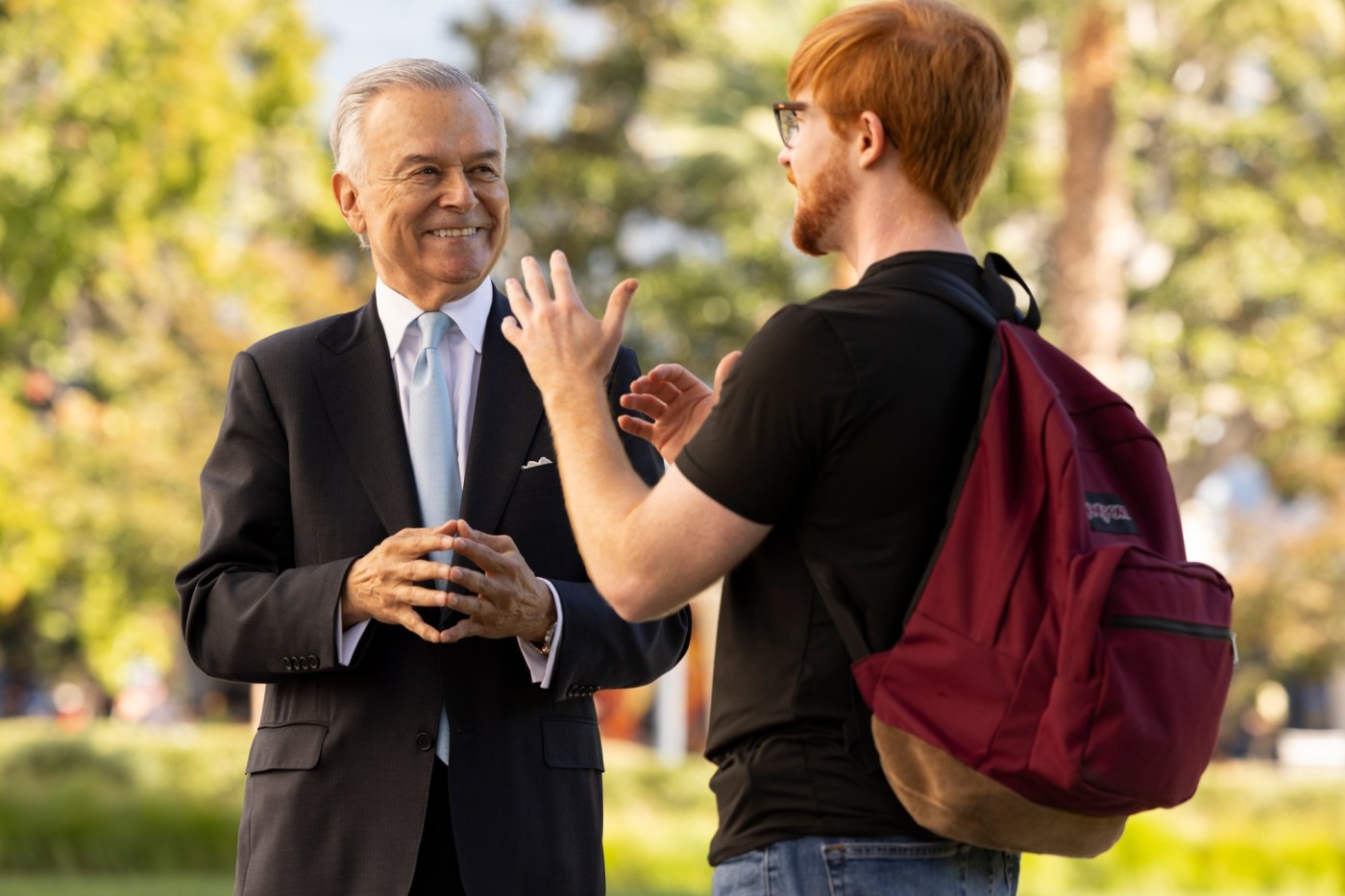
For many years, Cal State Fullerton alum Raúl R. Tapia has had a significant hand in creating success stories. That makes sense, given his altruistic nature and the fact that, having made his way from laboring in the Southern California lemon fields to advising a U.S. president in the White House, he himself is an extraordinary success story.
Despite his achievements, Tapia, who earned a bachelor’s in political science in 1972, considers the help he’s given others to be among his greatest honors.
Those honors could fill a textbook. An all-too-brief snapshot: After graduating from Harvard Law School and earning a master’s from Harvard in public administration, Tapia served on Jimmy Carter’s staff, as deputy assistant to the president for Hispanic affairs. He later worked on the finance and steering committees for the John Kerry, Al Gore and Clinton-Gore presidential campaigns.
As an entrepreneur and attorney, Tapia created and heads Tapia & Associates and works as an independent consultant, focusing on strategic planning, crisis management, telecommunications, municipal services, health care and public affairs. He is the founder, and former chairman of the board, president and CEO of the Republic Communications Corp., and was the founder, director, president and CEO of the AMO Broadcasting Co. In addition, he continues to serve on a number of for-profit and nonprofit boards of directors.
The multitude of awards Tapia has received through the years is no less impressive. A few examples: He garnered the Lifetime Achievement Award from the Hispanic Bar Association of the District of Columbia and was recognized as the Role Model of the Year by Latina magazine.
Closer to home, Tapia earned CSUF’s Presidents Award as the outstanding graduate of the Class of 1972 and, 22 years later, was honored by the university with the Vision & Visionaries: Distinguished Alumnus Award.

deputy assistant to the president for Hispanic affairs under Jimmy Carter. (Photo courtesy of Raul R. Tapia)
How did Tapia go from the farm fields to the White House and beyond? It began with a stellar work ethic — and life-altering help from Cal State Fullerton.
“I learned about the value of hard work early on,” said Tapia, the son of a seamstress and a steelworker. “My first job was at age 11, picking lemons in the foothills of Upland and Rancho Cucamonga.” He later worked as a grocery store box boy, among other menial jobs. “I didn’t think I had the grades to succeed in a university.”
Fortunately, CSUF thought otherwise, inviting Tapia into New Educational Horizons, a university program that brought together young students with similar backgrounds.
“The people at Cal State Fullerton have always assisted diamonds in the rough,” Tapia said. “They gave me an opportunity and a sense of direction. … My professors furnished me with a lifelong love of learning. For example, my freshman English teacher assigned me extra writing assignments outside of the regular coursework. My writing skills, which hadn’t been strong but are critical for any lawyer, improved dramatically due to her feedback and encouragement.”
Thanks to his commitment to help others, Tapia has served as a mentor in Cal State DC Scholars, a program in which students earn academic credit while interning in the nation’s capital. Over the past two decades, more than 650 CSUF students have been involved in the program.
“DC Scholars is a great program,” Tapia said. “However, I’ve been mentoring others long before that. … Being a good mentor involves stoking the embers that you see in a person and building that into a flame; that flame is hope. Rather than push, a good mentor suggests and provokes thought, and the most successful mentees I’ve worked with are intellectually curious.”
Tapia credits Jack Mandel, a lawyer who later served as an OC Superior Court judge, as a key mentor. The two first met when Tapia was a CSUF junior, and Mandel later assisted Tapia in his acceptance into Harvard Law School.
CSUF political science major Colson Houck Teal, who served in the Cal State DC Scholars program in the spring of 2024, as well as last summer, credits Tapia with helping him apply to law schools, while sharing his wealth of knowledge and experience. “Mr. Tapia has told me about what I can expect in law school, and he’s been helping me, in particular, with my law school application. … Not only is the information he provides incredible, but his positive spirit has also had a real impact. He’s shown me the kind of person I want to be, not just in my accomplishments but in how I want to live life in general.”
Tapia remains grateful for the help of others. “I’ve received far more than I’ve given,” he said. “I stand on the shoulders of my mentors and teachers. People believed in me and gave me hope and encouragement. And the debt I owe, one I can never repay, is the debt to Cal State Fullerton.”