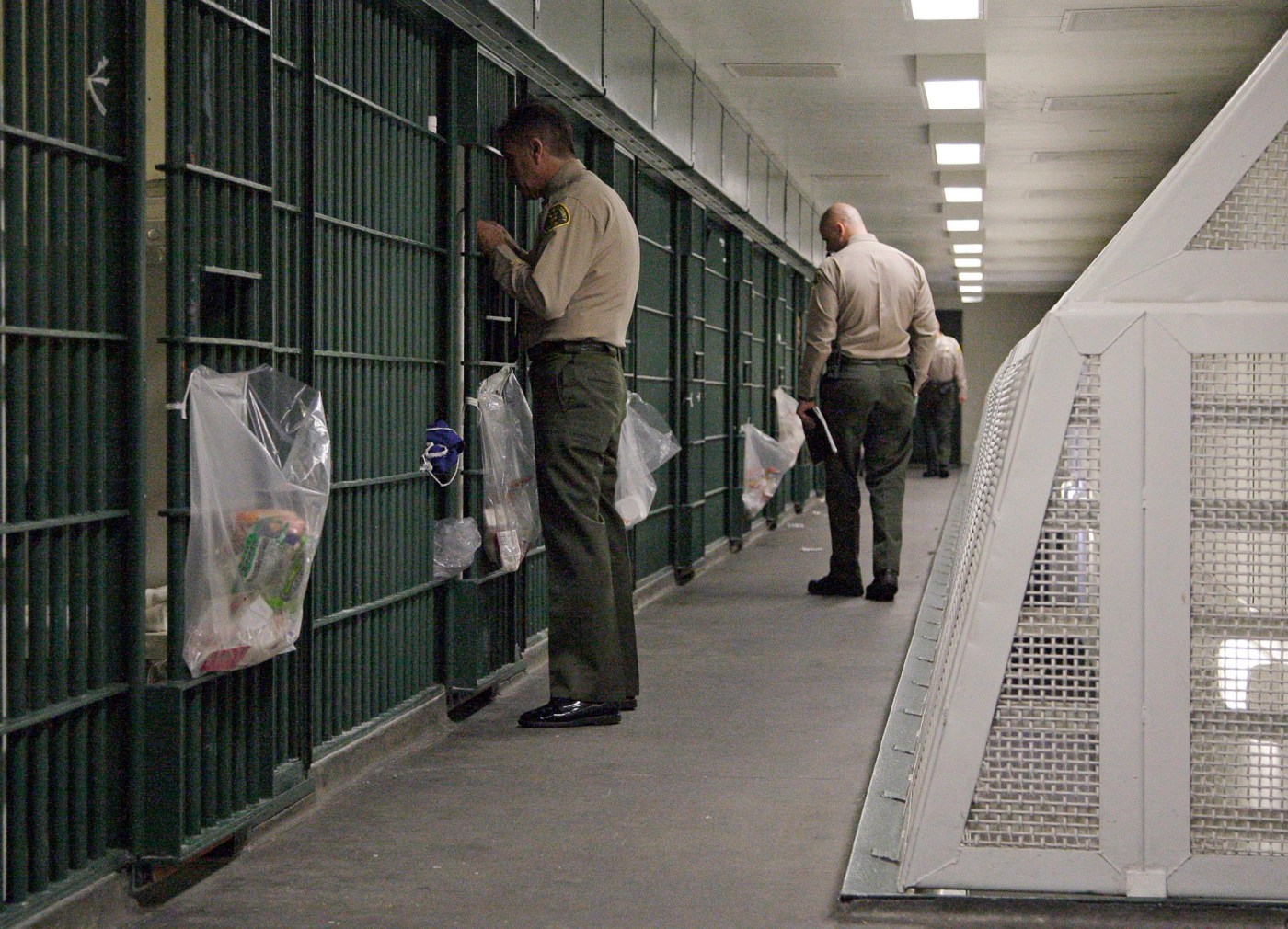
First of two parts
Every five days, on average, someone dies in the jails of Los Angeles, Orange, San Bernardino or Riverside counties.
Broken bodies, broken minds and substance abuse are at the root of most of the nearly 500 deaths since 2020. Homicides behind bars get more attention but are rare compared to suicides, drug overdoses and death by natural causes.
Los Angeles County Sheriff Robert Luna has called his jails the largest mental health institution in the nation, estimating that roughly 50% of the inmates are struggling with psychological problems. Other counties in the region concur with that estimate for their jail populations.
As one civil rights attorney said: “You’re dealing with a population that is physically sick, mentally ill and addicted, and they need help, a lot of help.”
The examples are plentiful. And painful.
Ronald Forsyth, deemed mentally unfit to even stand trial, suffered a slow death at the Twin Towers jail in Los Angeles from untreated anemia and hypertensive heart disease. A lawsuit claims that, at the end, he was unbathed and covered in “welts, bruises, cuts, open sores, skin infections and other signs of complete lack of care and attention.”
Forsyth, arrested on suspicion of battery, was 53.
Mario Solis asphyxiated himself at the Cois M. Byrd Detention Center in French Valley after stuffing two bars of soap, a toothbrush and a pencil into his mouth. According to a lawsuit, the pencil ruptured a vein in his neck.
Solis, arrested for allegedly stealing a bag of Skittles from a supermarket and scuffling with a security guard, was 31.
And Joshua Campos, a schizophrenic beset with bipolar and obsessive compulsive disorders, stopped breathing 13 minutes after snorting fentanyl from a metal stool in his cell at the Theo Lacy facility in Orange. His death cost Orange County $3.3 million in civil damages.
Campos, arrested on suspicion of solicitation, was 28.
For years now, sheriff’s officials who operate jails in the four-county region have argued that death is inevitable because they are not equipped to deal with the magnitude of the mental and physical illnesses confronting them among the inmate population.
These can become lethal when combined with despair, depression and addiction.
But civil rights activists, grieving families, elected officials and even the state Department of Justice have demanded to know why jails can’t do better to intervene with those spiraling toward death.
People like Ronald Forsyth, Mario Solis and Joshua Campos.


6-month examination
A six-month investigation by the Southern California News Group examined who’s dying in county lockups, how they are dying and whether anyone could have stopped them from dying.
More than a thousand pages of lawsuits, databases, audits, coroner reports and investigative reviews going back five years were analyzed. They tell a story of a jail system struggling to keep up with the problems created by a complex population of inmates, many of whom are already in bad shape when they arrive.
Yet the records also show instances of neglect and repeated failures of supervision. Minutes — or even hours — have been lost during emergencies due to delayed and substandard safety checks. Red flags go unnoticed before health crises and suicides. Drugs slip by security, while those with addictions languish on wait lists for treatment.
Two-thirds of those who die have not yet been convicted of anything. Some die within days of their arrests. More than half did not reach the age of 45.

Conditions have gotten so bad in Los Angeles County that California Attorney General Rob Bonta filed a lawsuit in September against the Sheriff’s Department for inhumane treatment of inmates. Bonta said in a statement he had no choice but to go to court over the rat- and roach-infested cells, mold-covered walls, broken toilets and inadequate drinking water found during a series of inspections at Men’s Central Jail in 2024.
“Many individuals suffer physical or mental deterioration in these punitive conditions but are unable to access necessary medical or mental health care,” Bonta’s statement said. “The lack of access to care contributes to the shocking rate of preventable in-custody deaths, such as suicides.”
Bonta similarly launched a civil rights investigation in 2023 into the Riverside County jails, which had one of the highest per-capita death rates in the state a year earlier, partly fueled by overdoses from fentanyl and other drugs.

Of the 19 inmates who died overall in custody in Riverside County in 2022, seven died from fentanyl overdoses. Among them was Michael Vasquez, 20, who openly kept his drugs in a property box inside his cell and was discovered dead on his bed by his cellmate, records show.
“We had one belief, that he would be safe,” said his sister, Marissa Vasquez, at a news conference in June. “We hoped he would get access to the mental health resources, and this is a decision we regret daily, not bailing him out.”
Sheriff Chad Bianco has attributed the fentanyl-related deaths that year to a nationwide trend of the deadly opioid flooding jails. From 2022 to 2024, overdose deaths within Riverside County’s jails dropped by more than 60%, data shows.
Natural causes top category of death
From January 2020 through November this year, 478 people — 37 women and 441 men — have died in custody in the four counties reviewed by the Southern California News Group. While the jails in each of the counties differ in size and demographics, the manner in which people die in custody is remarkably consistent.
The youngest hanged himself at just 19. The oldest succumbed to a bone marrow disorder at 91.
Of the deaths, 45%, or 217, were labeled as “natural,” a designation that sparks criticism from justice reform advocates because it does not factor in the level of care received by the inmate, or how the conditions inside may have contributed to health declines.
Some inmates missed medical appointments before their deaths, while others never received thorough assessments, or weren’t on the proper medications.
In the past year, nearly half of the 1,100 grievances sent by inmates to the Los Angeles County Office of Inspector General pertained to their medical care.
The second highest category of deaths in the four-county region was drug overdoses, accounting for about 22%, or 103, of the fatalities. Half involved fentanyl. Methamphetamines were the next most common drug found during autopsies.
Those deaths occurred in cells, on transport buses and even in holding tanks ahead of court appearances, raising serious concerns about the thoroughness of searches for those entering and exiting secure facilities. While some jails search the belongings of staff, none currently requires officers to go through body scanners.
Of the deaths examined over the five years, about 14% were by suicide.
Reports and surveillance footage showed multiple instances of inmates covering their doors with paper or towels before taking their own lives, though officers are required to maintain visual contact during their rounds. Others fastened ligatures in plain sight of unwatched security cameras, or had known histories of suicidal intent, yet were not placed under adequate supervision.
Contrary to what Hollywood would suggest, homicides were the second-lowest category, with only 6.5% of the deaths attributed to such violence.
Nearly 7% of the deaths remain under investigation, some years after the fact.
In-custody deaths in the four counties have largely trended down since pandemic highs, dropping from 101 deaths in 2022 to 63 — a 37% drop — in 2024. The number of natural deaths halved in that time, while suicides and overdoses decreased 30% and 22%, respectively.
Those declines suggest recent reforms may be making a difference. However, the total number of deaths in Los Angeles, Orange and San Bernardino counties still remained above 20-year averages, according to data from the state Department of Justice.

One of deadliest years in LA County
While Los Angeles County had the highest number of deaths in each of the past six years, it also had the largest jail population by far.
A comparison using deaths per 1,000 inmates showed that L.A. County typically had one of the lowest death rates among the four counties. That is, until this year, when it shot past its neighbors as those counties dipped into post-pandemic declines.
Los Angeles County now is on track to have one of its deadliest years — potentially the deadliest — in the past two decades, data shows. The county averaged about one death per week until the most recent fatality in early November.
It’s difficult to say why L.A. County has spiked while its neighbors have leveled off. The 41 deaths this year generally follow previous trends — 20 were due to natural causes and 10 were attributed to drugs. Overdoses and suicides surpassed six year averages, but were still below the highs of 2021 as of Dec. 4.
In a statement, the L.A. County Sheriff’s Department said it had not identified a specific reason for the spike, but it acknowledged that the inmate population is “older and faces more chronic medical and mental health issues than ever before.”
A surge in the population also might play a role. Quarterly reports by the L.A. County Office of Inspector General have repeatedly warned for the last two years: “Overcrowding in the Los Angeles County jails continues to jeopardize the ability of the Sheriff’s Department to provide humane conditions of confinement.”
The combined jail population at county facilities was on the verge of dropping to its recommended capacity of 12,400 at the end of 2024, but, amid a political shift toward tougher-on-crime laws, the numbers reversed, jumping to 13,419 as of September 2025.
Because staffing rarely increases at the same rate, higher populations mean it is easier to miss warning signs and more difficult to get inmates to the services they need.
“Overcrowding exacerbates all of the conditions that lead to death,” said Melissa Camacho, a senior staff attorney at the ACLU.
The state attorney general’s office, in its lawsuit against L.A. County, estimates that more than a third of all deaths in its jails fell under what it considered “preventable circumstances.”
Some argue that the deaths of Ronald Forsyth, Mario Solis and Joshua Campos were all preventable.
Lack of intervention in 3 deaths
A schizophrenic with a traumatic brain injury, Forsyth had been waiting five months for a transfer from Los Angeles County’s Twin Towers Correctional Facility to a mental health facility. Before his death in January 2024, Forsyth had refused treatment for his anemia and his psychotropic medication for months. And the jail staff accommodated him.
The problem was, he was too mentally ill to make such a life-or-death decision. The 53-year-old had been institutionalized since his teens and a court had appointed his father, Charles Forsyth, as his conservator, legally in charge of making all of Ronald’s decisions. But jail staff never contacted Charles, whose name and telephone number were in his medical file.
“They had him sign a form saying he refused medication; there was literally a court order prohibiting exactly that,” Charles Forsyth said in an interview. “So what does he die of? All of the things the medication was treating.”
A week before he died, Forsyth told his father “something was wrong” but he couldn’t articulate what. The lawyer working on Forsyth’s case at the time said he needed another 10 days to find placement for his son in a less restrictive facility.
Forsyth was in a medical unit with checks every 15 minutes. Anything serious would be caught, Charles told himself.
The coroner ruled that Ronald Forsyth — who at the end of his life was lying in his own feces — died from heart disease, a natural cause. His family alleges in a lawsuit, however, that his death was anything but natural.
“He smelled of waste, he was unshaven and disheveled, and he moved slowly and clumsily,” wrote his family’s attorney, Arnoldo Casillas. “These conditions were not reported to mental health staff by any of the deputies that conducted safety checks or otherwise observed Ronald Forsyth.”
On the day he died, Forsyth was weak, dizzy and in distress, Casillas wrote. He fell and split his forehead and was too weak to pull himself back up to his bunk.
A deputy conducting safety checks at the time “walked by his cell quickly” and never noticed him “lying on the floor about to die,” the lawsuit alleges. If his struggles had been caught sooner, a blood transfusion could have saved Ronald’s life, his father said.
“It’s not like he had a heart attack and died. If you die from anemia, it is a slow, gradual death,” Charles Forsyth said. “His death is the consequence of incompetence and negligence.”
In Riverside County, Mario Solis’ body was a road map of past suicide attempts.
Solis had horizontal cut marks on his wrists, fresh or in the healing stage, ligature marks on his neck, and chunks of flesh missing from his arms and hands. Correctional staff in the Riverside County jail system also discovered a small noose Solis had crafted on the metal stool in his cell.
In the days before his death, Solis had taken to wearing his underwear as a mask.
Jail staff was quite familiar with Solis from his past incarceration. In his latest five-month stint, Solis had been housed in four jails. He often displayed unpredictable, aberrant and suicidal behavior that required a higher level of care, according to a lawsuit filed by his family.
On the morning before his death, Solis was found to be mentally incompetent to stand trial for his alleged crimes and was ordered to be committed to the custody of the California Department of State Hospitals. He never made it there.
That night, a nurse at the Cois M. Byrd jail facility was unable to give Solis his psychiatric medication because he had flooded his cell, according to the lawsuit. Photos show soiled, wet towels covering the toilet bowl and water-soaked books, papers, food, milk cartons and other trash scattered across the cell.
After midnight on Sept. 3, 2022, two correctional deputies conducting welfare checks found Solis sitting on the floor, slouched over with his face and body leaning against the cell door. The deputies yelled out to him, but Solis didn’t respond.
Instead of checking on Solis and seeking medical attention, the two jailers continued doing their rounds for another 11 minutes, only realizing when they returned to check on him again that he was dead from swallowing miscellaneous items, according to the lawsuit.
The Riverside County sheriff-coroner determined Solis’ cause of death was accidental, not a suicide.
Attorney Denisse Gastelum, representing Solis’ family in their lawsuit, strongly disagrees. She described Solis’ death as one of the worst cases of jail abuse and negligence she’s ever seen. “It’s horrific. This one just breaks our heart,” she said.

In neighboring Orange County, another family was left heartbroken after the jail system allegedly failed their loved one.
Joshua Campos had hallucinations and heard voices. Schizophrenic and bipolar with obsessive compulsive disorder, Campos was booked on March 4, 2022, into the Orange County jail on a warrant for misdemeanor lewd conduct.
Jail housing officers knew of his extensive psychiatric history: He had 10 previous psychiatric hospitalizations, multiple suicide attempts and abused drugs.
But after he was placed on mental health evaluation for two days, Campos was moved to the general population at the Theo Lacy facility in Orange. That placement contributed to a federal grand jury finding the Sheriff’s Department was liable for Campos’ death from a fentanyl overdose.
Attorneys for Campos’ father, Jay, said Campos did not belong in the general population, but rather in a special cell where jailers could keep a closer eye on him. Indeed, a surveillance camera caught Campos unwrapping something and then snorting it from a metal stool in his cell on March 7, 2022. Thirteen minutes later, he stopped breathing.
But as happens so many times in jail, no one watched the video until it was too late.

Lapses in monitoring
Attorneys and relatives complain that, time and again, inmates are caught on security cameras killing themselves or taking lethal doses of drugs, but those videos are not viewed until after the person is dead.
“If you have the opportunity to look after he died, why didn’t you look at it before he died?” asked attorney Annee Della Donna, who is representing the father of inmate Sean Whiting, who died by suicide in December 2022 by stuffing orange peels down his throat. Sean’s father, David Whiting, is a former columnist with the Southern California News Group.
Orange County Assistant Sheriff Nate Wilson, who is in charge of the jails, said in general it’s not feasible to monitor the thousands of cameras in the jail at every moment.
“I’d rather have my staff walking the floor,” Wilson said, adding that video feeds are limited. “You can’t hear what’s going on, you can’t smell. We don’t want (staff) to rely on just watching a camera.”
If deputies at Orange County’s Theo Lacy jail had watched the surveillance cameras, they would have seen inmate Nelson Gam twisting his bedsheet into a knot, right before hanging himself in September 2022, according to an investigation by the district attorney’s office. Hours earlier, Gam, 65, handed a nurse a message slip imprinted with the words “I NEED HELP PLEASE!!” and “ASAP!!”
The message, however, was handled in routine fashion — that is, a mental health professional would get back to him within 24 hours. By then it would be too late. On the medical message slip, Gam had checked the boxes for “depressed” and “anxious,” but left unchecked the box for “suicidal.”
Similarly, an inspector general’s report found that no one was watching when Massimo Barbagallo, 49, climbed and then jumped off a second-story railing inside the North County Correctional Facility in Los Angeles County in January 2023. Officers found him unresponsive in a hallway, so badly injured that they didn’t attempt to render emergency aid.
And in July of that year, surveillance cameras caught 22-year-old Maxwell Aguirre tying a ligature to his door and then hanging himself in plain view, yet officers were instead busy watching YouTube videos on a computer, according to a lawsuit.

Mismatched cellmates
Activists and families also have criticized sheriff’s officials for at times not properly vetting inmates placed in cells together, which in a few cases led to violent homicides — the least common category of death in the region’s lockups. Only L.A. County experienced more than two homicides a year in its jails, reaching a high of four in three of the years reviewed.
One of Riverside County’s homicides resulted from an ill-advised pairing of inmates at the Cois M. Byrd center in January 2023.
Mark Spratt, 24, a Fontana resident charged with fraud after he allegedly was caught with stolen debit cards, was assigned to a cell with Micky Payne, 33, an admitted gang member from Perris with a history of violent encounters who had just been sentenced to state prison.
A lawsuit filed by Spratt’s family claimed Payne initially blocked Spratt from entering his cell for approximately 10 minutes before allowing him in. Payne, who is Black, also allegedly made a phone call complaining that he was being housed with a White inmate.
About six hours later on Jan. 12, 2023, correctional officers were alerted to an altercation inside their second-story cell. At some point, an officer in a control room opened the cell door remotely, a violation of safety protocol.
Soon after, in an assault captured on video, Payne dragged Spratt out of their cell, hoisted him in the air and flung him over a railing to a metal table below. Spratt was taken to a nearby medical center, where he died of massive injuries.

His family insists that, given their vastly different criminal histories, Spratt should never have been housed with Payne.
Similar allegations were lodged in a fatal assault just four months later in Los Angeles County.
Andrew Balderrama, who was arrested on a nonviolent misdemeanor in February 2023, found himself housed in the Twin Towers jail with a cellmate who had a history of psychosis and told employees he had thoughts about killing someone, according to a lawsuit.
The cellmate, Vincente Tellez, reportedly referred to himself as a “suicide bomber” ordered to cause harm by a celestial being.
In May of that year, medical staff observed that Balderrama was suicidal and hallucinating. Accordingly, he was to be confined to a single-person cell. Nevertheless, he and Tellez were transferred from temporary housing into their shared cell on May 13, 2023.
The very next day, deputies found Tellez on top of Balderrama, beating and choking him. He suffered a neck fracture and brain damage, and died three days later at Los Angeles General Hospital.
A lawsuit filed on behalf of Balderrama’s family by attorney Denisse Gastélum insisted the two men should have never been housed together.
“Vincente Tellez was a known violent predator who preyed on the weak and the most vulnerable,” Gastélum wrote.
And in July 2023, a cellmate suffocated Jeremiah Hardwell, 29, in the same facility. A review of the housing criteria suggested “the deceased was not a compatible match with their cellmate,” according to an inspector general’s report.
Autopsies: The final say
Often, families wanting to know the full picture of their loved ones’ deaths in jail look to autopsies for answers. At times, however, the picture is muddy. Some are forced to turn to lawsuits and even hire their own forensic experts to piece together the puzzle.
A 61-year-old man was listed as dying of “multiple organ failure” and heart disease in March 2023 by the Los Angeles County Medical Examiner’s Office, yet a review by one oversight agency found that he had presented with hypothermia and a body temperature of 87.6 degrees after heating systems failed in Los Angeles’ downtown jails.
In Riverside County, the cause of death for an inmate who died in 2020 was listed as acute methamphetamine intoxication even though he had been violently subdued by a team of correctional deputies inside a cell at the Larry D. Smith Correctional Facility in Banning two days before he died.
Christopher Zumwalt, a 40-year-old Cabazon resident, had removed his clothes and was acting erratically and violently in a sobering cell when about a dozen deputies fired two rounds of tear gas and a stinger grenade, which produces a flash of light, smoke and disperses small rubber projectiles, into his cell.
Zumwalt could be heard screaming on a video of the encounter obtained by the Southern California News Group. According to a federal lawsuit, Zumwalt was punched in the face, coughed and struggled to breathe as smoke and gas filled the cell.
Nevertheless, after strapping him into a restraint chair with his hands behind his back, staff covered his head with a spit mask. He then was moved to a safety cell and left alone for about 10 minutes, according to the lawsuit.
When two deputies returned, Zumwalt was unresponsive and without a pulse. He was taken to Loma Linda University Medical Center and placed on life support, but died two days later, according to the suit.
Although the autopsy attributed his death to the drugs in his system, it also acknowledged “other significant conditions of physical confrontation with law enforcement.” The death was labeled a homicide.
His family’s attorney, John Burton, called the coroner’s conclusion “absurd,” and believes Zumwalt went into cardiac arrest due to asphyxiation and the “accumulated effect of traumatic injuries inflicted” by the correctional deputies.
In December 2023, Riverside County settled the lawsuit for $7.5 million, the largest settlement ever involving an inmate death.

(Photo by Jeff Gritchen, Orange County Register/SCNG)
Sometimes autopsies are inconclusive. Nearly four years after 43-year-old Carlos Manuel Robles Lopez died in an Orange County jail, the cause of his death remains a mystery. An autopsy in November 2021 ended with the notation “sudden unexplained death in schizophrenia.”
One expert on autopsies performed after in-custody deaths believes most coroners and medical examiners lack the independence necessary to conduct thorough and unbiased assessments.
That’s because in counties like Orange, San Bernardino and Riverside, the coroners offices are run by the sheriff’s departments, which are in charge of the jails. Only L.A. County has a separate medical examiner’s office. But even in L.A. County, many of the autopsies are conducted while a sheriff’s detective is in the room.
“There is a culture of connection between these two offices that makes these records written in a way that protects police and protects local governments who have to write the check when families file lawsuits against the county for killing their loved ones,” said activist Terence Keel, director of UCLA’s BioCritical Studies Lab and author of “The Coroner’s Silence.”
Some advocates and families have argued that the inherent conflict of interest between coroners and sheriff’s departments can lead to a death being classified as “natural,” for example, when neglect or substandard conditions played a role.
To avoid such conflict, Orange County prosecutors hire an independent pathologist to conduct autopsies in custodial deaths. And a state law signed this year will require all counties with sheriff-coroners to contract out for in-custody death reviews starting in 2027.
Keel’s team at the BioCritical Studies Lab studied dozens of autopsies of those who died in Los Angeles County jails from 2009 to 2018. While 43% of the 59 autopsies reviewed by his team had been labeled “natural,” more than half of those inmates had evidence of physical violence on the body, raising questions about whether injuries sustained in the jails had contributed.
Even when a death is truly natural, Keel said in an interview with the Southern California News Group, the risk factors for a common killer in the jails like heart disease — stress, poor diet, sedentary lifestyles — are all exacerbated by conditions on the inside.
“There are very few other institutions that can mimic the stress and danger of a jail, there just aren’t,” Keel said. “The truth is that jails are violent, dangerous places, and they’ve always been.”
Coming Sunday, Dec. 14: What are jail officials doing to reduce in-custody deaths?