A month out from opening day at UCI Health – Irvine, Jess Langerud trekked through the 350,000 square-foot, 144-bed hospital and peeled protective stickers off of medical equipment.
“I’m pulling all the little plastic covers that people didn’t take off,” said Langerud, who as the project’s principal manager, is tasked with shepherding the seven-story, all-electric hospital’s ground-up construction. “I don’t mind it. It’s the little details.”
Over the past four years, Langerud supervised the efforts of more than 1,000 people committed to building the hospital at the southwest corner of Jamboree Road and Birch Street.
He spent the last few weeks overseeing the shipments and installations of hundreds of monitors and, one by one, the sterilization of 18 operating rooms before any red lines could be painted.
The new UCI Health hospital was part of a multi-year expansion on a 1.2 million-square-foot medical campus that now includes the Joe C. Wen & Family Center for Advanced Care and the Chao Family Comprehensive Cancer Center and Ambulatory Care buildings, all of which opened in 2024.
Completion of the new hospital makes the campus whole. And sticker-peeling was just one of thousands of tiny details that made today’s opening possible.


Q. It took four years to build the hospital. How did that change the project?
Langerud said making sure the hospital was up-to-date, despite the four-year, multi-phase construction timeline, was one of his top concerns. But the blueprints for inpatient rooms also took that challenge into consideration. The rooms, he said, were planned in a manner that gave his crew “a tremendous amount of flexibility.”
“I already have all the gas piping, the vacuum, the suction, the data, the power — all of that is already there. It’s simply a matter of petitioning the Department of Health and saying, ‘Because of X, Y or Z, we want to change a room’s designation from medical surgical to a higher level of care with ICU critical care’.”
And to make sure the hospital’s equipment did not become outdated, Langerud said his people waited to place orders until just a few months before this week’s planned opening.
“We’re not going to pick, in 2021, the widget that we’re going to install in ‘25. We’re going to wait until we get to ‘24 and a half and see, literally, what’s on the cusp of (the) coming half.”
But some aspects of the hospital could not be saved until the last minute. Instead, they required ongoing preparation and upkeep.
For example, Langerud said the blood bank and lab on the third floor took “tremendous collaboration and many sleepless nights” to set up.
Putting together and maintaining the Beckman Coulter machine — essentially a conveyor belt snaking around the lab that analyzes, tests and sorts blood samples — was chief among Langerud’s concerns for the room.
“You better get that order right the first time when you ask for that stuff to be built. Because if you need a replacement part, it’s got to come from Germany or Sweden.”
But before those elements arrived for construction, the room had to be mapped out “down to the millimeter” to fit the machine’s parts together in sequential order. And even after it was installed, everything about the machine – including water and fluids – required constant vigilance.
“We had to have staff in here every day since it was put in to maintain and sustain it.”
Q. The UCI Health-Irvine facility is the nation’s first all-electric, acute-care hospital. It relies on solar power and water energy, and it’s designed to create a smaller carbon footprint than other hospitals. How does the power get throughout the hospital?
Pipes.
Langerud says that behind a “very unassuming, unmarked door” lies the hospital’s “back spine” — sprawling, stretches of piping that run through a concrete tunnel to supply the hospital with its energy.
“This is where all of the water, power, oxygen, medical gas, laughing gas, comes from a central utility plant into the hospital,” Langerud said. The pipes travel in different directions to service both the hospital and the Chao Family building next door.
Another cluster of pipes feeds down the tunnel to what Langerud described as a separate utilities plant, where “our emergency generation is, where our emergency water supply is.” Langerud said the operation has “70,000 gallons of water, 70,000 gallons rolling with petroleum fuel, to feed the generator (that) runs in an emergency.”
Being an all-electric hospital even means something for the cooks.
“Whether it’s the range tops, grill, the ovens, the fryers; all of it is powered through electricity,” said Guadalupe Guillen, the hospital’s director of culinary and nutrition services. But, she added, none of that changes the service. “I can still do your California smash burger or sear your steak or whichever else.”
The kitchen is staffed at all times by a culinary team of 20 people manning two cook lines to deliver the day’s menu, featuring dishes like phở or pasta that cater to the county’s diverse palette.
Q. What kinds of amenities will patients see?
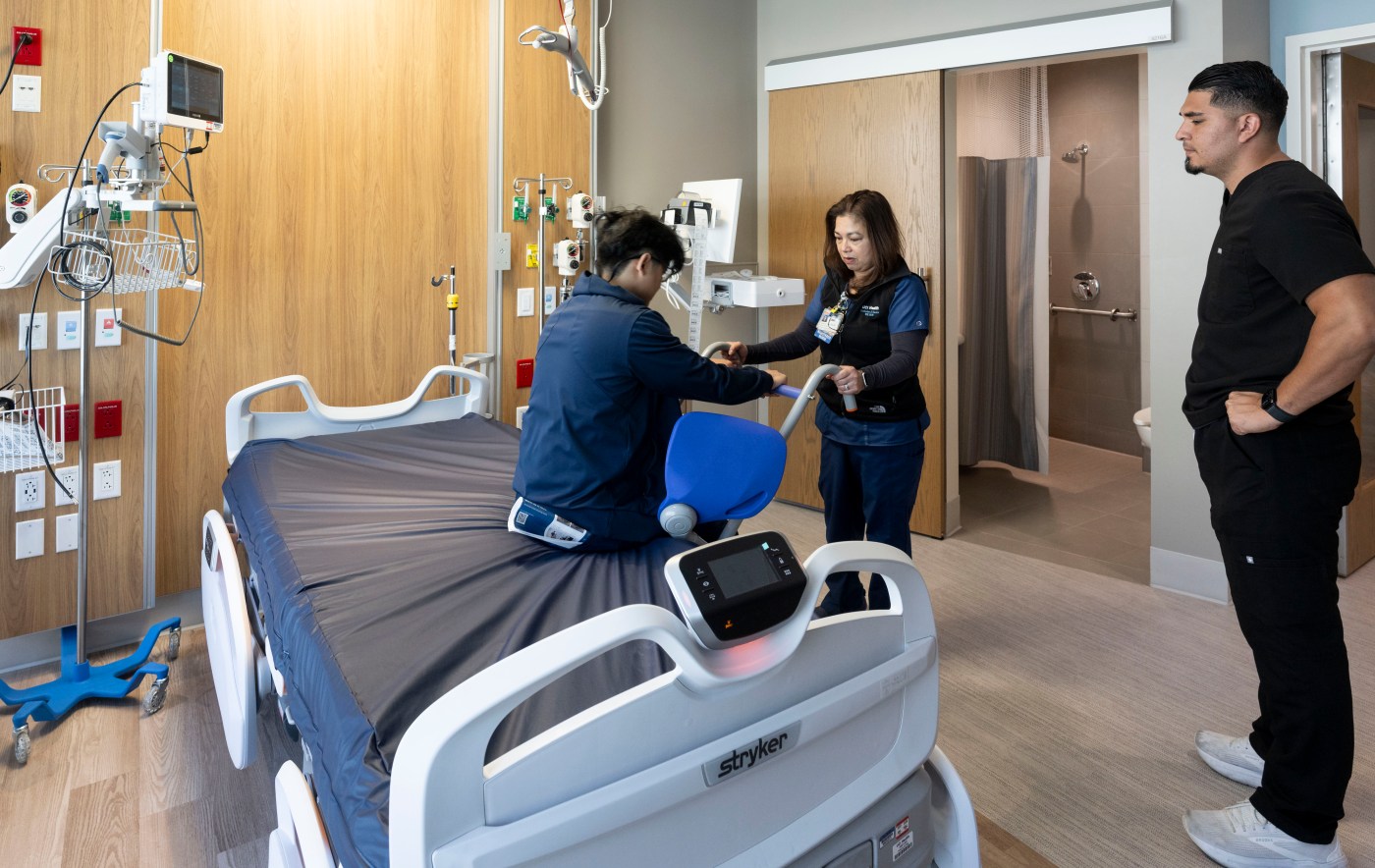
No roommates. The hospital’s inpatient rooms are all single-occupancy, averaging 250 square feet and featuring private bathrooms and showers.
And family members and loved ones can spend the night on a couch that includes a hidden desk and transforms into a pull-out bed.
“It doesn’t feel like a crinkly plastic couch you left the cover on,” Langerud said. “It’s comfortable. And it uses fabrics that have no odor, so they don’t omit any odor or gases.”
Patients who stay at the hospital also have their own 75-inch monitor that doubles as a means for entertainment and patient care.
When a patient is admitted, he or she can use the monitor to watch educational videos — offered in multiple languages — on such topics as hand washing and “managing your post surgical wound, or how to best manage getting to the restroom after you’ve had orthopedic surgery, or whatever else,” Langerud said.
And just as the instructional videos are prescribed by medical to be appropriate for each patient’s plan of care, the monitor also takes into account individual dietary restrictions.
“So you will actually order your food every day through your television,” Langerud said. “It knows all of the different menu items that the culinary team is providing.”
Such orders and other bits of information eventually pop up on another screen at the nurse’s station.
Patients also won’t face the traditional “one, two, three ‘lift’” that happens when nurses are moving patients to and from the bed. Instead, the ceiling of each room is connected to a lift system that can haul a patient up from a wheelchair and into a bed.
Langerud said the lift is rated up to a thousand pounds.
The hospital is within a few hundred yards of one of the biggest wetland preserves in Southern California, and the paintings hung up in each room reflect that fact.
In all, the hospital has 600 pieces of art, 500 of which come from UCI’s archive of California Impressionism. The other 100 are originals.