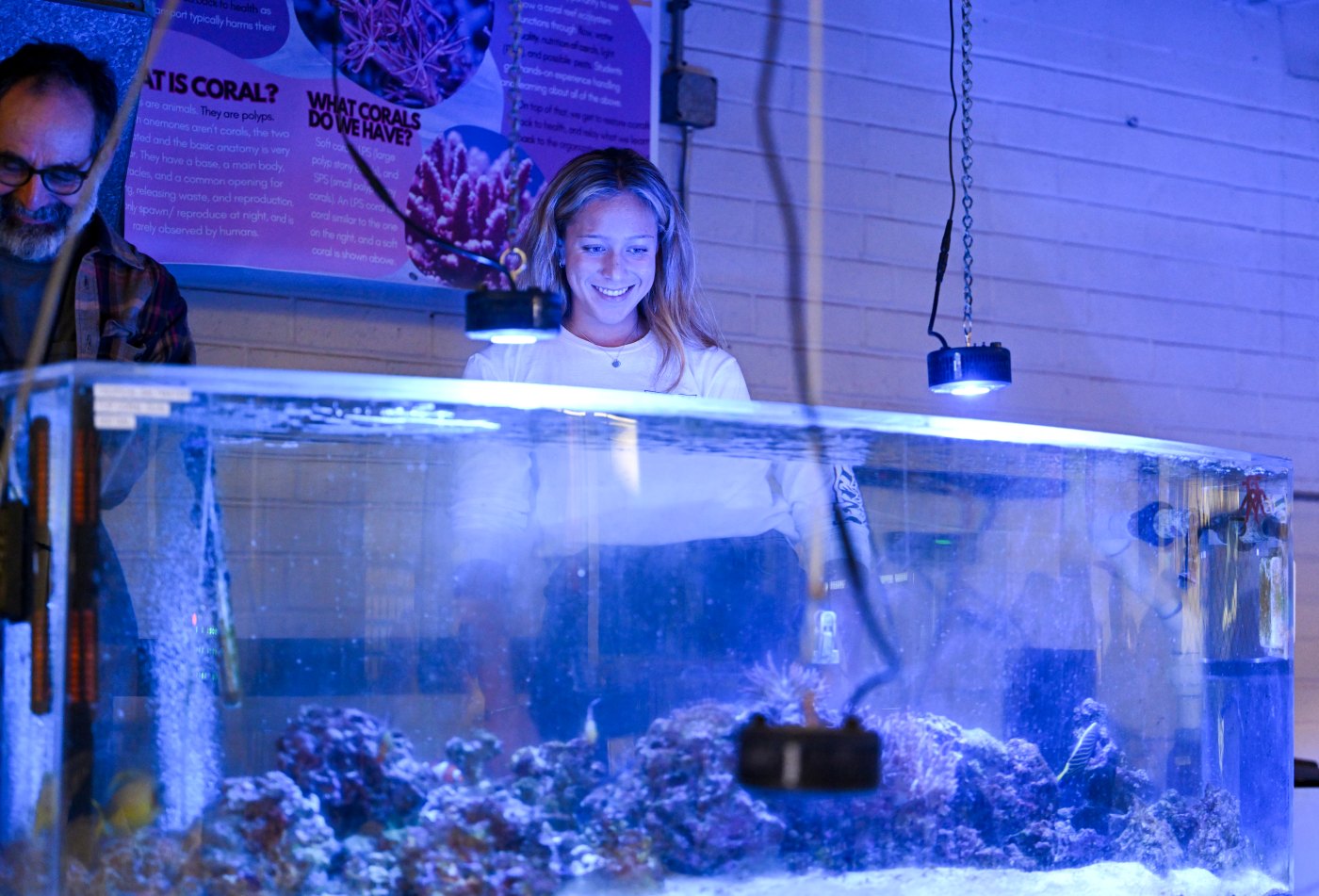
Southern California steelhead trout will soon find a safe haven to survive and thrive in a Huntington Beach high school.
When a fire, flood or other natural disaster hits, the endangered trout will be collected and transported to Edison High School until their habitat is safe to return to, housed in two 500-gallon holding tanks for safekeeping.
School officials, teachers and students, as well as representatives from the Resource Conservation District of the Santa Monica Mountains and the California Department of Fish and Wildlife, gathered on Thursday, Dec. 18, for a ribbon-cutting of the new addition to Edison High’s Innovation Lab.


“When there’s a problem, either it has burned, there’s been a drought or flood, some event that is threatening a population of steelhead in a creek, California Department of Fish and Wildlife would initiate a rescue,” Rosi Dagit, principal conservation biologist for the RCDSMM, said. “They would go in, capture the fish and take them to this facility to hold them until they can go back into the watershed if it has recovered, or a nearby watershed.”
The new, state-of-the-art facility will be able to support up to 650 rescued steelhead trout, a temporary refuge until they can be returned to the wild.
Southern steelhead trout populations have been declining for many years, and recent wildfires and droughts have further reduced the upper watershed populations that are most at risk.

The school’s innovation lab was once an auto shop, transformed into a functioning aquarium, aquaculture, aquaponics, and hydroponics facility that provides students with real-world, hands-on experiences in marine aquarium science, as well as for learning technology behind sustainable aquatic systems.
Dagit said steelhead trout rescued during the Palisades fire had to be placed in a different watershed. They could not return to their own waterways due to a thick sheen left from fire residue.
“That’s what makes this holding facility such an important thing – we need to find a place where we can take these trout until their habitat recovers,” she said.
RCDSMM has been doing steelhead trout research in the Santa Monica Bay since 2015, and realized the fish populations were not recovering, despite habitat improvements, she said.
Then, the Thomas fire hit in 2017, followed by the Woolsey fire the next year, Dagit said. “These fires extracted upper watershed populations and it became even more of a crisis.”
When the idea for a holding facility came up, Edison was selected because it already has a robust aquaculture system up and running. It’s also an ideal location, set between Los Angeles and San Diego counties.
Greg Gardiner, co-director of Edison’s aquaculture program and recipient of the 2018 California Teacher of the Year award, said the school started working on marine conservation curriculum a little more than a decade ago. Gardiner heads the program along with three other instructors, Diane Drogo, Thomas Khoury and Alexandria Griffith.
The program will help enhance skill development and critical science concepts for the students, as well as add to research on maintaining a life support system for these Southern steelhead trout and their feeding behaviors in a holding facility before they are released back into their natural river system, Gardiner said.
“It’s just a great opportunity,” he said. “We’re all about conservation, preservation, restoration and education. We’re really trying to educate our students about the importance of why we need to preserve the waterway areas, and how we can give back to our natural community.”
The students learn everything from marine biology to water quality and operational equipment, learn about the health of the fish and the stresses in their environment. Much of the curriculum counts as college credit.
“The students are really growing and getting real-world experience working with these different systems we have in there,” Gardiner said. “We’re very excited to be able to be a housing facility for these endangered fish, and we want to be able to support them and be able to get them to a new area they can be successful in, or return to the same area if the natural conditions work out.”
Already, the school has programs working with the Hubbs-SeaWorld Research Institute and the CDFW to raise sea bass and trout. Just a week ago, the class released sea bass they raised into Huntington Harbour, helping restore the natural population.
Southern steelhead are the “fish of the future,” Dagit said, because they can tolerate warmer water temperatures and they are very flexible in their ability to spawn in a creek they weren’t born in if their home creek isn’t available.
“When you think of the climate changes, these fish are the ones that can handle all that,” she said. “These fish can come in and live in fresh water, they can make a decision to stay in creeks or go back to the ocean — some fish never go out, some go and come back. They have this incredibly flexible lifestyle.”
Steelhead trout spawn in the freshwater and then can return ocean and can do so many times, unlike other fish species that die when they spawn.
Their population numbers are extremely low. In the past 20 years, only 172 have been documented in the areas of habitat between San Diego and Santa Barbara.
“Granted, we’re not doing monitoring in all those creeks, but even if we’re off by a factor of 1,000, we are still really low numbers,” Dagit said. “That gives you a sense of how critically endangered they are.”