Five new Mobile Resource Vehicles will help reduce recidivism among juveniles, people experiencing homelessness, transitional-age youth and other populations by removing access barriers and strengthening compliance with court orders, Orange County Probation Department officials said.
Described as “first-of-its-kind,” the MRV community outreach program was designed to bring multiple department services directly to clients using the vehicles, which were unveiled in a press conference Friday, Dec. 19. There are three vehicles about the size of an RV and two are smaller versions.


Two of the vehicles — a command post and a community outreach vehicle — were funded through a $2 million grant awarded by the California Board of State and Community Corrections through its Mobile Probation Service Centers Program.
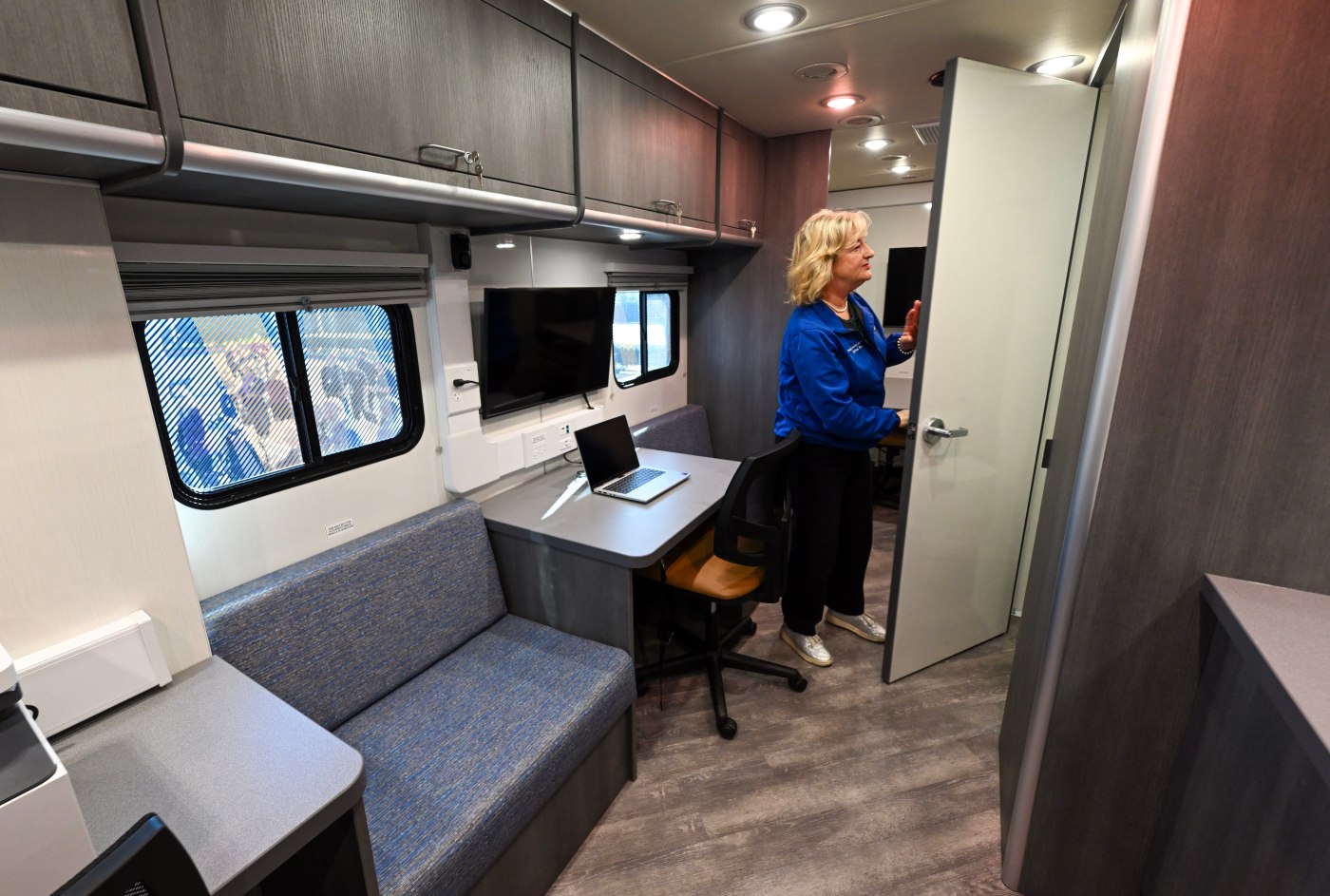
The community outreach vehicle features a mobile laptop library with free internet access and on-site probation officers who can help with job searches, resume development, job applications and interview preparation. There are also spaces available for partnerships with community organizations, such as Working Wardrobes, along with storage for clothing and shoes, hygiene kits and other essential supplies.
Orange County Probation Department spokesperson Aashi Patel said that while the county has a variety of mobile units, the Probation Department’s fleet is designed to bring services “under one roof.” The community outreach vehicle also has two built-in private rooms that can be used for case management and healthcare support, and as a space for clients to change clothes before an interview.
The command post has four private built-in workstations for face-to-face meetings and can serve as a mobile “centralized coordination hub” for countywide emergency operations. It also features high-speed internet provided by Starlink and GPS technology to monitor vehicles and manage dispatch operations.
The vehicle can also be used in non-emergency situations, such as during the county’s biennial point-in-time counts, when resources are provided directly to people experiencing homelessness, or when the agency is called to assist with countywide emergencies such as fires, floods or power outages. Patel said any county agency can collaborate with the Probation Department and use the command post, giving partners access to its functions and features.
“We hope to expand this to agencies across the county, including city and local law enforcement,” she added.
A third MRV, funded through a pretrial services fund, will bring live court services directly to communities. Officials say it is intended to address barriers faced by groups such as people experiencing homelessness, who may struggle to secure reliable transportation to and from court — increasing the risk of re-incarceration.
The other two mini MRVs are funded through the county under OC Cares, and have already been deployed in the community, Patel said, with the larger MRVs expected to roll out early next year.
“The essence of the MRV fleet is that services and resources can be brought directly to the community,” Patel said. “By reducing barriers and filling gaps with the fleet, OC Probation will continue to support the community.”
Santa Ana Mayor Valeria Amezcua, who previously spent 30 years with the Orange County Probation Department, welcomed the initiative.
“Accountability works best when it is paired with an opportunity,” said Amezcua, who began her career with the agency at 18. “The mobile resource vehicles will help reduce barriers to support by delivering services in underserved or remote areas, and we know in the city of Santa Ana, we will need your services.”