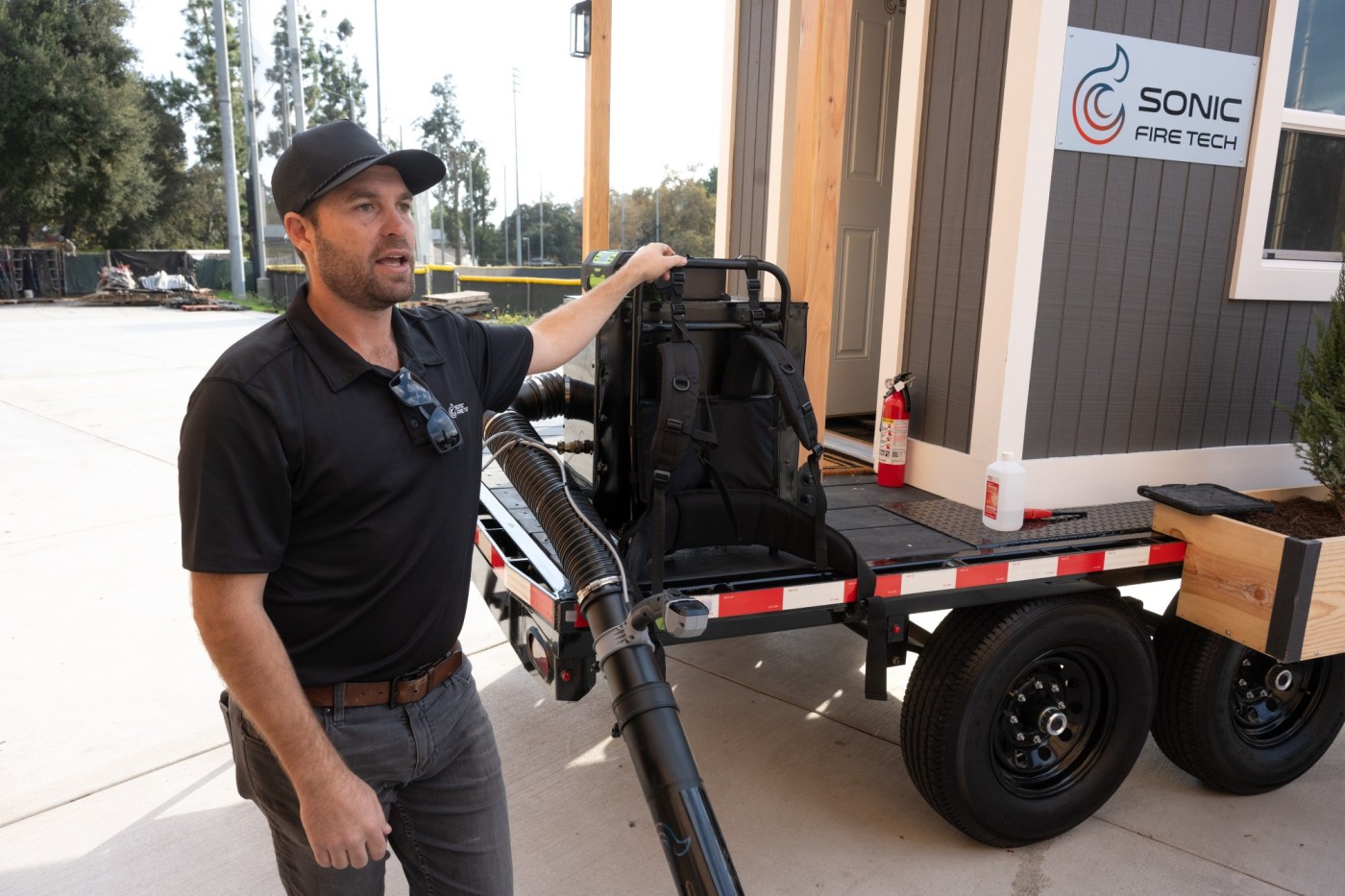
Remington Bixby Hotchkis thinks fighting wildfires with water in California may be so yesterday.
The ranching family scion with roots stretching back to the 19th century San Joaquin Ranch in Orange County to the early days of oil drilling in Long Beach and a spread in the Santa Ynez Valley, is leading an innovative effort in California to commercialize a new technology that can put out fire with sound-wave energy instead of water and chemicals.
“I really see this acoustic suppression technology as replacing the need for water, which is a very valuable resource in our state,” said Hotchkis, whose great-grandfather, Preston Hotchkis, was an early proponent in the 1940s of importing sorely needed water to the Los Angeles area. As the first president of the Colorado River Association and director of the Metropolitan Water District, Preston Hotchkis, who died at 95 back in 1989, advocated the transfer of Colorado River water to Southern California.
With the January 2025 wildfires in the Pacific Palisades and Altadena communities fresh in his mind — as well as watching his old Altadena home burn down — Hotchkis says “the suppression technology could prove to be revolutionary” for halting advancing flames threatening homes near forests or grasslands, referred to as wildland urban interfaces, or WUIs.
He’s now leading commercialization efforts for an infrasound fire suppression technology in California for Ohio-based Sonic Fire Tech, which is catching the eye of electric utilities, insurers and a few homeowners in L.A. area burn areas.
The technology behind Sonic Fire is simple. To protect a house, it routes infrasound waves from a generator through ductworks that sit on the roof’s ridge and under eaves. On the ridge, the sound waves fire down the pitch to catch any fire that might start in debris in the gutters. Under the eaves, they are aimed toward the ground to suppress flames that pop up near the walls, catching bushes or branches on fire.
The system turns on when sensors detect flames — even from a cigarette — producing a thumping sound that breaks down the oxygen that feeds a flame. No ear plugs are needed.
At the moment, the biggest barrier to getting the technology adopted is cost.
He’s signed up 20 homeowners — mostly mansions that are underinsured in the affluent Pacific Palisades area — to buy and install the technology, which can cost 1-2% of a home’s value, or $65,000 to more than $100,000 for a system.
Within a week of the L.A. fires, Hotchkis found himself participating in a rigorous entrepreneurship competition with the Massachusetts Institute of Technology where he won first place for a breakthrough approach to protecting homes from burning embers.
While he had a validated business plan from MIT in hand, he had no product — until he was introduced earlier this year to former NASA engineer Geoff Bruder and the Sonic Fire Tech engineering team working to develop infrasound fire suppression technology. Recognizing the shared vision, he joined Sonic Fire Tech and planted his flag in California, citing the $424 billion in annual wildfire costs nationwide and the possibility of the biggest potential for profit in the Golden State.
“California has the biggest problem,” he said.
The system is designed to extinguish embers before they blow into crevices and under eaves during a windstorm of fire like that which what happened in the Pacific Palisades and Altadena areas last January.
“Our goal is to get that price significantly lower, to make our technology more accessible,” Hotchkis said.
California is the first outpost to bring the technology to market for the company, which already is getting a receptive audience from state Insurance Commissioner Ricardo Lara, Fire Chief Dan Munsey of the San Bernardino County Fire Protection District and major electric utilities in the Western U.S.
“I dumped five gallons of gasoline on a small Christmas tree, lit it on fire, and watched 10-foot flames before we used sound waves to put it out,” said Munsey, who tested out a backpack version of the technology at his agency’s Richard Sewell Training Center a few months ago. “It absolutely works.”
In October, Lara said at a demonstration of the technology at the Hope Ranch in Santa Barbara that homeowners can’t afford something that doesn’t exist, especially as insurance companies retreat from the state.
“We are at a critical point now where the department finally has embraced technology,” said Lara, who highlighted funding available through Cal Fire’s Office of WildfireTechnology Research and Development to test out new technologies like Sonic Fire Tech’s.
Is the technology pie in the sky? Maybe not.
In October, the startup raised $3.5 million in funding from a group of investors. It’s now in talks with several other investors for funding “north of $100 million,” including establishing a manufacturing operation in the Cleveland area to begin assembling motors and other fabricated parts for the fire suppression system, Hotchkis said.
We asked Hotchkis about his work with Sonic Fire and the fire suppression technology’s prospects in California. His answers have been edited for clarity and length.
Q: Is there a demonstration of this technology that others in the Pacific Palisades and Altadena communities can see firsthand?
A: The company is planning to host multiple demonstrations of its Sonic home defense system across California in the early part of 2026.
Q: What is the maximum distance to extinguish an approaching fire?
A: Our home defense systems are designed to protect “zone zero,” which is the immediate adjacent area of a homes structure — up to 5 feet in distance. However, the system is designed to operate effectively in detecting and suppressing ignition up to 30 feet around the home. It is intended to protect against the threat of embers that accumulate around the home and ignite the structure in a wildfire scenario, like we witnessed in the L.A. fires. The larger system we are working on for commercial, utility and first responder applications is designed to operate with an effective range of over 100 feet.
Q: Are electric utilities showing interest in the technology?
Yes. We have a demonstration contract with PG&E’s California EPIC program, which is focused on testing our acoustic suppression technology’s effectiveness at protecting their critical infrastructure, at a range of 300 feet.
We are building our system to showcase our commercial system, to protect substations for utilities as well as corridors for transmission lines. The idea is to demonstrate a 300-foot radius around a transmission line, as a non-ignition zone so we can prevent the arc that sparks and starts wildfires.
We’ll have a controlled burn, permitted to demonstrate the effectiveness of the technology. This is really meaningful to the utilities. Preventing the spark from occurring is our moonshot. But right now, what’s feasible is protecting homes from conflagration risk, and that’s what we’re focused on.
There also is interest in the technology coming from data centers that recognize the “collateral damage” caused by water, chemicals and gas to extinguish fires.
(Editor’s note: PG&E’s EPIC program, which stands for Electric Program Investment Charge, is a state-mandated program funded by utility customers to invest in the research, development and demonstration of emerging clean energy technologies.)
Q: Does the insurance industry need to qualify this technology?
A: We are currently in the early stages of a certification process with Underwriters Laboratories (works in testing and certification of products for safety), FM Global (an international property insurance and loss prevention company), and National Fire Protection Association (a nonprofit that publishes codes and standards to reduce fire, electrical and other hazards) while working with fire marshals across the state to validate our technology for multiple uses. They have all recognized that new codes have to be written for this novel fire suppression method, which has clear advantages over legacy water and chemical-based suppression systems.
The largest reinsurers (an insurance company that backs other insurance companies) have told us that if this technology is proven out to work, and is validated in a way that’s meaningful and quantifiable for them and acquired by homeowners, they can see this being required by underwriters to make insurance more competitive.
Q: Is the sound suppression system a new idea?
A: No. This has been around for 100 years. Some have looked at drones (or firefighting flying saucers) to carry smoke sensors and thermal cameras to find fire and use sound waves to snuff out flames. In 2012, DARPA (the Pentagon’s Defense Advanced Research Projects Agency) — spent 10s of million of dollars showing sound could put out a fire with a suppression system, but they weren’t able to make it efficient enough to bring it to scale.
(A decade ago, Seth Robertson and Viet Tran, two engineering students from George Mason University developed a fire extinguisher that used a 10-inch subwoofer to generate low-frequency sound waves to put out a fire. They showed off their extinguisher on The Tonight Show starring Jimmy Fallon.)
Q: Why is this system needed?
A: I have a rare insight into California’s resource and the original founders of Los Angeles County. My great-grandfather (Preston Hotchkis) told our family that the water coming to L.A. can support 11 million people, and right now we’re at 10.5 million. And so I know water is a very precious resource — especially in the U.S. Southwest, as Nevada and Arizona develop. I’m very motivated to replace water infrastructure with some other alternative, and that’s where I see acoustic suppression in the future. I think that’s the way California growth is more sustainable than it has been.
The wildfires in California are among the worst in the nation.


About Remington Bixby Hotchkis
Age: 37
Title: Chief Commercialization Officer, Sonic Fire Tech
Employees: 20
Revenue: $3-5 million in 2025
Experience: Launched Los Angeles-based wholesale coffee bean distribution company, Bixby Roasting Co., scaling it into a national retailer before its acquisition by Arkansas-based Westrock Coffee Co. in February 2023.
Founded: In 2019, by Geoff Bruder, a former NASA engineer at the NASA Glenn Research Center in Ohio where he worked on power systems for the space agency’s planetary missions, and attorney Michael Thomas, chairman of the startup. Bruder, the chief executive offficer, came up with the technology for the initial Sonic Fire suppression system three years ago by extinguishing a fire in a tin pan filled with isopropyl alcohol in the driveway of his Rocky Ridge, Ohio, home. Other key players include Hotchkis, who joined in April, and Dan McCormack, chief operating officer and director of finance.


