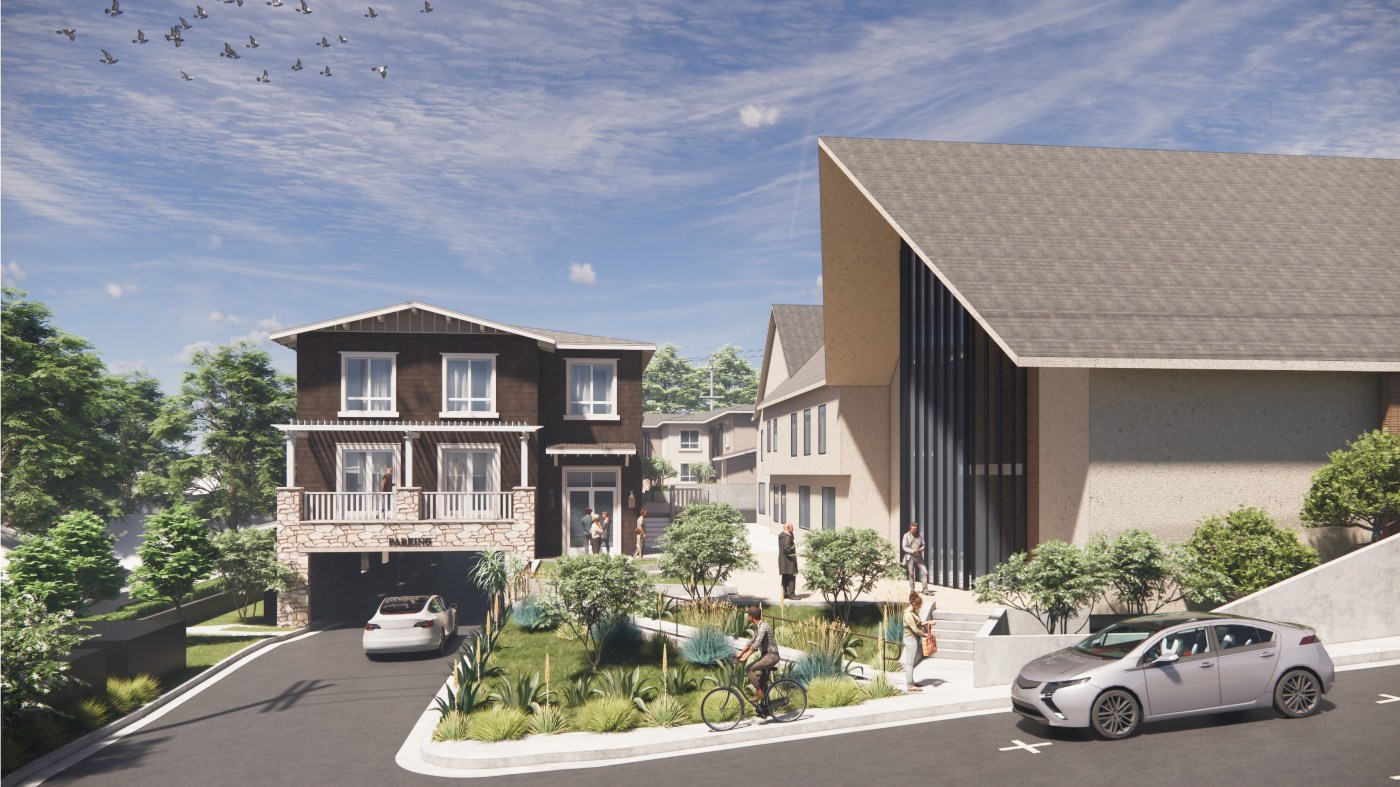
A Laguna Beach church proposing to use part of its property for an affordable housing project has revised the plans it is submitting to the city.
Neighborhood Congregational Church, a non-denominational church near downtown, had submitted a 44-unit project to the city last spring, but The Rev. Rod Echols said Wednesday, Jan. 21, that the proposal will now be for 28 affordable units and a manager’s unit.
Also, a proposal to demolish the original sanctuary and build a Spirit Center has been scrapped, partially because of the expense, he said. Instead, he said the sanctuary and Bridge Hall will be “rejuvenated.”
As government funding for affordable housing sees tightening, the church and its partner developer, Related California, needed to adjust expectations, Echols said.
A public forum to discuss the new plans will be held at 7 p.m. on Thursday, Jan. 22, at the church property at Glenneyre Street and St. Ann’s Drive.
“Ultimately, what would determine the amount of affordable housing, in addition to land use and neighborhood considerations, was the availability of public funds,” said Bill Witte, a longtime Laguna Beach resident who owns Related California. “The 29 units is what we’ve arrived at that continues the land-use considerations, but also the realities of how much money can be available from the state that the city can make this happen.”
The church property was identified by the city as a possible site for state-mandated affordable housing – it’s near a hub of the town’s public amenities, such as a nearby grocer, the high school, the beach, and downtown within walking distance.
And church officials, partnering with Related California, proposed the change to their campus to take advantage of state legislation streamlining the process for religious institutions and schools to build affordable housing.
The effort, Echols said, has been five years in the making. In 2024, the church introduced its first proposal for adding affordable housing. At that time, the plan would have included 72 units.
Residents in the surrounding neighborhoods have raised concerns about impacts such as height changes that could block their existing views, density and traffic in an already busy area. Some said they worried the planned style of the new project might not fit with the area’s community character.
Witte said many of the residents’ concerns will be addressed in the new proposal, which was submitted to the city in December.
“We approached this as developers, but also as longtime residents,” said Witte, who has lived in town for more than 30 years.
The Craftsman-style building is now proposed for two stories, rather than three. It would have a mix of studio, one-, two-, and three-bedroom apartments that could be homes for seniors and families who earn between $35,550 to $125,940 a year and qualify based on minimum and maximum income restrictions.
Rents would range from $888 to $2,640 a month, and priority would be given to income-eligible tenants who work in Laguna Beach, Witte said.
The project also includes a subterranean parking structure with 41 spaces. Thirty of those spaces would go to residents and the remaining spaces would be controlled by the city for public parking, including parking on relevant days for the church.
Other community benefits would include widening of the sidewalk along Glenneyre Street, widening Catalina Street and a community plaza and green space that would be between the entrance to the parking and the entrance to the church. Presently, there is no ability to enter there.
The community plaza would help with that, and it would also include a playground for children who will live in the development, Witte said.
This project came about because of the state mandate for affordable housing. In Laguna Beach, the city must have zoning for an additional 198 affordable units. The city conducted a detailed review process for potential sites and the church offered to work with the city to make its site available, Witte said.
“It’s the one site that has been formally identified by the city now as a site for affordable housing as part of its housing element,” he said.
Funding for the project would rely heavily on a federal low-income tax credit program, he said.
“This project, in order to compete as a family housing project for these tax credits, half the 28 units will be two- and three-bedroom units, the other half will be studio and one-bedroom units,” Witte said.
In addition, Witte said, because it’s affordable housing, it requires public assistance, which means some financing would have to come from the city and be approved by the City Council. The city has received $2.5 million from the state’s Local Housing Trust Fund, but hasn’t formally committed that funding to this project.
Next steps include a public hearing at the city’s Planning Commission in March. If approved then, Witte could apply to the state for a 9% tax credit in April.
City officials will need to approve the land use and the housing plan
“If we’re successful in making that April date and in June be approved for tax credit, we’d be able to start construction by the end of 2026,” he said, “and complete by early 2028.”