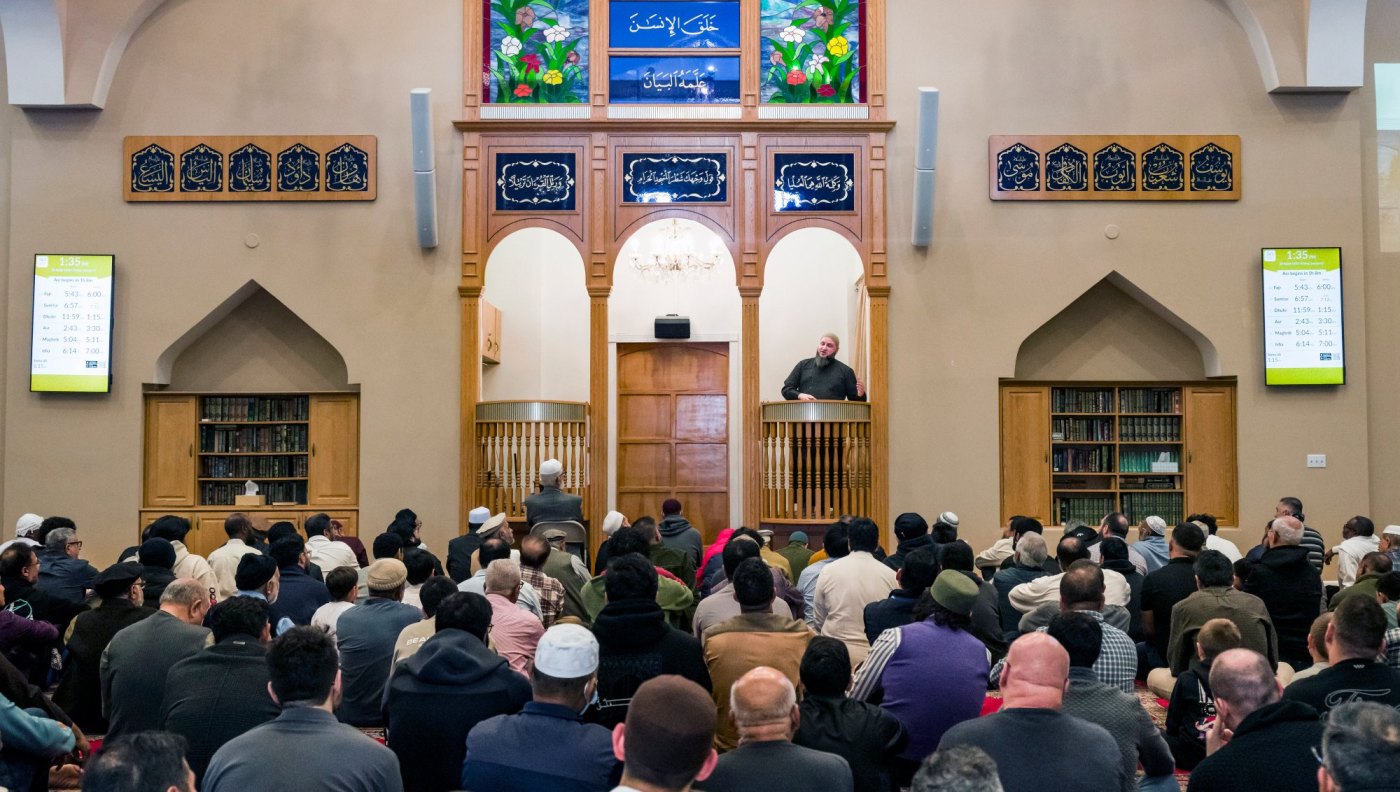
When Hassan Mukhlis’s parents emigrated from Pakistan in the 1980s, they landed in Santa Ana and later purchased a home in Garden Grove, next to the Islamic Society of Orange County.
“I’ve been here my whole life,” said Mukhlis, a public defender and president of what is now the largest Muslim community center in Southern California. “I’ve been at ISOC essentially, since birth, you would say.”
Mukhlis’s uncle helped bring the society to life in 1976 as one of its seven founding signatories. His father later served on the governing board and Mukhlis remembers his mother cradling his infant brother in the center’s kitchen. Mukhlis attended school at the society from preschool to eighth grade. He married there in 2014. And now, he picks up his children from the same school he attended.
The society, Mukhlis jokes, has “something for every stage of your life.”
As the Islamic Society of Orange County celebrates its own milestone 50th anniversary this month, Mukhlis said the organization also has big plans for the next 50.


‘The next 50’
When the society was incorporated in 1976, it was with the vision of finding a place for the muslim community in Orange County to congregate.
“The community was already meeting, getting together in people’s apartments and they had a garage that they would meet at in Fullerton,” ISOC Chairman Alam Akhtar said.
Community members later raised money to purchase in 1980 a small church at the northern corner of 13th and Kerry streets in Garden Grove to become ISOC’s home base.
And over the span of 50 years, the society has continued to expand, now encompassing six acres at the same corner and serving more than 1,500 people daily.
The center has its own mosque and K-12 school that currently enrolls 530 students. ISOC also offers community services and events at its campus, including funerals, marriages, a food pantry and even its own coffee shop and thrift store.
The society is hoping to expand its services. Since 2024, ISOC has been working on a master site plan. The plan — which reimagines the campus for more use and revenue opportunities — has received preliminary approval from the city. And pending further approval, renovations could break ground as soon as later this year or in 2027.


Akhtar credits Dr. Muzammil H. Siddiqi, a professor and scholar of Islamic Studies, with being pivotal to the organization’s longevity and prosperity. Siddiqi served for 43 years as the ISOC’s religious director before retiring in 2024.
“I distinctly remember the morning of 9/11,” Akhtar said. “And it just happened to be that our religious director, Dr. Siddiqi, who is one of the top scholars in the U.S., happened to have been in Washington, D.C.”
Siddiqi met with President George W. Bush shortly after the Sept. 11 terrorist attacks, gifting Bush a copy of the Quran.
“They talked about peace and the community in a very difficult time — not as Muslims, but as Americans. I thought that was a very powerful moment,” Akhtar said. “And that’s the type of leadership that ISOC has tried to lead with.”
Despite the ongoing struggle of being pigeonholed into “certain beliefs and stereotypes,” Akhtar said the ISOC remains nonpartisan and tries to “rise above the political noise” to help community members.
When the government shut down last year, for example, “we mobilized and overnight, supplied food to needy people within the county. And this wasn’t a political gesture, this was a response to what is happening in the community,” he said.
Shaykh Abdullah Misra took over as religious director in 2024. He said he feels “prepared, with the community support behind me,” to keep alive a new generation’s relationship with the Muslim faith.
“When I came to this position, everybody kind of put their hand on my shoulder and said, ‘You’ve got some big shoes to fill,’” Misra said.
“But I’m not trying to walk in those shoes,” he said. “I’m going to polish them, put them up, and walk in my own shoes.”
One of his goals, he said, is to bridge generational and cultural divides in one of the state’s most diverse counties. He said he’s focusing on religious programming that responds to the needs of the moment.
“There’s so much division in society,” he said. “I’m focusing on uniting people, not based on anything other than love for God and love for humanity. I think we’re very enfranchised here, and there’s a sense of deep belonging. You’re not trying to find your place in the society. What you’re trying to do is make your mark on society.”
And making that “mark,” Misra added, begins with supporting philanthropic causes and partnering with groups outside of the Muslim community.
“American Muslims have always been on the frontlines of American justice,” Akhtar said. “Now, we’re trying to extend our resources to larger communities, our neighbors.”
The organization has been working on strengthening its local ties, he said, whether that be reaching out to city and county elected officials, or partnering with and funding local nonprofits such as VietRISE or the Harbor Institute for Immigrant & Economic Justice.
But “bridging communities” is a “very, very, very difficult thing to achieve for a large organization, like ISOC, which can get stereotyped,” Akhtar added.
“ISOC has always had to play the role of bringing communities, bringing people together, regardless of whatever your point of view is. The political climate changes, the norms evolve, and we try to change how we’ve been able to respond to the needs of the moment,” Akhtar said.
“But we have experience with history.”