Orange County’s small businesses are feeling “overwhelming economic pain” from President Donald Trump’s tariff wars and ongoing immigration crackdown, a new economic impact survey by UC Irvine researchers says.
The study, which drew on responses from 375 business owners and executives through the month of September, was a joint effort between Second District Supervisor Vicente Sarmiento’s office and the UC Irvine Social Impact Hub. Businesses were invited to participate, with Sarmiento’s office reaching out to local chambers of commerce, trade groups and nonprofits to help distribute the survey.


Sarmiento said the purpose of the survey is to “drill down on the regional impact” of the tariffs and raids on OC’s business community.
“The goal of the study is to say, ‘You don’t have to have an emotional or passionate response to these policies, you just have to simply look at the data,” he said. “Whether you agree with it or not, you certainly are going to be impacted negatively.”
The survey is primarily an analysis of the policy impacts on small businesses, as 81% of merchants who responded represent operations with fewer than 10 employees. Of the remaining, 12% run businesses with 11 to 50 employees, and just 5% manage more than 50 employees. Most of the surveyed respondents work in retail and trade.
About 70% of respondents are US-born; one in four are foreign-born. White merchants comprise a little more than half of the sample, and Latinos make up a quarter.
Opinions about Trump’s economic and immigration policies varied by industry, with the strongest opposition coming from the information technology, education, science and health care sectors, the researchers with UCI’s School of Social Ecology said. Those working in manufacturing, mining or construction and banking, finance and real estate who participated were more ambivalent about Trump’s policies, with approval and disapproval rates roughly the same.
Overall, about 55% of respondents said they disapproved of the immigration raids and 53% disapproved of the tariffs.
Business owners and executives who disapproved of the tariffs said their companies were hamstrung by higher prices for inputs, lower product demand, supply chain shortages and a reluctance to hire or invest due to uncertainty over trade deals and a prolonged government shutdown.
Trump’s hardline immigration policy, meanwhile, has dampened employee morale and productivity for many small businesses, which has led to a decline in sales, those surveyed said.
UCI’s T. William Lester, who led the study with Raiven Greenberg, said the survey quantifies the “chilling effect” of the federal raids and tariff policies on individual businesses.
Trump administration officials said the policies being enacted in the president’s second term are intended to benefit local economies.
“President Trump promised to bring prosperity back to Main Street with an America First agenda that benefits every small business, just as he did in his first term,” Taylor Rogers, White House spokesperson, said in a statement. “In addition to slashing regulations and lowering energy costs, the Trump administration signed the largest Working Families Tax Cut in history to unleash unprecedented growth for small businesses with a permanent 20% tax deduction and full expensing of equipment investments.”
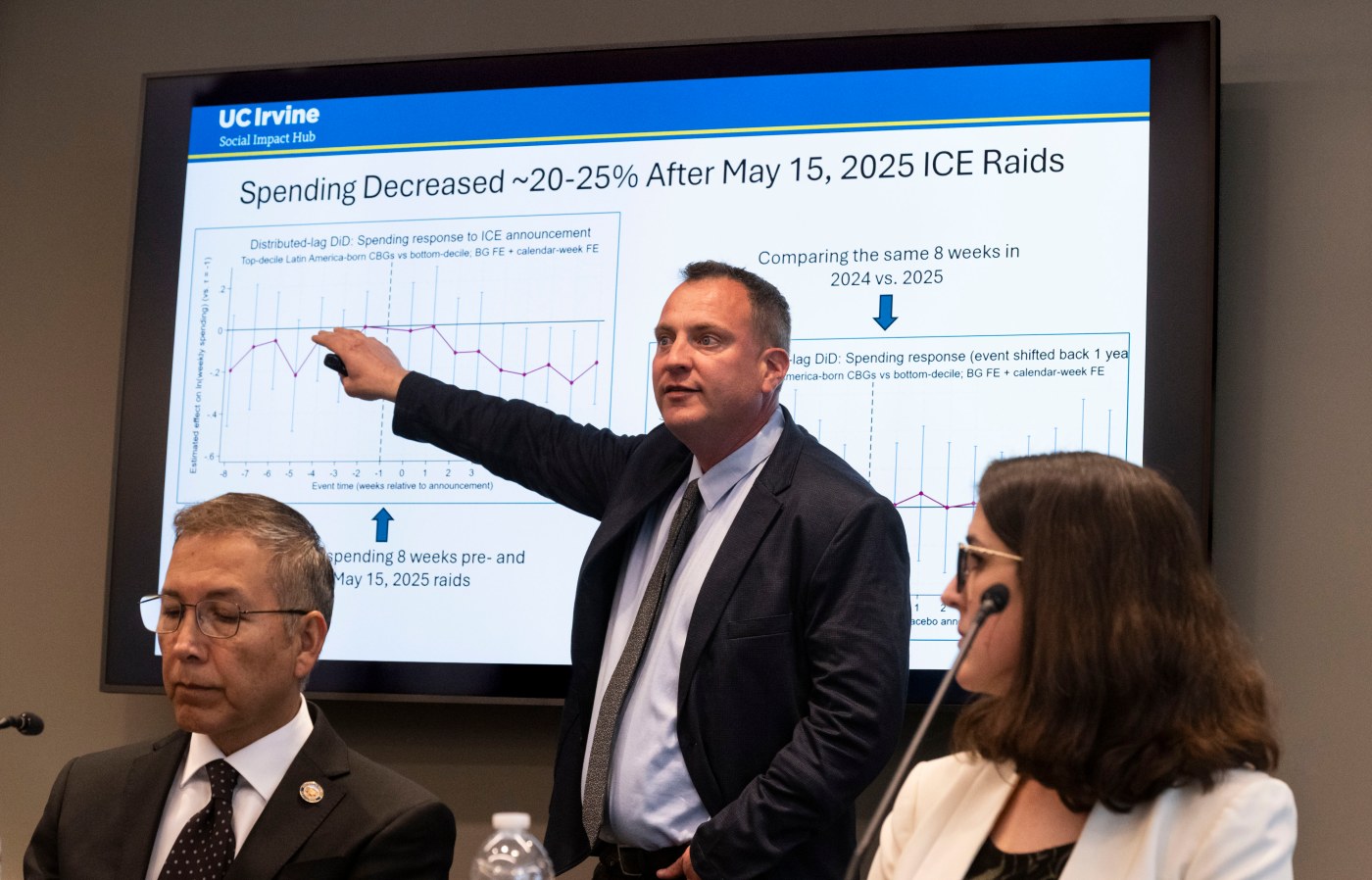
In a separate study, Lester analyzed foot traffic and credit card purchases to determine the impact of U.S. Immigration and Customs Enforcement operations on shops in neighborhoods with the largest foreign-born Latino populations.
The Trump administration has argued that the United States had seen an “unprecedented flood of illegal immigration,” and increased immigration enforcement is improving public safety and national security and is addressing a state of emergency at the southern border.
Orange County’s Latino enclaves, including Santa Ana and Anaheim, lost $58.9 million in sales revenue and $4.5 million in sales taxes in the eight weeks following May 15, the day that ICE announced worksite raids and mass arrests, according to preliminary findings from Lester’s research.
Impacted merchants are asking for direct assistance in the form of grants, loans and tax relief, marketing support and “Buy Local” campaigns,” as well as legal aid and rights awareness workshops, according to the survey. Some said the financial strain they experienced last year was worse than during the pandemic, as they’ve not been able to apply for assistance similar to the relief programs funded by the American Rescue Plan.
Sarmiento said there’s unfortunately very little the county can do in terms of providing direct financial relief to small businesses, as it relies heavily on federal and state funding, which has shrunk under the current administration.
Overall, the county’s business community is feeling cynical about the state of the economy, with two-thirds of merchants reporting a negative future outlook, the study’s authors said.
Some 60% of store owners said the ICE sweeps had a “somewhat” or “very” negative impact on the local economy, according to the survey. About 13% reported a “very positive” impact. More than 60% of respondents said Trump’s tariff proposals have similarly harmed the county’s economy. While 9% said the impact has been “very positive”.
Amid a slowing economy and the recent 43-day government shutdown, businesses across Southern California shed more than 175,000 jobs last year, while adding just 20,600 workers—a hiring rate 80% slower than what’s been normal growth in the post-Great Recession era.
Sarmiento said the immigration crackdown’s impact on the workforce is well established, but its effect on consumption within immigrant households is less explored—and could be a point for further research. Many immigrant families have expressed fear in going outside and buying groceries from mom and pop shops, a decision that Sarmiento said has a ripple effect on the entire economy.
“What’s not measured is the purchasing power of the immigrant population,” he said. “There’s money in the immigrant community that sustains businesses.”