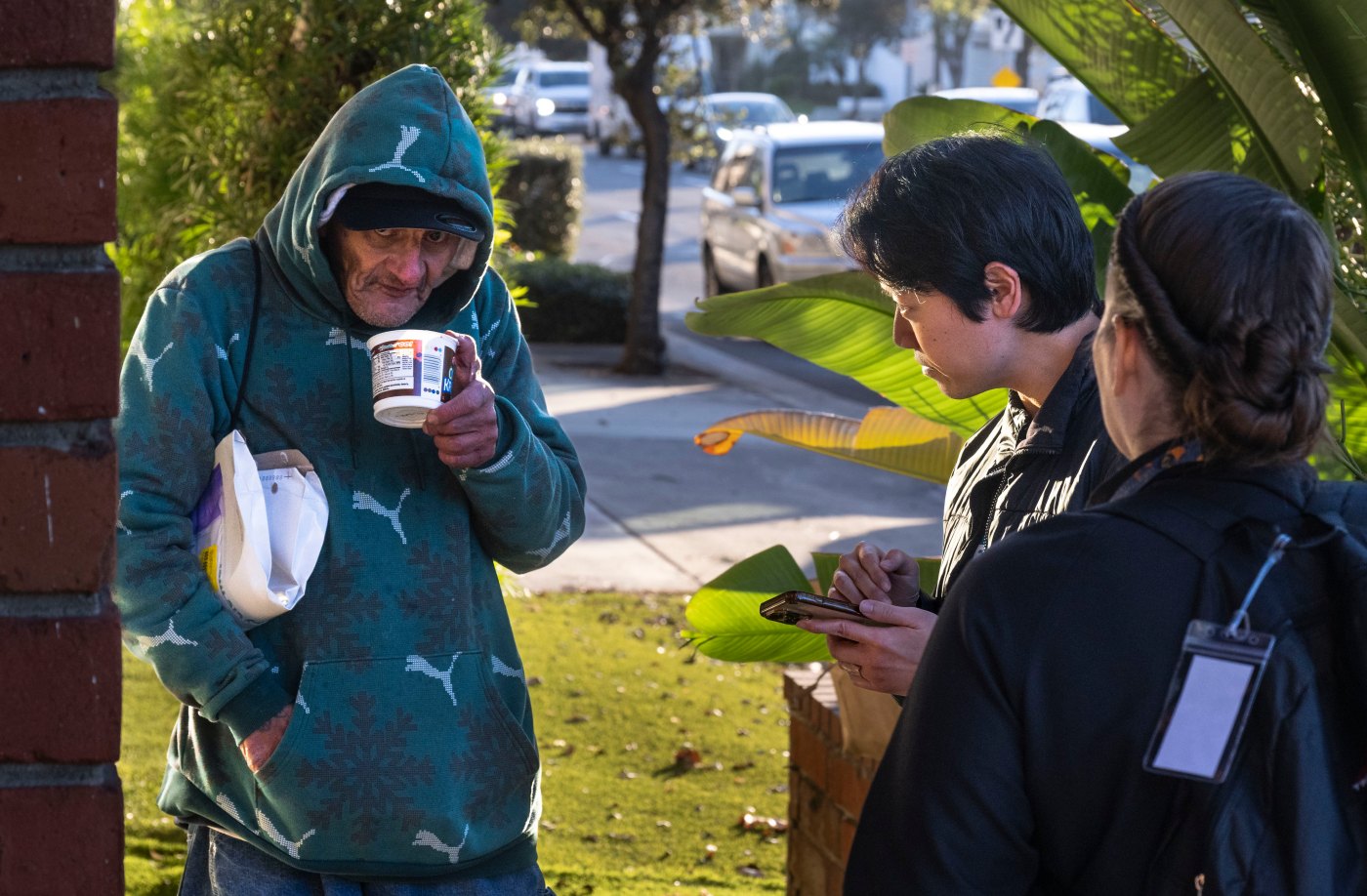
More than 100 volunteers packed the Santa Ana Civic Center well before dawn Tuesday, Jan. 27, bundled up in puffer jackets and sipping warm coffee against the cold outside.
The atmosphere around the check-in tables buzzed, maps and instructions were passed around — a setup a lot like a marathon or a voter registration drive. These volunteers had a no-less taxing morning ahead of them: canvasing Orange County’s unsheltered population for the biennial Point in Time Count.


Equipped with maps and care packages, more than two dozen teams fanned out across Central OC, surveying the people who are living on the streets or in their cars in a vast region spanning from Westminster to Newport Beach. The effort will repeat twice a day Wednesday and Thursday until volunteers have covered the entire county.
At the Santa Ana deployment site, volunteers logged at least 665 responses Tuesday morning after about four hours of canvassing, including 69 from seniors, 18 from veterans and 16 from youths. Teams were set to go out again just before sunset.
Doug Becht, the director of the Orange County Office of Care Coordination, said the homeless count is “not an exact science” and often requires volunteers to “use their best judgment” in evaluating interactions they have with people on the streets.
“It’s difficult to capture everybody who’s falling into homelessness,” he said. “The count is meant to provide context and data to policymakers.”
A census of the county’s population without housing is required every two years by the U.S. Department of Housing and Urban Development. It collects important demographic data such as how many families, juveniles and people with disabilities have become homeless, as well as information on where people gather and what their needs are, officials said.
For service providers, the count offers crucial insights into gaps, driving new programs to help groups that might be falling into homelessness at higher rates or are falling through the cracks.
Crucially, the results also determine how much state and federal funding a county receives to tackle homelessness. The 2024 count recorded more than 7,300 unhoused people in Orange County.
The 1,200 volunteers canvassing this week are asking a series of questions from standard demographic queries to log age and race, to inquiries aimed at understanding mental health and the various causes that lead to homelessness. Volunteers log the responses in an app on their phones.
Those who answer are offered a $10 fast food gift card, a bag of snacks and hygiene products, as well as information on finding shelter and other support services.
One of the challenges of conducting a comprehensive survey of the county’s homeless is that some might not feel comfortable divulging more personal details, such as mental health or substance abuse history, said Stephen Su, a canvasser and data specialist at City Net, the nonprofit that oversees the count.
“Sometimes they can get triggered by the questions and clamp up,” he said.
On Tuesday morning, Su chatted with a man in his late 50s who said he had been homeless since he was 18. When asked to identify a major contributing factor to his living condition, he only answered: “Poor life decisions.”
Another man, slumped over in a wheelchair, told Su that he became homeless two years ago because he “followed a woman.” He said he had tried to stay at an emergency shelter some time ago, but was denied entry.
For people who appear to be homeless but decline to answer questions, canvassers will fill out an “observational” survey to ensure those individuals are still counted in the census.
Shortly after sunrise, Julie Bechtol approached an older man sitting curbside near a gas station in Tustin. Next to him was parked a shopping cart containing two enormous trash bags filled with plastic bottles for recycling.
Squatting down in front of him, she asked a few questions in Spanish: Had he slept outside the night before? Was he interested in getting connected to some services?
He said he pays rent for an apartment and thanked her for the outreach, graciously accepting a Spanish-language homeless resources guide, a hygiene kit and some snacks.
Bechtol, a manager with the county’s Office of Care Coordination, said she felt conflicted.
“I didn’t record a survey for him because, right now, I’m going off what he told me, that he’s not homeless,” she said. “But based on his cartful of things, I don’t really believe that.”
Bechtol said it’s not uncommon for unhoused individuals to deny help, particularly offers to be connected to service providers.
A man in his early 40s, who Bechtol surveyed outside of a 7-Eleven in Tustin, said he became homeless five years ago after his mother took all his money and kicked him out of the house. He said he struggles with substance abuse.
He accepted a $10 gift card to Del Taco, but declined to be connected to any services, telling Bechtol he’ll “figure it out” on his own.