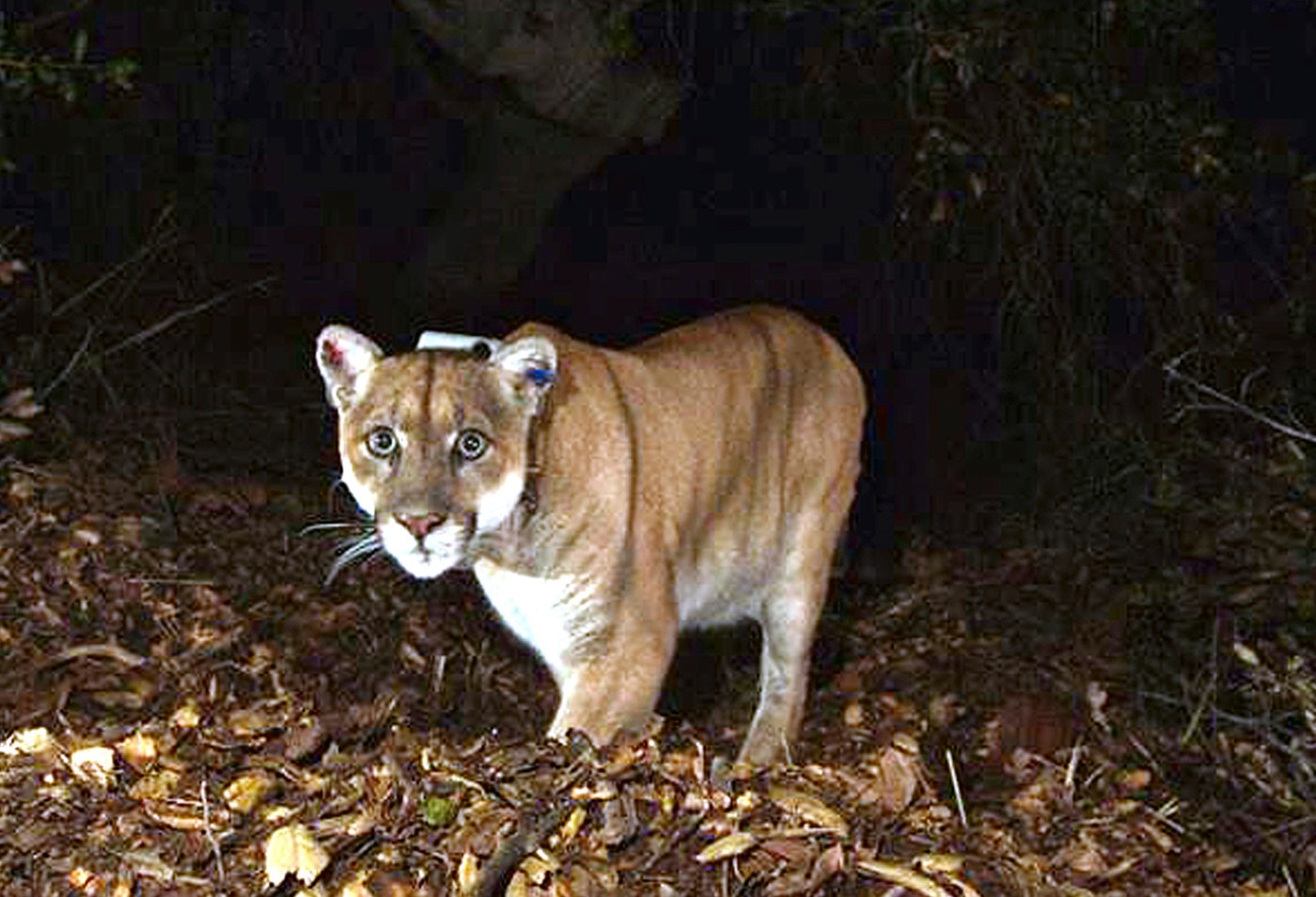
Most people in Southern California have never seen a mountain lion in the wild. And never want to.
Yet, these sleek, wild, predator cats roam the foothills and mountains from Ventura to San Diego, slipping in and out of millions of backyards and dozens of local canyons mostly unseen, except for those fuzzy images captured by trail cameras and home surveillance videos.
But these powerful, top-of-the-food-chain animals have captured the hearts and souls of many Angelenos who want to help them avoid a fate that threatens their very existence. They are asking the state to free them from being trapped in several local mountain ranges by urban sprawl and hemmed in by freeways they attempt to cross to mate, find food, or just survive, often leaving them dead on the side of the road as a result of vehicle strikes.

To avoid a doomed fate, two environmental groups have received a positive response this month to their nearly seven-year-old petition for more protections from the California Department of Fish and Wildlife. The DFW has offered six, select cougar populations in the Santa Cruz Mountains, the Central Coast, Santa Monica Mountains, San Gabriel and San Bernardino Mountains, Santa Ana Mountains and Eastern Peninsular ranges in San Diego County permanent status as a “threatened” species under the California Endangered Species Act.
Currently, they are “candidate species” after the state agency granted them temporary protections while they considered the petition.
If granted permanent threatened species status by the California Fish and Game Commission, after a hearing on Feb. 12 in Sacramento, it could mean money for more wildlife crossings, changes in developments or roadway plans that interfere with cougar connectivity, and a flagging of anything that could hamper the mountain lion’s survival, explain environmental groups and research biologists.
“These majestic cats have suffered so much from habitat destruction and vehicle strikes, it’s no wonder that state wildlife experts are calling for permanent protections. This is a chance to show how California prioritizes and protects the wildlife that makes this state such an amazing place to live,” said Sofia Prado-Irwin, staff scientist at the Center for Biological Diversity, one of the two groups that brought the petition for permanent protection in 2019. The other is the Mountain Lion Foundation.
What’s making them sick?
Their problems are two-fold.
Mountain lions need wide ranges to hunt, usually for deer, and for males to find unrelated females for breeding. These large felines are boxed in by freeways and when they dart across lanes of speeding traffic, they are usually killed, making vehicle strikes the leading cause of death. Secondly, they can get sick, with weakened immune systems that can lead to death, from eating small prey such as rats, mice and squirrels that have ingested rat poison left outside near wildlands, as the poison transfers into their systems.
Vehicles strikes are the No. 1 cause of death of cougars roaming the Santa Ana Mountains in south Orange County, said Wilson Vickers whose job was to due necropsies of every dead cat for the UC Davis California Mountain Lion Project for decades until he retired recently.
From 1981 to 2013, vehicle strikes accounted for 50 of 94 known mountain lion deaths in the Santa Ana Mountains, about 53%, the DFW report stated.
The 64 lions listed in the DFW report are likely to be killed trying to cross the I-15 Freeway. Many have been found dead along the 241 and 261 toll roads in past years, Vickers said. This has led to fencing being put up to stop the cats from entering the highway lanes. The university is working with Caltrans to add fencing along the Ortega Highway, another dangerous roadway for Santa Ana Mountain wild cats, he said.
About 67 cougars are living in the Santa Monica Mountains near Los Angeles, the DFW report estimates. This population has been reduced by vehicle strikes and by animals sustaining rodenticide poisoning over the past decades. Scientists worry that these are cut off from populations to the north in the Simi Hills and mountains in Ventura County and the Central Coast, and that their offspring are sustaining detrimental effects of inbreeding. Some estimate this group could become extinct in 10 to 20 years.
To promote crossings, groups such as the National Wildlife Federation and Save LA Cougars have helped raise funds for the $87 million Wallis Annenberg Wildlife Crossing — a unique bridge created just for animals and plants being built across all 10 lanes of the 101 freeway in Agoura Hills.

When completed, the elevated crossing will help mountain lions and other wildlife safely cross the 101 freeway. And it will connect the Santa Monica Mountains and Simi Hills in an effort to end genetic isolation of the local mountain lion population living only 10 miles from the Los Angeles city limits. The project already covered with trees and soil is expected to be finished in November or December, said Beth Pratt, California regional director of the National Wildlife Federation and a leader of Save LA Cougars.
“These isolated populations have become genetically separated and that leads to inbreeding,” Pratt said on Monday, Jan. 26. “I am really encouraged that the California Department of Fish and Wildlife recognized the science, that we need to do more to make sure these populations will still exist.”
If declared a threatened species, it could result in grants for fencing, underpasses and overpasses in other areas, such as freeways and road ways near the Santa Monica, Santa Ana, San Gabriel and San Bernardino mountains, Pratt said. It could also require changes to developments and road way plans near foothill and mountain ranges. “It doesn’t ban development. It gets us to pause a little bit,” Pratt said.
Tiffany Yap, urban wildlands science director at the Center for Biological Diversity, said in addition, the status upgrade can influence foothill and mountain development land use. It may help with the removal of rat poisons from the communities abutting the wild lands where cougars forage, or help reduce interactions with mountain lions eating sheep, goats or other livestock, which can trigger permitted taking of the mountain lions, known as depredation permits.
In October 2024, 20 mountain lions were killed through depredation permits statewide, the DFW reported.
“We can reduce those kinds of conflicts and put more resources into predator-proof enclosures for goats and llamas,” Yap said.
Why save the lions?
A deeper, existential question is why should Southern Californians want to save the lions from extinction? Put another way, why should anyone not a research biologist care?
That discussion starts with the love affair Angelenos had with P-22, an intrepid mountain lion who crossed both the 101 and 405 freeways and survived until his death in December 2022. And who then lived in a small, eight square mile area of L.A. city’s Griffith Park for 10 years. The “Hollywood Cat” had his own social media handle, was featured on magazines, newspaper front pages and TV news broadcasts. He became the first urban wild feline with celebrity panache.
Some said it made people of Los Angeles County accepting of a wild cat living in their midst, a paradigm shift of attitudes about a predator animal who hunts deer, on occasion pet chihuahuas, and rarely, but it has happened, small children when possibly mistaking them for food sources.
“The popularity of P-22 has opened folks’ hearts and minds,” said Yap.

For Pratt, loving wild animals — including cougars — is not just an L.A . thing. It’s part of the progressive California culture that says all creatures, human and wild animal, should co-exist. And that care for the environment, both plants and animals, are critical.
“There is something about the California value system,” said Pratt. “We love our wildlife. A lot of people still love having that connection to the wild world.”
There’s a certain level of excitement when folks learn about mountain lions nearby.
On Dec. 2, biologists at the Arroyos and Foothills Conservancy, saw a mountain lion on a trail camera image in the Verdugo Mountains, land it owns that is surrounded by the communities of Sunland, Tujunga, La Crescenta, Glendale and Shadow Hills. This mountain lion seen within what they call an island of habitat was rare.
“A new mountain lion has taken up residence in the Verdugo Mountains,” announced its newsletter to donors. Only three mountain lions were documented in the Verdugos since 2022, and their cameras haven’t captured an image of one since 2019.
Another cougar was seen in a neighbor’s surveillance camera footage in nearby Sycamore Canyon in Glendale, said Ruby Siehl, urban wildlife research leader with the group. Ten acres in that canyon was purchased by AFC so that mountain lions can get from one wild land to the next — like a land bridge. It was the first time a mountain lion photo evidence popped up since 2024, she said.

She said she’d never seen one personally, and would not want to encounter one, she said. Also, the neighbor’s footage was at night, when no humans were nearby. This lion was traveling a circuitous route from mountains to foothills to backyards and front yards, navigating urban sprawl but avoiding encounters with people.
“This is a powerful reminder of why preserving connectivity is so vital,” Siehl said. “Wildlife must be able to safely travel between the open space of the San Gabriel Mountains and the habitat islands of our urban areas, like the Verdugos,” she added.
Aside from the thrill of knowing such a magnificent creature lives literally with us, usually in peaceful co-existence, perhaps sets an example of how humans should behave. Also, Yap said they play a role in balancing the ecosystem.
For example, their kills often provide food for other animals, from tiny beetles, to bigger mammals such as bears, foxes and coyotes. Birds, from large raptors such as turkey vultures and golden eagles, to songbirds such as warblers, also feed off a mountain lion’s kill. Finally, the dead deer decomposes and that benefits the soil, which helps trees and other vegetation to thrive.
“Losing them from these systems could have dire consequences,” Yap said.
Pratt, who is the author of two books on wildlife and holds lectures on getting along with the natural world, said there is something bigger at stake than removing mountain lions from the Santa Monica or Santa Ana mountains.
“Look at this beautiful natural landscape we have (in California),” she said. “It wouldn’t be the same without mountain lions or bobcats. If we lose that wilderness, we’ve lost the connection to a world we are a part of. We would lose something in ourselves.”
The Hearing
The California Department of Fish and Wildlife recommends the mountain lions (Puma concolor couguar) in certain regions should be classified as a threatened species under the California Endangered Species Act. California Fish and Game Commission must approve the designation. Meetings are scheduled for Feb. 11 (Wednesday, 1 p.m.) and Feb. 12 (Thursday, 8:30 a.m. (vote is expected). California Natural Resources Headquarters Building, 715 P Street, Second Floor, Sacramento, CA 95814. See: https://fgc.ca.gov/Meetings/2026#feb for agenda and how to join the meetings.