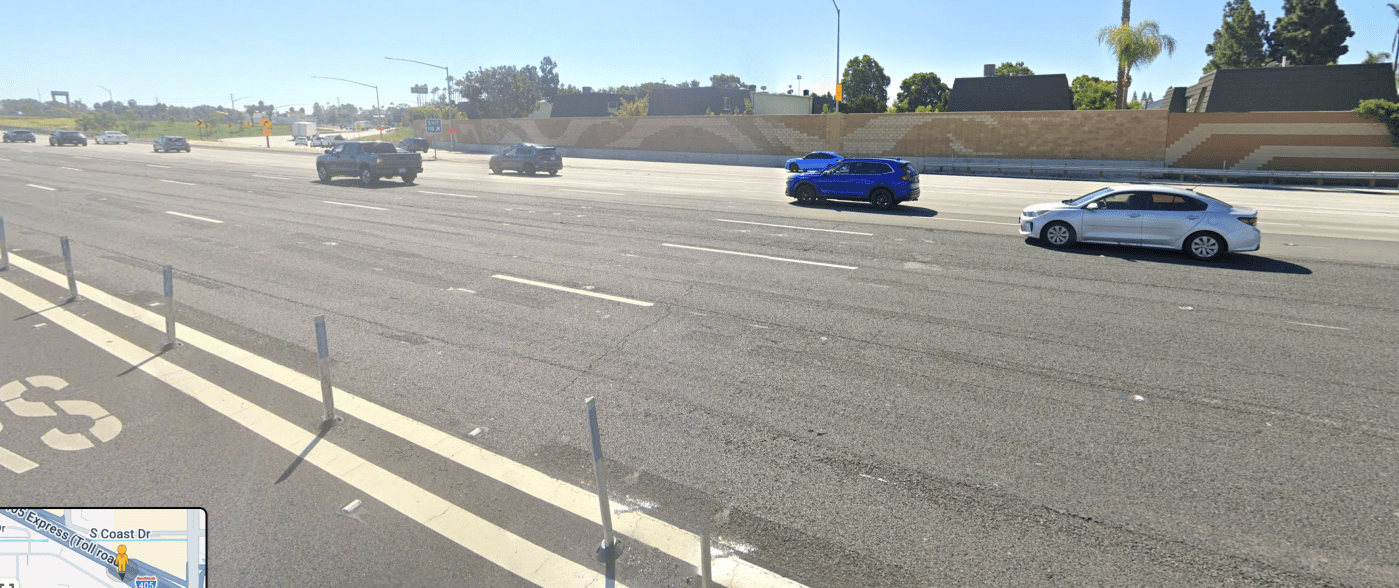
Q: Hi Honk: I was driving north on the 405 Freeway early Sunday morning. Right around Harbor Boulevard, traffic suddenly slowed to an almost stop due to a large number of emergency-response vehicles. I was in the fast lane as I drove into this mess. Traffic was quickly diverted into the FasTrak lanes to ease the congestion. I followed, and once it was safe, quickly merged back into the regular lanes. And once I got home a few minutes later, I got the feeling that no one in particular had diverted cars into the Express Lanes, and that I’d possibly followed dozens of scofflaws somewhere I shouldn’t have been. And, yes, I drove under a license-plate reader. So, o wise and wonderful Honk, do the powers that be know when there’s an accident and understand that normal traffic may be in their lanes, or will I be getting a notice with a fine attached?
– Dave James, Fountain Valley
A: Next time, Dave … .
“Make sure there is an officer there” waving drivers on, said Officer Fernando Perez, a California Highway Patrol spokesman out of the Santa Ana station.
An officer may direct you out of the Express Lanes, too, into the general lanes if there is a collision blocking traffic.
Without permission, offenders could be cited for crossing over the double solid white lines.
Joel Zlotnik, a spokesman for the Orange County Transportation Authority, which runs those Express Lanes, said the CHP, a fire department or Caltrans notifies his agency when an official diversion onto the Express Lanes occurs — think major collision or a tanker spilling its cargo. In such cases, the toll is waived for those vehicles.
If the diversion is going to be lengthy, the Transportation Authority will display on its electronic signs that anyone can take the Express Lanes for free.
CHP officers can temporarily remove the hard plastic, bendable poles that separate the Express Lanes from regular freeway traffic. Sometimes there are gaps where they have been knocked down. Yes, cars and trucks can drive over them slowly, but they can easily damage vehicles.
No episode was reported that night to the Transportation Authority, Dave, so license-plate readers likely will help dole out tolls — and, if the vehicle doesn’t have a transponder, a $25 fine.
“If there is a first-time oopsie, there is a way to make a request to waive it,” Zlotnik said.
When you get the violation notice, Dave, there will be a number on it to call to ask for the waiver.
The fine could be waived, but not the toll.
Q: Dear Mr. Honk: Do you think there will be any sort of public recognition when the last license plate in the current series (9ZZZ999) is issued? What about the first in the new series? Just curious.
– Martha Siditsky, Laguna Niguel
A: Martha, the Department of Motor Vehicles doesn’t have any plans to break out the party favors.
At this point, the DMV expects that last plate in the standard-issue sequence to be handed out in July.
“The new ‘reverse’ series configuration will begin with 000AAA1 and ultimately end with 999ZZZ9,” Ronald Ongtoaboc, a DMV spokesman, told Honk in an email. “You may start seeing these plates on the road in the coming months.
“The current sequence has been in use since 1980, and the first combination was 1AAA000,” he said. “The sequence has over 100 million plate combinations. The new series is expected to last 40 years based on historical data.”
To ask Honk questions, reach him at honk@ocregister.com. He only answers those that are published. To see Honk online: ocregister.com/tag/honk. Twitter: @OCRegisterHonk