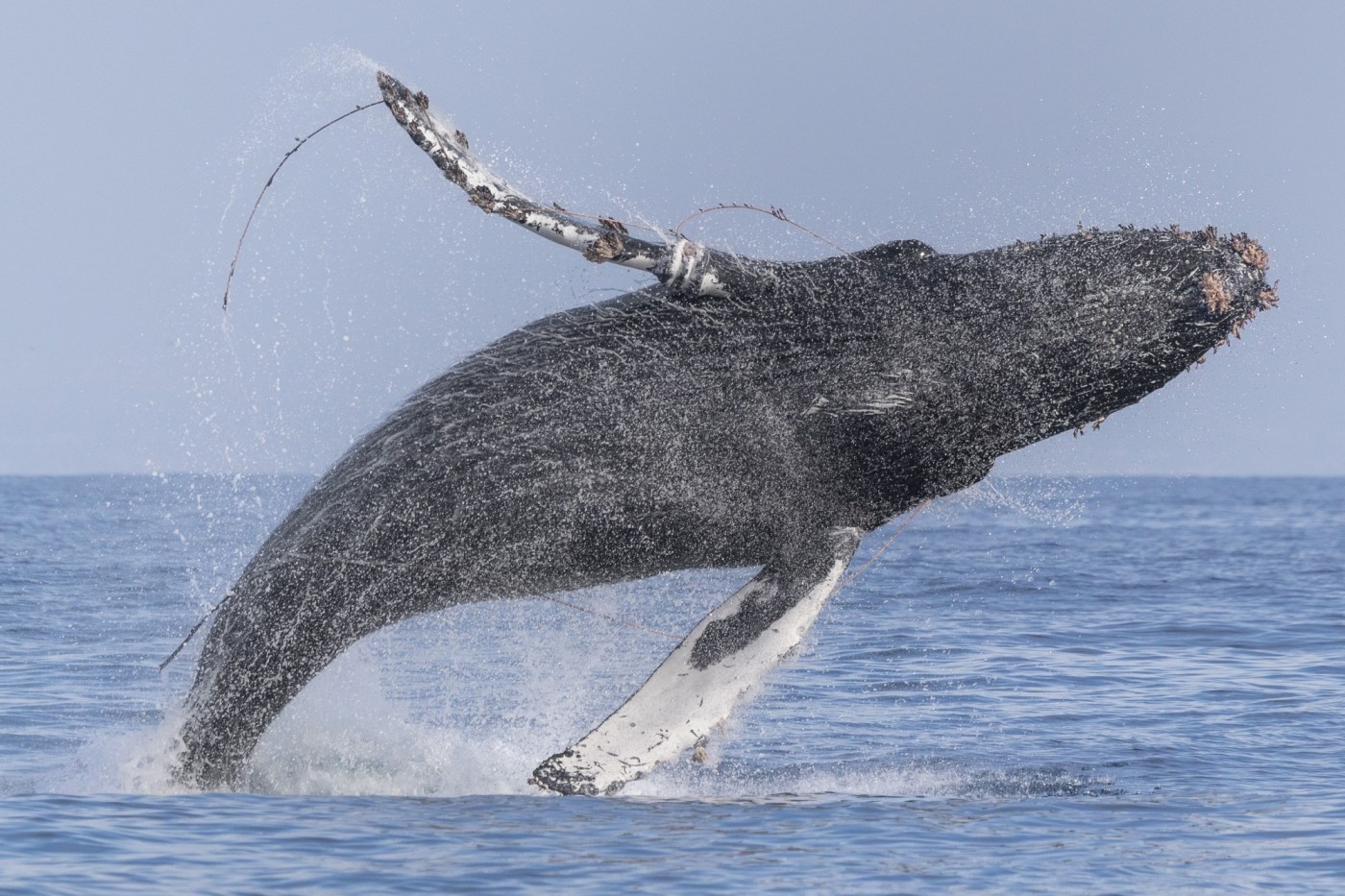
The California Department of Fish and Wildlife has approved “whale safe” pop-up gear fleet-wide for fishermen harvesting Dungeness crab, extending their window for pulling up the crustaceans off the California coast.
Fishermen have begun receiving notices they can sign up to use the now-approved gear that previously was being piloted by some in the industry under an experimental permit. The decision by the agency, which had been sued in the past for not doing enough to safeguard humpbacks and turtles, is being heralded as a milestone in collaboration and a breakthrough for conservation.


“Authorizing pop-up gear is a huge step toward ensuring fishermen can catch more crab without worrying about entangling a whale, and consumers can enjoy that crab caught during the spring knowing that it is whale safe,” said Geoff Shester, a marine scientist for Oceana, who has been part of the California Dungeness Crab Fishing Gear Working Group, adding he is hopeful other states will follow California’s lead.
To address the problem of whales entangling in fishing gear, including the lines used by crabbers, the wildlife agency had created with the working group stricter regulations for crabbing seasons in 2020, which often delayed the start or ended them early because of the presence of whales, especially humpbacks, moving into fishing ranges stretching from Northern to Southern California. National Oceanic and Atmospheric Administration experts estimate that approximately 75% of large whale entanglements are fatal.
Called a pop-up because it only appears when a fisherman summons it from the seafloor via a transmitter on the boat, the gear that was used in the wildlife agency’s approved studies was developed by Bart Chadwick, a San Diego scientist and former Navy researcher, who founded his company SubSeaSonics in 2019. The state wildlife agency already requires fishers catching box crabs in Southern California to use only the ropeless gear.
Chadwick gives huge props to the fishermen — there are currently 530 permits in the state, with 370 active boats — who took part in gear trials conducted under the experimental permit issued by the wildlife agency.
“It was really in gaining acceptance with the fishermen that we were successful,” he said. “They’re the ones who took it out and showed it could work. A lot of them were quite skeptical to begin with, and rightly so.”
What they found, he said, especially in the last two years, was that after purchasing the gear, they could fish the extra time in the spring, “and pay the gear off pretty quickly, and that it made sense for them economically.”
“Otherwise, they can’t go out at all,” he added, explaining the stricter regulations meant the regular crab season ended around April 1.
“People have seen the potential that they can get back their season,” said Ryan Bartling, a senior environmental scientist at the wildlife agency, adding that before restrictions were put in place, fishermen started in November and fished through as late as July. “If you look back five years ago, it was, ‘No way will this ever work,’ to now, we’ve got a significant portion of the fleet that is interested and poised to start.”
Chadwick first became familiar with the acoustic release technology while working on environmental projects for the Navy. While the technology expense made sense for retrieving expensive research gear, Chadwick said the challenge was to build something affordable for fishermen that would still be reliable in the harsh ocean environment.
What won the fishers over, Chadwick said, was that the new gear proved it could work and be lucrative, despite the fact that the fishers had to make investments, some of which were offset by grants from the wildlife agency.
Chadwick describes the gear as resembling a fish cage (called a sled) that holds a buoy a coil of line, and a small electronic release unit with a rotating top. When an acoustic message is sent, it rotates and releases the buoy, and the buoy pulls the line up.
Instead of the lines hanging in the water and potentially ensnaring a passing sea creature, they wait lying along the ocean floor, he said.
During testing from April to July last year, the crabbers brought in more than 217,000 pounds of crab worth an estimated $1.4 million, and had 98% reliability with the gear deploying properly, he said.
The cost for a system with eight sleds, each containing up to 25 traps, and the transmission systems is about $12,000.
“The $12,000 costs something, but it’s not huge compared to the revenue they’re bringing in,” Chadwick said, explaining he spoke to a fisherman who, last year, used the gear and grossed $150,000 over two-and-a-half months of fishing.
What holds some back, he said, is that they don’t have a ton of capital to go buy that much gear at once.
“A donor did come forward this year and is providing a $5,000 stipend toward the gear,” he said. “So all the new fishermen who sign up this year get this.”
Among the fishermen enthusiastic about the gear is Ben Platt, who has fished for 40 years. He tested the ropeless pop-up gear through its evolution, from being too time-consuming and taking up too much space to the current specs.
“When the whales come back, they tell us to get the traditional gear out of the water,” he said. “If the pop-up gear were not available, I’d be putting my traditional gear away and trying to figure out what to do for the next two and a half months. Some guys will argue it’s too expensive. Well, it’s not as expensive as not working.”
He also likes a clean boat, and traditional gear gets “junked up and mossy” while floating and waiting in the water.
Now he’s counting on the new gear to save his season this year, he said. Typically, a third of his income comes during the spring and early summer, and that money is gravy on top of a good winter season.
But this winter, the season opener was horrible because of delays and environmental factors, he said. “It’s absolutely belly-up.”
Platt said he is happy that all the positives for the fishermen should translate into the conservation of whales. With about 175,000 pots in the waters off California, he and other fishers don’t want to see marine mammals or turtles harmed.
“It’s kind of been environmentalists against the fishermen butting heads,” he said of the earlier years. “This is the first time we’ve worked in collaboration.
“By working with us, they’re actually helping us,” he said. “So it’s a win-win, it’s really cool.”