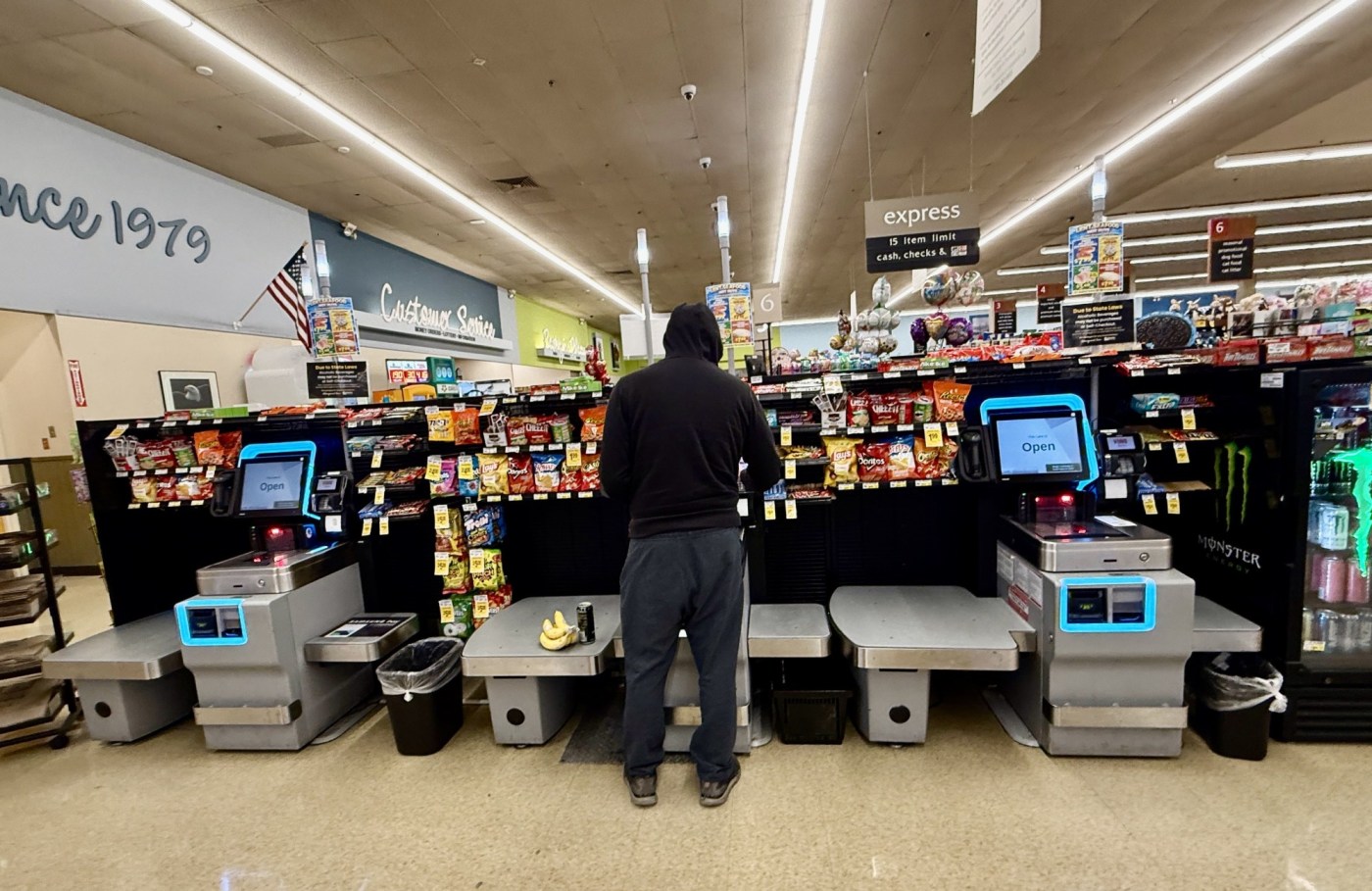
Major grocery and retail drug stores in Costa Mesa will be required to heavily regulate self-checkout under a new law that city leaders say will combat retail theft and protect jobs.
The City Council adopted an ordinance this week that will bring sweeping changes to retail operations’ self-checkout lanes: requiring one employee to oversee every three checkout stations, capping self-checkout transactions at 15 items and barring the purchase of any item kept in a locked case.
In approving the new rules, Costa Mesa became just the second city in the state to regulate self-checkout lanes, roughly half a year after Long Beach passed its first-of-its-kind legislation.
Costa Mesa’s measure, which diverges from Long Beach’s model in just a few ways, is expected to affect nearly two dozen retail establishments in town — the threshold is more than 15,000 square feet of space.
Violations of the rules could prompt fines of $100 for each incident, capped at $1,000 per day.
“Costa Mesa has a proud history of championing pro-worker and public safety initiatives, and by passing this ordinance, Costa Mesa will provide thousands of workers – union and non-union – with extra support and better service for customers,” Jose Perez, president of United Food and Commercial Workers (UFCW) Local 324 shared in a statement following the law’s passage. “UFCW members look forward to seeing additional cities in Orange County pass legislation like this to ensure quality jobs and safe, positive shopping experiences.”
A heated discussion over the self-checkout ordinance proposal lasted more than two hours at a January council meeting, with more than two dozen people arguing in favor and against the proposal. Grocery store workers spoke in support of the law, which they said would address the pressure of being overworked and bearing the brunt of customer frustration. Store managers and trade group representatives, meanwhile, argued that the regulations were an overreach of local government authority that would not meaningfully curb retail theft.
In response to public feedback, the City Council made several changes to the proposed ordinance: businesses are given 60 days to comply with the mandates and the right to cure — the timeframe for correcting an issue — has been extended from seven to 15 days.
City staff will report back to the council within a year on the law’s implementation, officials said.
The final measure passed in a 5-2 vote on Tuesday, Feb. 17, with Councilmembers Jeff Pettis and Mike Buley opposed.
Pettis said he had spoken with a handful of Long Beach grocery store owners in recent weeks, 90% of whom reportedly hated the self-checkout law. Two large supermarkets he visited closed some kiosks to avoid having to hire more workers, Pettis said. Some Costa Mesa shoppers, he said, told him they’d switch to shopping at the Ralph’s in Westcliff for a less cumbersome retail experience.
“I’m very concerned about migration of our sales tax dollars to other cities and I am about free market capitalism and regulating business,” he said.
Mayor John Stephens, who acknowledged his colleagues’ concerns, said the city has implemented a few “fail-safes,” including the one-year review, should the measure become too onerous on residents. He also urged residents to report back if they’re being negatively impacted by the new regulations.
Councilmember Loren Gameros said the ordinance will protect people from working-class families who are overworked at grocery stores.
“I wonder how many of those who speak against this ordinance this evening actually has to sling groceries for 8 hours to feed their family to make ends meet,” he said. “I wonder how many people have to run back and forth to a liquor cabinet while they’re watching three, four, five, six registers at the same time, stooping, bending, rushing.”