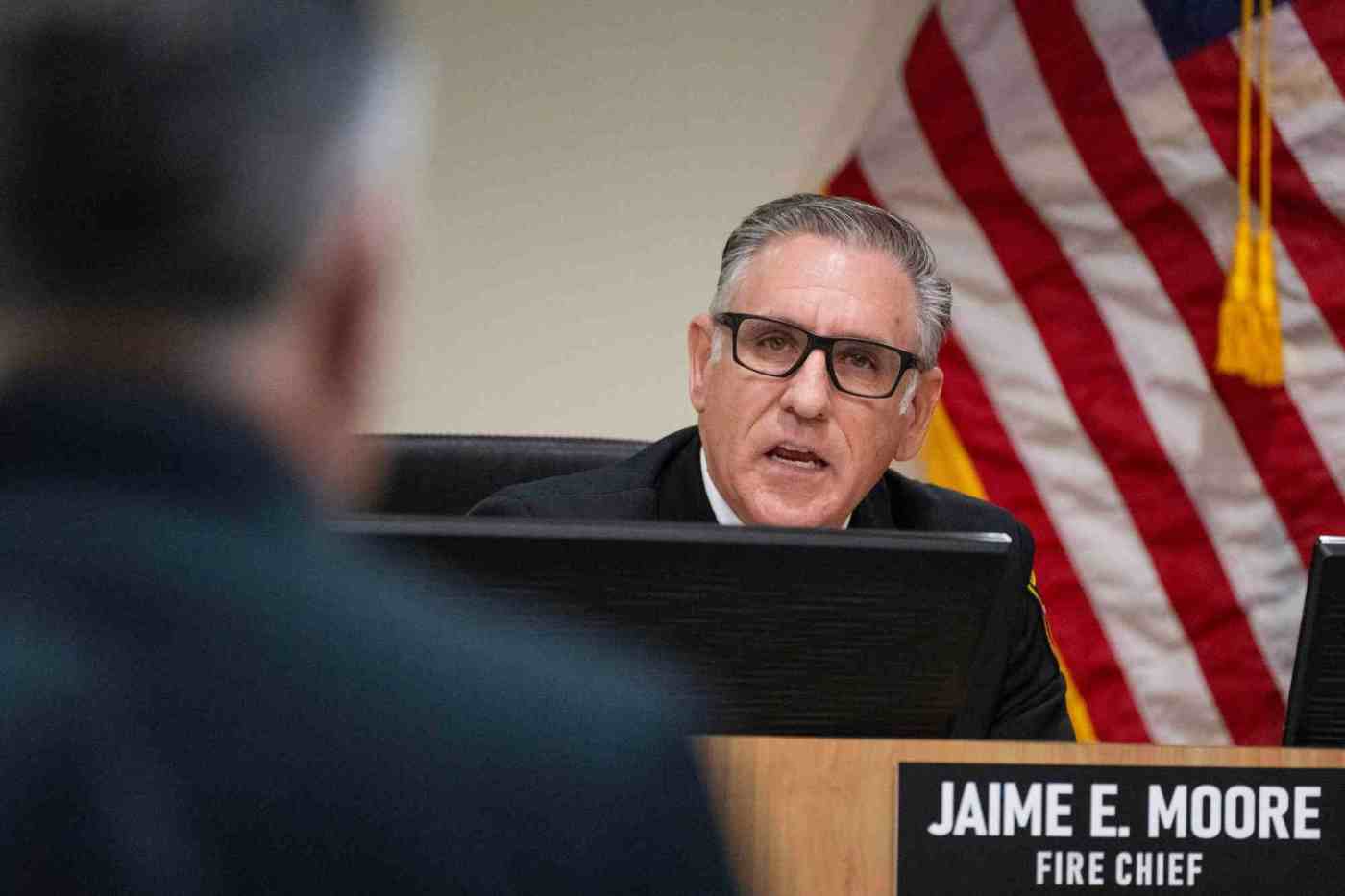
On the eve of the one-year anniversary of the eruption of the Palisades fire, the Los Angeles Fire Department’s recently sworn-in chief admitted there were missteps made by leadership when examining the response to the blaze before the agency locked in on corrective action to prevent residents from enduring another harrowing wildfire experience.
“We acknowledge where we must do better,” said Jaime Moore during a LAFD’s Board of Commissioners meeting on Tuesday, Jan. 6. “We take responsibility for making these improvements, and we’re fully committed to making sure that lessons learned from the Palisades fire result in meaningful and lasting change.”
Moore, during a 10-minute verbal report to the commissioners, said the mistakes taken by the department last year were not the fault of frontline firefighters but instead they “reflect leadership decisions, legacy systems and long-standing structural constraints that must evolve to meet today’s risk environment.”


Moore, who has worked for the department since 1995, was promoted to assistant chief in 2018 and later to deputy chief. He was sworn in as the department’s 20th fire chief in November.
He acknowledged that the department’s analysis of its response to the fire in a report was edited several times to “soften language and reduce explicit criticism of department leadership in that report. That editing occurred prior to my appointment as fire chief, and I can assure you that nothing of this sort will ever again happen while I am fire chief.”
That report was completed and released under interim chief Ronnie Villanueva in October, months after Mayor Karen Bass demoted then-Chief Kristin Crowley in February for, the mayor said, not planning properly and refusing to cooperate with investigators.
Crowley blamed city leadership for cutting the department’s budget and limiting it’s resources.
Just before the report was released, federal authorities announced the arrest of 29-year-old Jonathan Rinderknecht, a former Pacific Palisades and Hollywood resident accused of intentionally and maliciously starting the Lachman fire, which was ignited just after midnight on New Year’s Day, authorities said, and fought by firefighters who thought it was fully extinguished.
But it kicked up on Jan. 7 amid intense winds, becoming the Palisades fire, which destroyed thousands of structures, mostly homes in the Pacific Palisades and in Malibu, and left 12 people dead before it was fully contained on Jan. 31.
“We cannot leave any stone unturned and I am determined that we look at any and every issue to ensure that the right lessons are learned and the proper steps are taken to make sure that everything that needs to be improved is improved,” Chief Moore said.
“Please understand that the Palisades and Lachman fires were defining moments for this department,” he said. “They unfortunately exposed real limitations — limitations in system capacity during periods of extreme demand, including challenges related to staffing availability, resource placement and the speed at which conditions can change during wind-driven fire events.”
The agency has adjusted how it makes sure fires are completely out, including now using drones, the chief said: “These changes are now in place to help ensure this will never happen again.”
More changes are necessary, Moore said, as the department “cannot continue to rely on a system that is stretched thin on its best day and overwhelmed on its worst.”
Moore noted that 74% of the recommendations listed in the department’s analysis of its fire response have been implemented. They include revising how weather is interpreted when predicting fire behavior; how to deploy firefighters, fire engines and other resources earlier and more strategically; and how to better pull off-duty firefighters back onto duty. Also, the process of dispatching firefighters has been upgraded.
“This is about learning and not about assigning blame,” Commissioner Sharon Delugach said. “We believe that this is going to move us forward.”