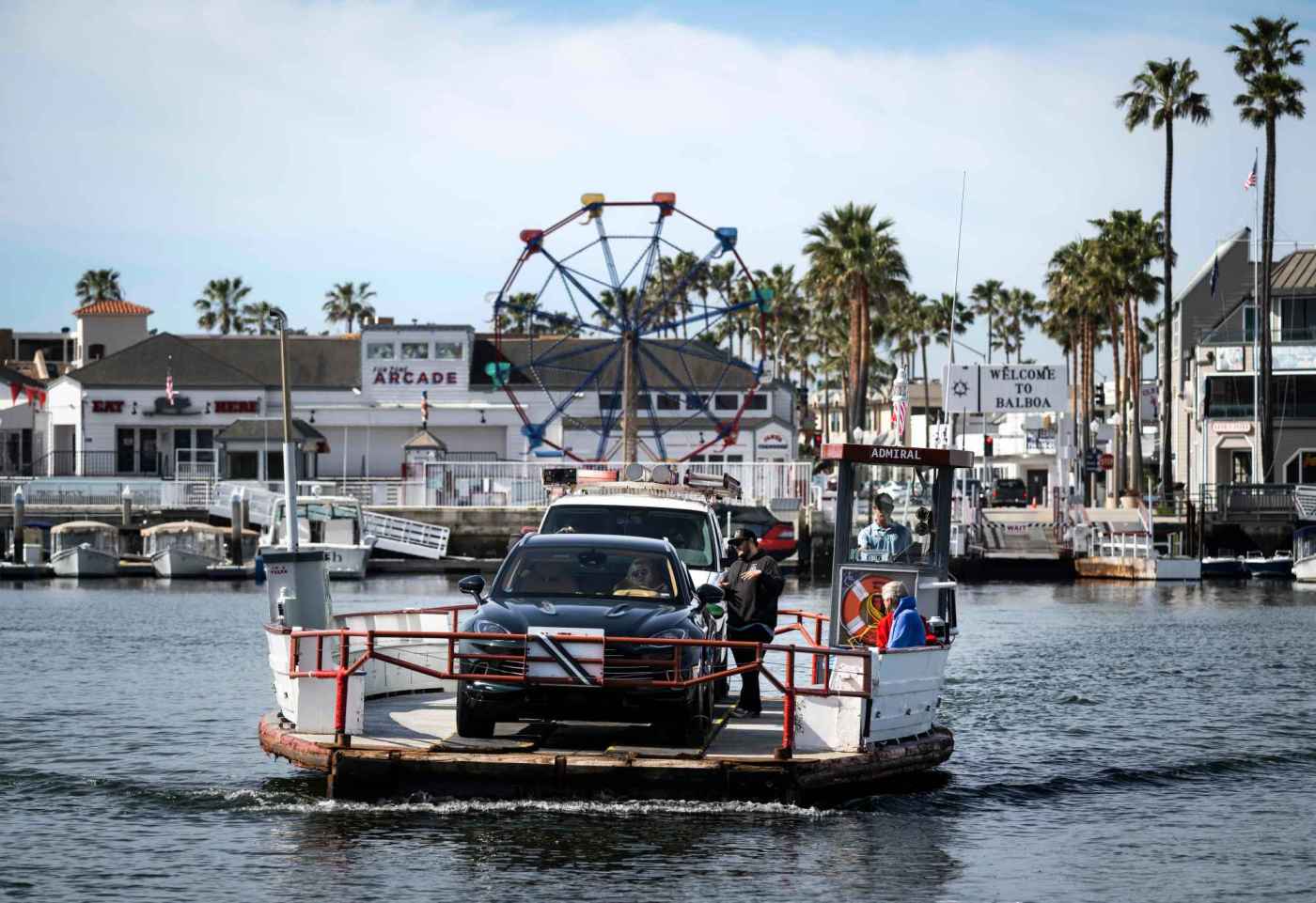
The Balboa Island Ferry, which has transported cars, bikes and pedestrians across Newport Bay for more than 100 years, has reached an agreement with state air quality regulators to fully electrify its fleet.
The California Air Resources Board and the South Coast Air Quality Management District will be contributing more than $10 million of the $12.1 million cost to replace the ferry system’s three vessels, Lynda Lambert, a spokesperson for CARB, said. The remaining funding will come from the ferry operator and project partners.
Lambert said the state agency, responsible for protecting public health by reducing air pollutants, is happy to support the ferry efforts for zero emissions through its California Climate Investment funding. AQMD will be using funding from its Carl Moyer Memorial Air Quality Standards Attainment Program.
“The short run of the Balboa ferry makes it an ideal case for using zero-emissions and will benefit air quality and public health, especially in adjacent communities,” Lambert said.
Since 2022, when CARB rolled out new regulations for ferries, tugboats, sportfishing vessels and whale-watch charters requiring a reduction in harmful emissions, Seymour Beek, whose father began operating the ferry in 1919, has been trying to get grant funding and time extensions to help with converting the diesel engines to battery use. In 2024, CARB announced an initial $7.9 million to help with the conversion.

The CARB regulation focuses on reducing emissions by replacing or modifying older diesel engines. It follows the requirement that all in-state sales of cars and trucks be zero-emission by 2035.
The agreement announced on Monday, which has been in the making since CARB’s first grant pledge, will make the Balboa operation the first car-carrying ferry in the state to become fully electric, Beek said.
Under the agreements, each of the ferry systems’ three existing diesel-fueled vessels will be replaced with electric battery-powered ferries that will charge from stations on Balboa Island.
“This collaboration brings together air quality agencies, fleet operators, and original equipment manufacturers to accelerate the adoption of zero-emission technologies in marine operations,” said Connie Villanueva, a spokesperson for AQMD. “This project will help improve regional air quality while demonstrating the viability of battery-electric ferries and the supporting infrastructure needed to advance these technologies in marine operations for future applications.”
Beek had initially bucked the requirement that he go zero emission or stop operating the ferries across the 900 feet of the busy Newport Harbor from Balboa Island to the Balboa Peninsula, saying converting the engines to use battery power would be cost-prohibitive, requiring alterations to the vessels’ structure, and his ferries were already very fuel-efficient and caused minimal pollution.
He also argued that ending the ferry service would mean losing a huge piece of Newport Beach history. He drew support from city officials and state lawmakers who lobbied for the ferries to get assistance.

But with financial help now to make the conversion, Beek said, “I think it’ll be cool once all the bugs are worked out,” adding that his father was an electrical engineering major at Cal Tech before he dropped out to sell real estate.
“It’s kind of full circle, he was very fascinated with windpower and electricity,” he said. “He’d sure be interested in this.”
Beek said the old ferries will continue to operate until the replacements are ready, which he expects will be a couple of years. When they are, he said, they will look like the ones in use now.
“People have an affection for the old boats,” he said. “They’ll have the same outline and maybe some improvements. We’ll try to keep the look the same with the cars in the middle.”