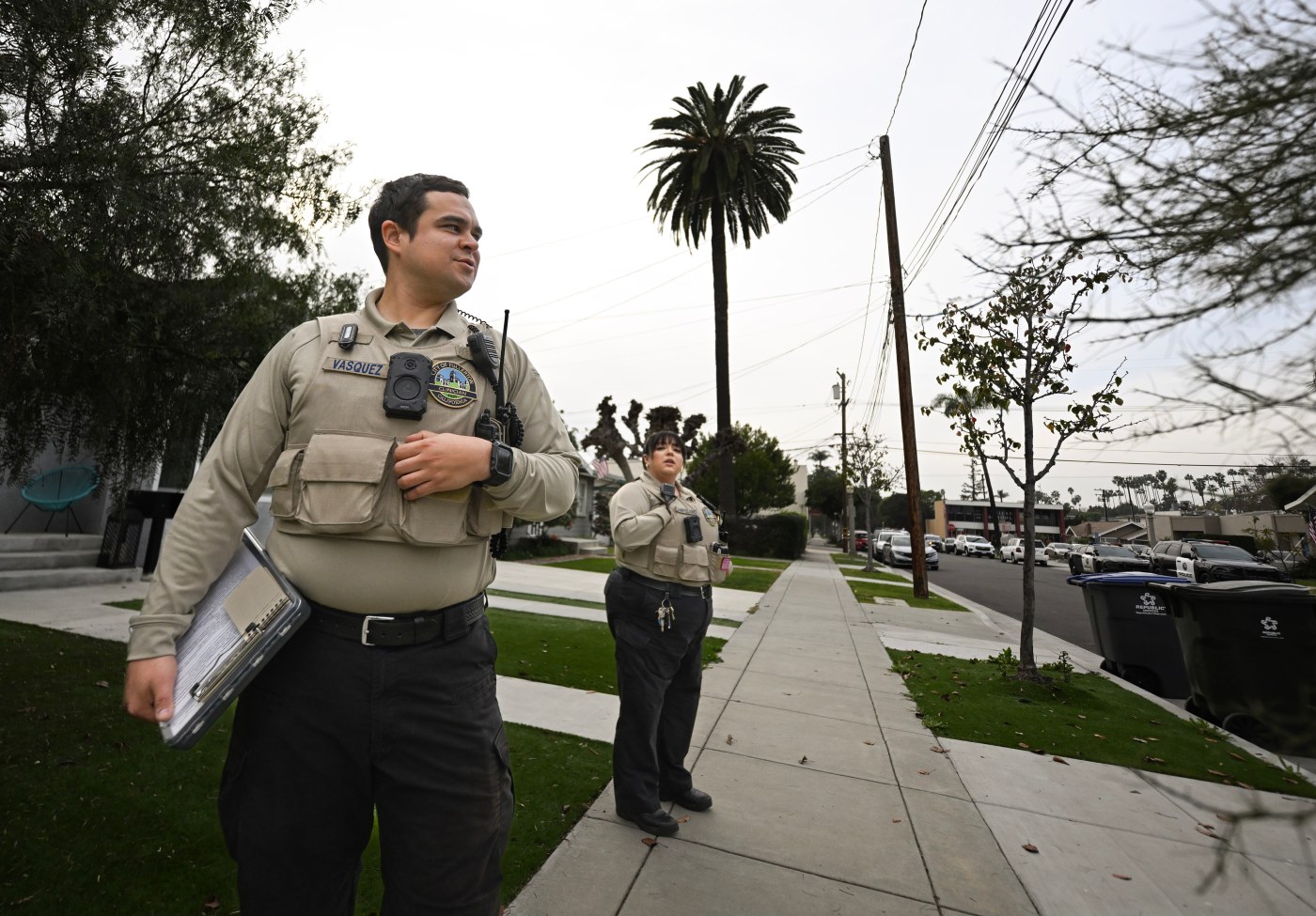
Sitting inside her vehicle, Maricella Campuzano, a behavioral health clinician with the Fullerton Police Department, called through a list of Orange County hospitals looking for one to help a 19-year-old who was in crisis.
The Fullerton teen was picked up by police after texting a loved one about harming themselves, saying “This is the end.”
One hospital didn’t have enough beds, another didn’t accept the family’s insurance; after several attempts, Campuzano secured a spot at a facility in Santa Ana. She let the officer transporting the teen know before heading over herself.
Campuzano is part of a two-person team of behavioral health clinicians the Police Department has had working with officers the last year as part of a pilot program for responding to people having mental or emotional crises – having an option for getting people help without having to rely on more traditional law enforcement responses.
“I would love to see behavioral health units be as standard as a CSI unit in a police department,” Campuzano said.
The pair typically monitors police radio traffic for potential calls and either self-dispatches to scenes or responds to direct requests from officers. They will also accompany officers to calls involving domestic violence or juvenile delinquency.
The unit has responded to more than 1,000 calls in Fullerton, with 43% resulting in a mental health evaluation.
After joining the department in November 2024 and completing training, Campuzano and Francisco Vasquez were deployed in February 2025. Services the two licensed clinical social workers can offer range from counseling and crisis response to mediation and community referrals.


For example, juveniles acting out can be directed to several intervention programs, Vasquez said, with incarceration “a last resort once all options have been exhausted.”
Instead, the agency can connect juveniles with diversion programs such as Shortstop, an early intervention service for at-risk youth ages 10 to 18, and the Sunburst Youth Academy, a leadership-building, boot camp-style residential program for teens based out of the Joint Forces Training Base in Los Alamitos.
Depending on the level of care needed, alternatives can also include psychiatric hospitalization or even conservatorship for severe mental health disorders.
The clinicians don’t stop with the department’s first interaction with someone, but instead develop treatment or “action plans” for individuals and conduct follow-up evaluations after calls to ensure services are effective.
“We do this by doing things like de-escalating crises at the moment, developing safety plans, distinguishing which level of care would be most appropriate,” Vasquez said, “and further facilitate linkage, looping in existing providers and social supports to reinforce needed care.”
Campuzano said the response from officers and the community has been positive.
“We’re met with more curiosity than adversity,” she said. “People are like, ‘Oh wow, I didn’t know Fullerton had that.’”
The behavioral health clinicians respond to local schools, colleges, and universities for calls involving youth or young adults who are considered at risk. They also assist with Fullerton’s unhoused population, often partnering with Fullerton’s Hope Center, a centralized hub the city says is used to address street homelessness.
When a new driver collided with a pedestrian, Campuzano said she was there to comfort the 16-year-old as the teen came to grips with the severity of the crash amid the chaos of distraught parents arriving and the crowd of onlookers gathering at the busy intersection.
“I was just there to try to walk them through the moment, keep them safe, and hold space,” she said.
Vasquez said the unit will be offering lessons learned from the pilot to other police departments in Orange County that are interested in starting their own Behavioral Health Units.
The two-year pilot program, which was funded through a $1 million grant from Orange County Supervisor Doug Chaffee, is expected to run out of funds by May 2027. The department has looked for additional grants to keep the pilot going without success — federal funding for behavioral health programs is part of $88 million in grant funding cut by the Department of Justice in 2025.
“The behavioral health clinician program has been incredibly beneficial to our community, filling a service gap with much-needed mental health services,” Fullerton Police Chief Jon Radus recently said. “We’re grateful to Orange County Supervisor Doug Chaffee for his trust and support in getting this program off the ground, and we will be asking the Fullerton City Council to fund the program going forward.”