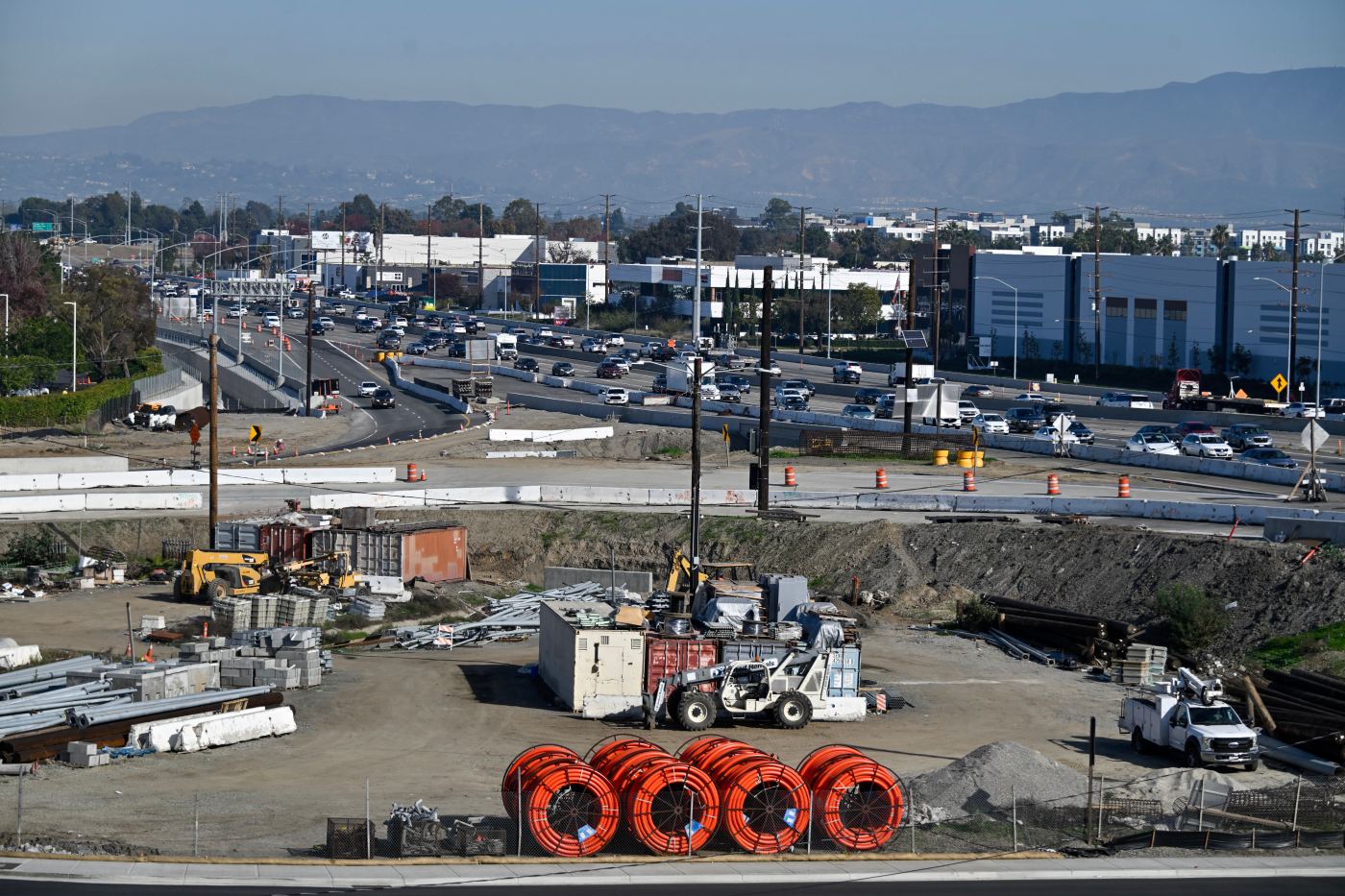
With construction underway or soon to begin on multiple of its freeways and weeks of testing already logged for its first modern streetcar, 2026 will be a busy year for transportation projects in Orange County.
“I really think that 2026 is going to be super busy; we have a whole host of projects that are underway, that we are going to start, that we are going to get close to finishing some,” Darrell E. Johnson, CEO of the Orange County Transportation Authority, said. “I think ’26 is going to be a very busy year working on all aspects of what we are working on for transportation and mobility in Orange County.”
Arguably the largest project expected to wrap up this year is the $649 million OC Streetcar, an electrified system that will take passengers 4.1 miles from the Santa Ana train station to a new transit hub on Harbor Boulevard in Garden Grove with 10 stops in between, including in the Civic Center area with the county seat and federal courthouse and downtown Santa Ana.
“We are definitely planning to open the latter half of 2026,” Johnson said. “We are super excited about it.”
After years of laying the tracks — which travel for much of the route down city streets — and installing the platforms and controls, the system is now being tested. For now, the train cars are running along a 2-mile stretch that is separated from streets but will move out into the public roads early in 2026.


“There is a defined set of testing” prescribed by the state’s safety regulators that will take about 6 months, Johnson said. “We want to make sure when we invite riders on everything works as planned.”
There will also be an education campaign getting underway, he said, focused on how to ride the streetcar as well as how to interact safely with the trains in the streets.
Ridership is expected to be 5,000 people a day once the system matures, around the five-year mark, Johnson said. “We are not building this for 2026; we are building it for 2030, we are building it for 2035 and 2040 and beyond. This is an investment in one of the densest and arguably one of the most important parts of our county.”
The Orange County Transportation Authority finished two massive freeway investment projects in the last few years — widening bridges and adding lanes in a $2.16 billion project on the 405 Freeway and investing $665 million to add lanes and make adjustments to address the bottlenecks on the 5 Freeway leading to the El Toro Y.
But with more Measure M2 funds available from the half-cent sales taxes collected in OC for transportation projects and federal and state funding awards, the agency has several more projects in the works that are more “targeted” and “more focused on bottlenecks and key points of congestion,” Johnson said.
Trying to address those issues along the 91 Freeway — the key connector between the Inland Empire, where more and more people head for housing, and Orange County’s jobs market — the agency is spending about $780 million on three segments.
Already under construction is a new interchange at Lakeview Avenue, with a new bridge for the road above, which is aimed at reducing the “weaving and merging” as drivers either stay on the 91 or take the 55 Freeway.
Also on the 91, closer to the 57, is a project to reconstruct the Tustin Avenue and Kraemer Boulevard bridges that should start in the middle of the year.
And at the 57, involving the La Palma Avenue bridge and lanes to the Raymond Avenue/East Street offramp, there will be more improvements made.
The La Palma Avenue bridge is expected to close during the summer for a full year, and other closures will be needed at times along the stretch, Johnson said, encouraging commuters through the area to monitor the agency’s social media.
“It is a lot of rework to accommodate space improvements for traffic safety, operational improvements and standardization,” he said of the projects’ goals.
Several of the agency’s projects include getting OC’s freeways back to standards. Where in the past Caltrans has allowed lanes that may have been slimmed to try to fit more, the standard is 12 feet and functions best, Johnson said. Projects are also standardizing ramps and shoulders and, on connecting city streets, bike lanes and other features where possible.
241 to 91 connector bridge
There is another project involving the 91 Freeway that is expected to launch in 2026.
After years of discussions and planning, a connector bridge from the 241 Toll Road to the 91 Freeway is in the final stages of getting all its necessary agreements in place and finalizing the design, said Stephanie Blanco, chief capital programs officer for the Transportation Corridor Agencies, which operates Orange County’s toll roads. (The express lanes are operated by the OCTA).
The TCA was recently approved by state officials as the agency that will collect tolls for the connector. It has been advocating for the improvement for a long time, working out timelines in recent years with the OCTA and the Riverside County Transportation Commission and projects they had for improving the 91 corridor.

The TCA is expecting to have the project ready for Caltrans to advertise for a construction contractor in the spring, Blanco said. “We are anticipating groundbreaking, starting construction mid- to late-2026. It is going to be a big year for this project.”
The addition of the connector bridge aims to reduce the backup of cars waiting at peak hours at the interchange between the two roads, which can be a couple of miles long now and is expected to grow to six miles by 2028, Blanco said. “And sometimes there are queue jumpers who create a safety hazard.”
“The 91 corridor carries more than 325,000 drivers on a daily basis in both directions. Because there isn’t a direct connection between the 241 and the 91 Express Lanes, those that are getting onto the 91 have to cross four lanes of traffic to get into the express lane, so that creates a lot of weaving, merging, conflicts, creating a bottleneck on the 91,” she added.
“There will be travel time savings for everyone.”
Most of the construction will happen at night, Blanco said. Work will likely start with prep at both ends — on the 91 where the connector will join the lanes, and on the 241 near the Santiago Canyon Bridge — and work toward the structure that will be built, which is expected to be completed in 2029.
Improvements on the 5 and 55
Another new project kicking off in 2026, breaking ground in January, is to make improvements on the 5 Freeway from the 405 Freeway interchange to the 55, through Irvine and Tustin.
“That’s going to be safety and operations. There is a lane addition (in each direction), but it’s really about making sure everything is standard there,” Johnson said. “It’s about a $715 million project.”


That work is expected to take about three and a half years.
Where the 5 hits the 55 Freeway is also where the OCTA is well into a project widening a key stretch of the 55 between the 405 and 5. Adding a second carpool lane and a new regular lane in both directions, along with realigning on and off ramps and making things more standard, is expected to improve commutes on the heavily traveled link.
The $520 million project was started in 2022 and has a little more than a year to go, Johnson said. “We are on the final home stretch.”
Additional projects already in drive
A few smaller projects underway are a $32 million interchange improvement on the 605 Freeway at Katella Avenue at the county’s northern border that should be completed in early 2027, and a $134 million project on the 57 Freeway adding a northbound lane and extending an auxiliary lane between Orangewood and Katella avenues, where lots of visitors get off for the Honda Center or Angel Stadium.
In 2026, the OCTA will continue efforts to transition transit riders to its new Wave fare payment system rolled out in the fall. Riders pay with their phone using a mobile app or using reloadable plastic cards, ending the use of paper passes.
Transiting to the new fare technology has allowed the agency to also roll out fare capping, which means the most a bus rider will pay for a day is $5, without having to decide with their first ride of the day whether they will use the system enough to warrant the purchase of a day pass — after $5 worth of rides, the passenger won’t be charged for any more that day. There is also a monthly cap of $69.
“You don’t know what you are going to do in the morning, you don’t have to have all your money at once,” Johnson said. “We are using technology to give people the best fare all the time.”
Education on the new fare system will continue into the new year, Johnson said.
What kind of bus riders will climb on board may also change in 2026 as the agency continues to invest in zero-emission vehicles to meet the state’s clean air requirements for 2040. OCTA has been testing both hydrogen and battery-electric versions.
In 2026, it will build a second hydrogen fueling station at its transit hub in Garden Grove and expects to purchase more zero-emission buses late in the year — with hopes of securing more grant funding, Johnson said.
“Not sure which technology we will choose,” he said of what can be an expensive transition. “We are trying to be thoughtful and aggressive on how we do it and not be wasteful of how we spend the taxpayer money.”

A large south Orange County project in 2026 will be rebuilding the popular beach trail in San Clemente that was damaged in landslides that also dumped debris on the train tracks, forcing another lengthy pause in rail service through to San Diego County. The Los Angeles-San Diego-San Luis Obispo, or LOSSAN, Corridor is considered a key rail line in the region.
The beach path’s bridge at Mariposa Point has been out since January 2024. The trail will be rebuilt as a ground-level path, relying instead on cutting back the hillside and adding a catchment wall to protect it and the nearby train tracks.
“We fully expect to have the pedestrian trail completely reopened,” Johnson said. In another section of the coastal rail line, riprap will be added next year to further bolster protections from ocean waves.
Replenishing eroded sand is also part of the $300 million in work the agency has received state and federal funding for, but that project has a longer lead time, Johnson said.
He said he expects by the end of the year to get the sand replenishment elements of the project through the permitting process, which can be lengthy. Delivery probably won’t happen until 2027.
In a separate project, the agency has been working to replace a nearly 100-year-old rail bridge over San Juan Creek in San Juan Capistrano. Trains are already operating on a newly built bridge and crews will spend 2026 removing the old bridge — which has to be done carefully because of the natural habitat in the area — and the project is expected to be completed in 2027.
“Our focus for 2026 is clearly on reducing congestion, enhancing safety and just expanding reliable choices for all people, whether they move by car, by bus, by train,” Johnson said, “and just the idea of balancing the needs and continuing to invest in the county.”