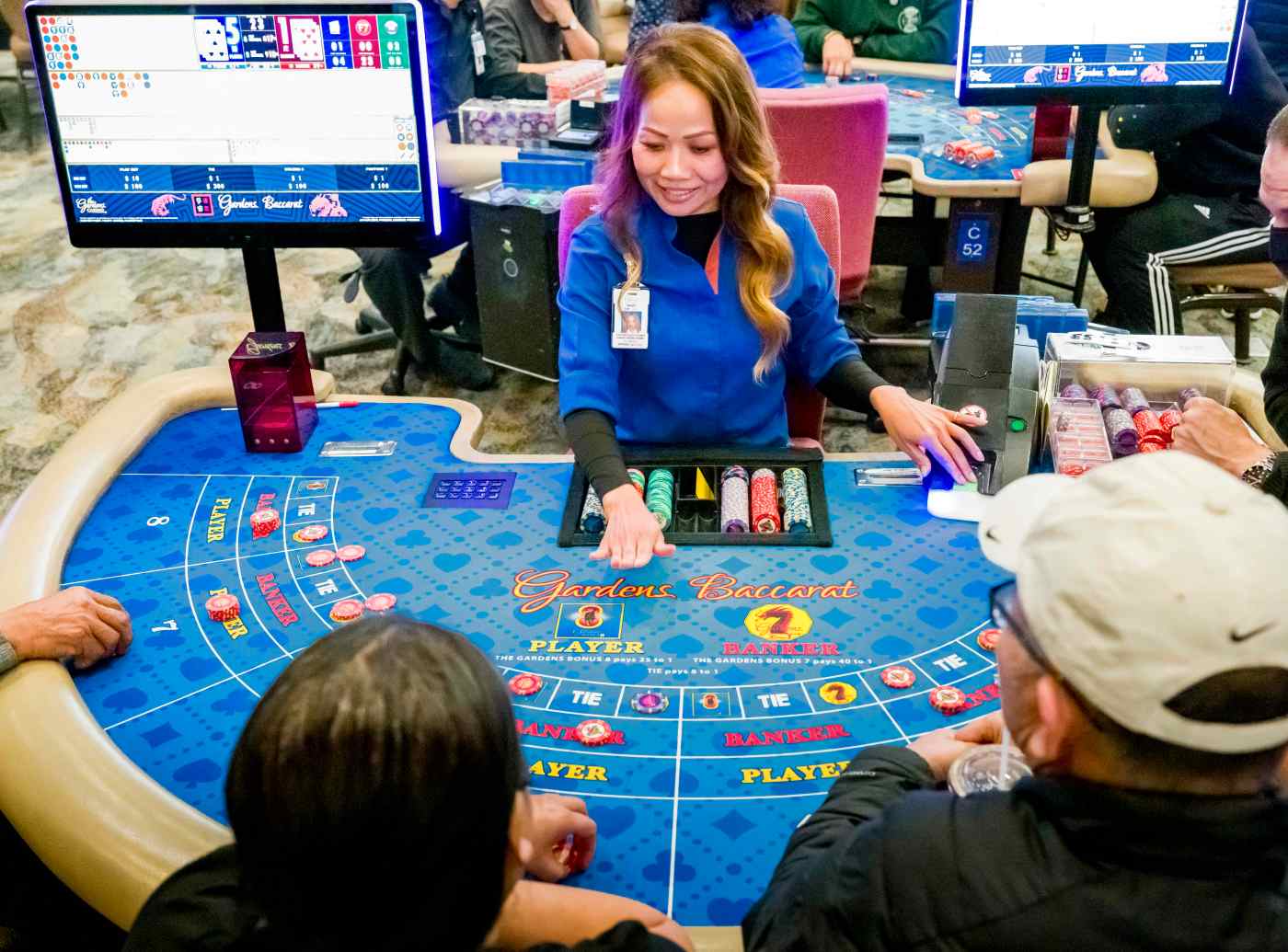
California’s $5.6 billion cardroom industry may be holding a losing hand.
A few days before Christmas, California Attorney General Rob Bonta proposed new rules that would drastically alter how casinos run blackjack, baccarat, pai gow and other card games.
The changes are so disruptive that the cardroom industry says it will be forced to close down all blackjack-style games in California, pull back on card game tables generally, and target layoffs of nearly 13,000 to its statewide workforce.
Poker is the only card game immune to Bonta’s rule changes — leading some cardroom operators to rethink their business models going forward.
Local governments where the cardrooms operate are so rattled by possible losses of tax revenue generated by the casinos in their communities that they met for an emergency video conference call Wednesday, Feb. 11, to discuss the economic impacts. Elected officials, administrators and finance staff from Hawaiian Gardens, Bell Gardens, Commerce, Compton, Gardena and elsewhere were listening in.
Those Los Angeles-area communities all have major cardroom casinos, including the Commerce Casino & Hotel, Crystal Casino, the Gardens Casino, Hustler Casino, Lucky Lady Casino and Parkwest Bicycle Casino — which together make up a bulk of the multi-billion-dollar industry in California.
“I’m at a loss for words,” said Victor Farfan, councilmember with Hawaiian Gardens. “This decision will be devastating. It shakes at the very foundation of our city. We will not be able to provide essential services for our community.”
Hawaiian Gardens, a tiny, 612-acre city of 14,150 people and the smallest in Los Angeles County, collects about 60% of its general fund revenue of $20 million on taxes paid by the Gardens Casino cardroom along East Carson Street, according to Farfan.
Less than a block from the casino along Pioneer Boulevard, city staff in Hawaiian Gardens have held ongoing discussions about cuts in services — including fire and police — if the final year of its two-year budget cycle starting July 1 doesn’t realize the revenue stream it once anticipated.
If more than half of the city’s budget is wiped out — which is likely if Bonta’s regulation goes into effect — Hawaiian Gardens may be forced to restructure its debt under a Chapter 9 bankruptcy protection filing, according to Farfan. Unlike other bankruptcies, Chapter 9 protects taxing entities from creditor lawsuits while it develops a plan to adjust debt obligations. During such a process, Farfan worries the city of Hawaiian Gardens could lose its independence and be absorbed by Los Angeles County or taken over by the state.
“This is the harsh reality,” Farfan said.
City budget shortfalls
The scramble to plug possible budget holes in local governments is coming nearly a week after Bonta finalized a complex set of gambling rules that he says are needed to force cardroom casinos into compliance with California laws.
At the moment, California has two different kinds of gaming systems that operate side-by-side — one for tribal casinos and the other for cardrooms.
Tribal casinos operate under federal law and offer casino-style gaming on tribal land, granted by Proposition 1A. That proposition amended the state constitution to allow federally recognized Indian tribes to operate slot machines, lottery games, and banked card games.
A banked card game is a type of gambling game in which players place bets against a central dealer, known as the banker or house, rather than directly against each other.
Cardrooms — like the Gardens Casino — are state-licensed venues that, under state law, may only offer player-banked or peer-to-peer games — or tables where players play against each other, not the house.
Bonta is now saying California laws on banked games must adhere to the federal Indian Gaming Regulatory Act of 1988 and California Proposition A1 passed in 2000, according to the California National Indian Gaming Association. However, the cardroom industry disputes the tribal gaming industry’s legal interpretation of these laws, saying that Bonta’s rules could disrupt its business model.
Pai gow was the first card game using a player-dealer position in the cardroom industry in 1983.
Outsourced player-dealer services— or third party proposition players as they are known in casino parlance — came in 1990. An outsourced player-dealer service is a licensed independent company, not the casino itself, whose employees play in cardroom table games to ensure they remain active and filled, acting as a neutral party like any other player in the game.
Bonta’s new rules would upend the card games.
The cardroom rules, which were submitted by Bonta and the Bureau of Gambling Control and approved by the state’s Administrative Law Office in early February, go into effect April 1. The rules give cardrooms until May 31 to report how they’ll modify their card games — but the industry says it can’t comply with the rule because of their “vagueness” and belief that they don’t line up with their interpretation of what are permissible card games.
The rules also end their ability to have blackjack-style tables — a big money draw for cardrooms.
So, is the sky falling?
The California Gaming Association, which represents the interests of cardrooms, is preparing to file a lawsuit against the state in the coming weeks, citing the new rules as a break from longstanding precedent that allowed such table games at cardrooms since before passage of Prop. 1A, according to cardroom advocates interviewed.
Layoffs coming?
Keith Sharp, general counsel at The Gardens Casino, said he is bracing for layoffs approaching nearly half of his workforce of 1,300 people who work as dealers, customer service representatives, food workers, and others.
The new rules would effectively end at least 11 of the blackjack-styled tables and threaten the remaining 70 or so tables of baccarat, pai gow and other card games, said Sharp on Wednesday.
“We’ve been playing blackjack forever, and now he’s (Bonta) decided we can’t,” said Sharp, who alleges Bonta is influenced by lobbyists from the tribal casinos in California. “A handful of people, wealthy tribes, want to control all gambling in California. They want to monopolize the industry. As a result, we will lay off hundreds of people here.”
For decades, California tribes have spent hundreds of millions of dollar in a long string of casino-related ballot initiatives over the years, including:
- Prop 5. In 1998, Californians passed a measure that would have enacted tribal-state compacts to set up gambling on tribal lands. A union, the Hotel Employees and Restaurant Employees, brought a suit against the validity of Prop 5. Most of the measure was struck down by the California Supreme Court, “jeopardizing Indian gaming tribal self-sufficiency.”
- Prop 1A. A constitutional amendment that fundamentally shifted the landscape of gaming in California, allowing tribal governments to operate gambling in California on reservation lands, passed in 2000.
- Prop 26. In 2022, the tribes pushed this measure — which failed — that would have legalized in-person sports betting on tribal lands and permitted craps and roulette.
- Prop 27. Also in 2022, concurrent with the tribal-backed Prop. 26, California’s tribes lobbied heavily against an initaitive from DraftKings and FanDuel that would have legalized online sports bettting. This measure also failed.
- Prop 68. In November 2004, Californians rejected a ballot measure that would have authorized slot machines in 16 California cardrooms and racetracks.
- Prop 70. In November 2004, voters rejected a measure that would have allowed tribes unlimited expansion of casinos on their reservations.
- Props 94, 95, 96, and 97. In February 2008, all four propositions were approved, expanding the scope of tribal gambling enterprises in California.
Change rattles dealers
Nary Chin, a 55-year-old cardroom dealer at Hawaiian Gardens, put her four children through local universities and colleges since joining the casino in 1999.
“This will affect my life a great deal [if layoffs happen] because I’m a single mom,” said Chin, who earns a six-figure salary with tips. “This is like family here. I learned how to speak English at the tables. Why do we need to change when everything is going so well already?”
Chin has memories of growing up poor with her family in San Bernardino when they first immigrated to the U.S. from Cambodia, and later moving to Long Beach. “I came from a very poor family, where we barely had food on the table. I don’t want to go back to that,” said Chin, who says she’s been getting panic attacks worrying about the layoffs.
Diane Nguyen, a 49-year-old customer service representative at Hawaiian Gardens, joined the cardroom in 2001.
“I heard they want to take away our blackjack tables. That’s going to hurt a lot of us,” Nguyen said. “Hopefully, this doesn’t happen.”
She financially supports her mom, father and child, the latter of whom attends online classes at Mt. San Antonio College in Walnut. “If I lose this job, I don’t know what I’d do,” said Nguyen who has a mortgage to pay in La Puente. “I’m always stressed.”
The layoffs may still come despite best efforts by the cardroom industry to save them.
Kyle Kirkland, president and general manager of Club One Casino in Fresno, and president of the California Gaming Association, forecasts layoffs statewide approaching 13,000 in an industry with 20,000 directly employed by cardroom casinos and another 10,000 who are vendors.
“If 60% of my business goes away, or is disrupted, we seriously have to think about what the reboot is for our business,” said Kirkland, whose group represents 72 cardrooms. “What Bonta is doing is pandering to the tribes.”
Illegal gaming?
James Siva, chairman of the California Nations Indian Gaming Association, has a different take.
He said that Bonta’s regulations are an important step in combating “unscrupulous and illegal gaming in California.”
“The regulations further clarify that games and practices employed by commercial card rooms are indeed prohibited under California law. Running a business contrary to that law is an illicit business, period,” said Siva in a statement. “We hope that the [state] Department of Justice will now enforce these regulations so California can ensure a well-regulated gaming industry that is safe for consumers.”
In a statement issued Feb. 9, Bonta said that he followed all the proper requirements to submit the regulations for public comment and gather input. His office refused to answer additional questions submitted by the Southern California News Group.
The proposed regulations were first introduced in the spring of 2025.
“Prior to their introduction, DOJ held numerous meetings with stakeholders to discuss potential regulation of games,” said Bonta, pointing out that the regulations were ultimately sent to the Office of Administrative Law for review on Dec. 23, 2025, with their approval coming Feb. 6.
Players at cardrooms are surprised by the changes.
“It’s absolutely ludicrous,” said Jack Gardner, a Norco plumber who lost $130 playing in a poker tournament on Wednesday at the Gardens Casino. “The poker side could be impacted as well if they make cuts on blackjack and other card games. This is the closest one to my house. There’s a lot of people who work in these casinos, and now they could be without jobs. That’s terrible. It’s another sign of why business is leaving California.”
John Doan, an entertainment consultant from Garden Grove, drives to the Gardens Casino twice a week to play blackjack. “If they change the fundamentals, the game disappears,” said Doan, who won $340 on Wednesday. “I’m a blackjack player. Once you change the fundamentals of the game, it’s not football any more, it’s soccer.”


