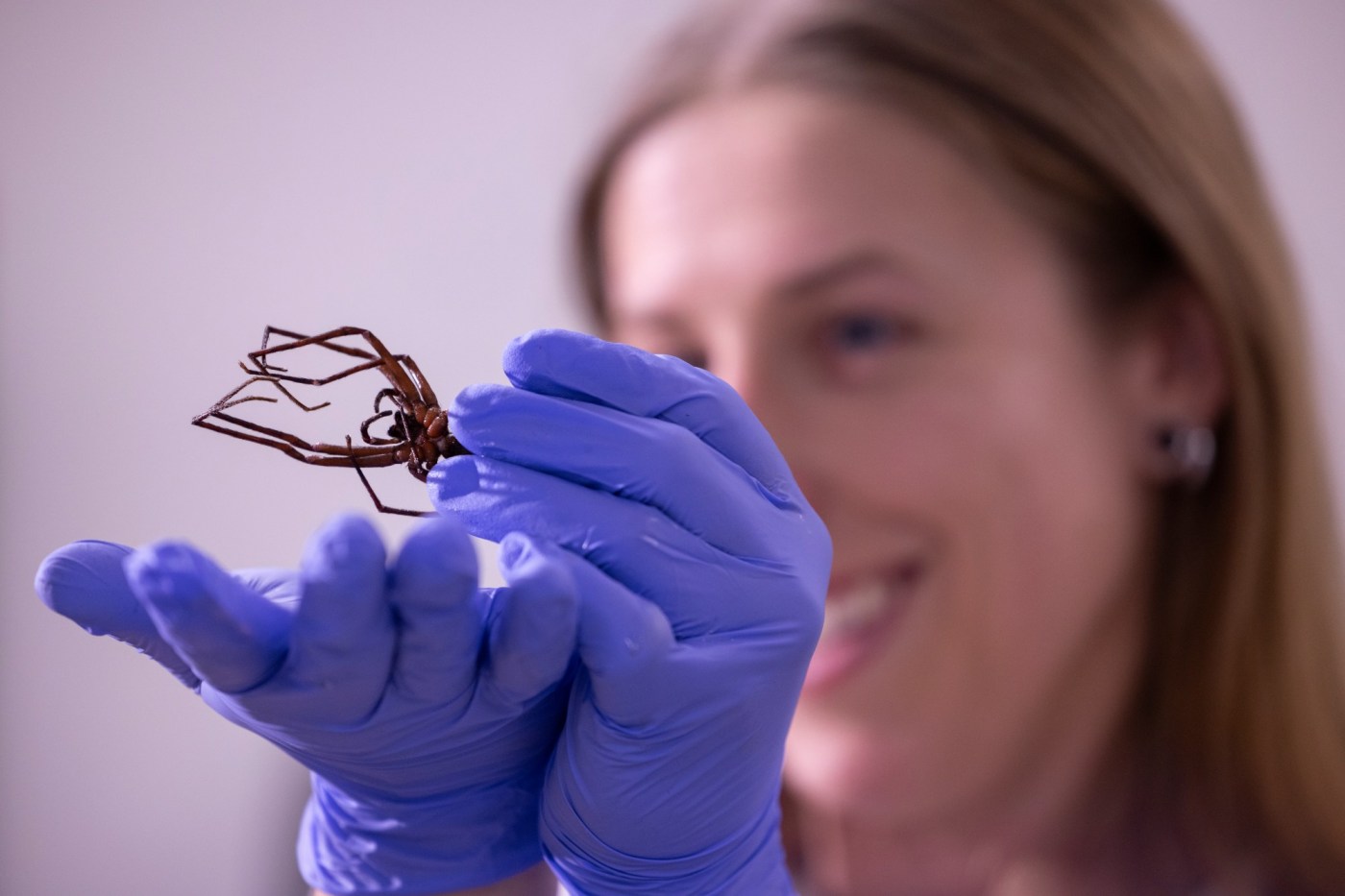
While most people flinch at the sight of a spider, Cal State Fullerton assistant professor of biological science Anna Holmquist is fascinated by them. She sees the eight-legged creatures not as pests but as essential players in ecosystems that offer insights into biodiversity and community ecology.
Holmquist’s passion for spiders and other insects and invertebrates began at a very young age, and she has clear memories of turning over rocks in her backyard and being mesmerized by the hidden world she found underneath.
“Even in kindergarten, I said I wanted to be an entomologist,” Holmquist said. “So it started young.”


Since joining CSUF in July, Holmquist has been introducing Titan students to her worlds of arachnology, entomology and molecular ecology through hands-on labs, fieldwork and research-focused coursework.
“I was really looking for a school that prioritized research, but also prioritized teaching and mentorship,” Holmquist said. “That’s something that I’m really passionate about, working with students and teaching. … While there is a strong research program here, there’s also emphasis on teaching and mentorship.”
During her undergraduate studies at North Carolina State University, Holmquist researched how the urban heat island effect was restructuring spider communities in trees across the city of Raleigh, N.C.
As a doctoral student at UC Berkeley, Holmquist conducted key dissertation research on an island in Indonesia, studying spider biodiversity and regional species diversification. She returned to Indonesia on a Fulbright Award, but the COVID-19 pandemic forced her to cut the trip short.
When she came back to the United States, she landed in California and began work in wildfire systems, looking at the 2020 wildfires and asking questions about arthropods, insects and spiders and their response to changing wildfire regimes in the state. The mountains and deserts that are part of this region also provide Holmquist the geography that aligns with her research interests.
“Unfortunately, (this is) the perfect place for me to be in terms of studying the impact of wildfires,” Holmquist said. “And then we have these mountain systems with really complex evolutionary histories of species that live there. And we have our deserts here that provide a whole new angle for me of thinking about environmental challenges and how that drives biodiversity. The locality and all of the research opportunities it provides was also something that I was really excited about.”
Holmquist is currently working with a CSUF graduate student who is continuing work on her 2020 wildfire research, looking at the burn impact on different ground-dwelling arthropods. Assisting on the project are three undergraduate students who have joined the lab and are processing hundreds of burn site samples by removing the insects and preparing them for DNA sequencing.
Holmquist also has plans for Titan undergraduates to begin research on two different spider species to understand their webs and how they use them in specific ecological strategies.
“That’s something we’ll be beginning to study as well from the angle of how these communal webs and these complex social behaviors could help spiders succeed in an urban area,” Holmquist said.
Holmquist currently teaches ecology courses and is developing an entomology class that will be offered next fall. She also plans to provide undergraduate opportunities to expand and further utilize the College of Natural Sciences and Mathematics’ entomology collection. Additionally, she is looking forward to studying the desert systems and unique endemic diversity found in the CSU Desert Studies Center, located on the edge of the Mojave National Preserve.
Of the more than 50,000 known spider species, Holmquist does have a few favorites, including the genus Fecenia in the family Psechridae, which builds a distinctive web and is found only in Southeast Asia, and the genus Mesida in the family Tetragnathidae, which has five described species in Indonesia, although her research on Sulawesi, an island in Indonesia, suggests there may be as many as 20 additional previously undocumented species.
Holmquist contends that the fear surrounding spiders is largely misplaced, noting that only about 10 species are medically significant. She believes the focus should instead be on their essential role in ecosystems, where they serve as both predator and prey.
“They’re incredibly diverse and abundant, and they’ve been often overlooked in science,” Holmquist said of spiders. “Being able to get more students involved in entomology and hands-on research is really crucial for increasing diversity in STEM.”
As a woman in STEM, Holmquist has seen the challenges many students face, and at CSUF, she hopes to provide a community and a lab environment that welcomes students of all backgrounds and offers opportunities for meaningful research.
“Being able to come (to CSUF) and build a laboratory environment that allows all students to come and join and really learn about research and science in a hands-on way is really important to me,” Holmquist said. “It’s one of my main missions.”