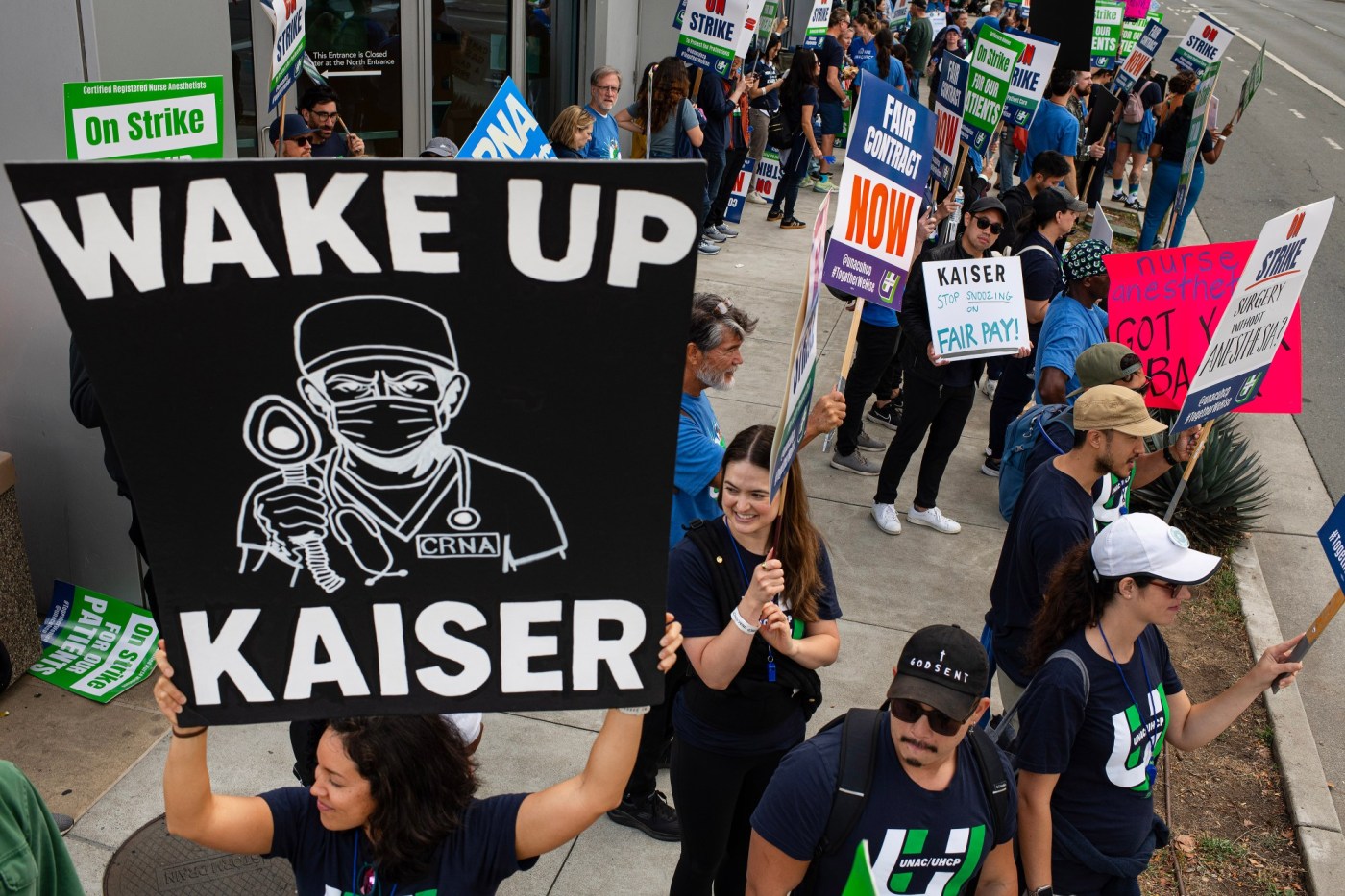
As 31,000 nurses and healthcare professionals prepare for an open-ended strike beginning Monday, Jan. 26 against Kaiser Permanente, the Oakland-based healthcare system says it has contingency plans in place to provide patient care at medical facilities in California and Hawaii.
In the days before the strike — the second since a five-day walkout last October — an independent mediator is helping iron out differences, while Kaiser has crafted its own plan to diminish the union’s bargaining swagger by suing to break up its national alliance.
The healthcare provider filed a lawsuit against the union and its alliance partners this week that would splinter the bargaining process into local contracts so that Kaiser can offer competing compensation packages in order to drive down costs.
Kaiser is also recruiting thousands of travel nurses to replace the striking workers, according to union officials and social media posts from nurses sharing their upcoming travel plans to California.
In a statement to the Southern California News Group, Kaiser said it “does not make sense to return to a (bargaining) process that has been stalled for months” with the union group that oversees the Western U.S. — called the United Nurses Associations of California / Union of Health Care Professionals, or UNAC/UHCP.
Liz Hawkins, a nurse and secretary for UNAC/UHCP, who has been sitting at the bargaining table with Kaiser since last spring, believes Kaiser is using the lawsuit as a strategy to reduce her union’s clout at the bargaining table.
“They’re saying they are under no obligation to bargain as a group,” Hawkins said. “They’ve pushed that national agreement to local conversations. We disagree with that.”
Also see: Kaiser strike ends without labor agreement for 31,000 healthcare workers
As of Sept. 30, 2025, Kaiser’s footprint, which covers the Western states where strikes wrapped up in October, also includes Colorado, Georgia, Maryland, Virginia and Washington, D.C. Nationwide, Kaiser has 608 medical offices and 40 hospitals.
In Southern California, where Kaiser operates its regional headquarters in Pasadena, the healthcare provider oversees 16 hospitals, 200 medical offices and 91,900 employees serving 4.9 million members. Northern California has nearly 91,500 employees at 21 hospitals and 203 medical offices serving 4.6 million members.
UNAC/UHCP is the largest of the 23 bargaining units in the Alliance of Health Care Unions, a federation of 23 local unions representing more than 60,000 Kaiser employees nationwide, formed to collectively bargain for wages, benefits, working conditions and patient care within Kaiser’s unique National Labor Management Partnership. That alliance is what Kaiser wants to break up.
The Kaiser Permanente suit, which was filed Wednesday, Jan. 21 in the U.S. District Court for the Central District of California in Los Angeles, alleges the alliance breached its obligations under the national bargaining agreement.
Also see: Kaiser affiliates will pay $556 million to settle a lawsuit alleging Medicare fraud
The suit also says the union has not bargained in good faith, and is “authorizing repeated strike and picketing actions over unreasonable wage increases” that would not ensure the affordability of healthcare for Kaiser members and the communities served. Kaiser’s lawsuit also cited an 83-page union report accusing it of “fraudulent practices, endangering the health and safety of its patients, and other unethical and unlawful activity.”
“We don’t see a path to an agreement through national bargaining,” said Kaiser in its statement on the lawsuit. “Because it has become clear that the national process is gridlocked, we are moving the remaining unresolved national issues to the local bargaining tables — the most effective and timely path to secure new contracts, wage increases, and enhanced benefits for our Alliance-represented employees.”
It is unclear what the lawsuit means for the upcoming strike and future negotiations between Kaiser and individual bargaining units in the alliance.
Meanwhile, Mark Ghaly, former state secretary of the Health and Human Services Agency from March 2019 to September 2024, was brought in as an independent mediator in the labor dispute last year as part of talks at the national level with the alliance, said Hal Ruddick, executive director of the Alliance of Health Care Unions. His fees are jointly shared through a labor management partnership trust, he said.
“I don’t intend to comment further on the details of his selection, qualifications and appointment, other than to say it was jointly agreed,” Ruddick said.
Ghaly has previous experience with Kaiser, having played a role in mediating a settlement in last year’s strike with Kaiser by 2,400 mental health workers.
Ghaly previously led the state’s health agency through the pandemic and spearheaded initiatives like CalRx, California’s initiative to provide affordable prescription drugs, and Master Plan for Aging, a 10-year blueprint launched in 2021 to restructure state services and policies to support older adults with disabilities and their caregivers.
Kaiser and the UNAC/UHCP are negotiating to replace a five-year contract that expired Sept. 30. The union is striking for higher wages and benefits and hiring more employees to fill staffing shortages. It initially sought a 38% pay hike over four years and is now seeking a 25% raise. Kaiser has offered a 21.5% pay hike over four years.
Travel nurses coming
The healthcare organization also is taking other steps to prepare for Monday’s strike.
Some pharmacies connected with the hospitals have temporarily closed, while Kaiser Permanente has already begun bringing nurses from out-of-state to fill open positions left by striking nurses at short-staffed medical facilities. Facebook pages like “Strike Nursing Network,” “Nurse Jobs” and “Strike Nurse” are filled with posts from nurses looking to compare pay, where to go when they arrive in California and when they’re expected to report to their assigned jobs.
Last October’s strike, the largest ever for Kaiser unions and first since 1980, began with the healthcare giant flying in thousands of replacement staff from around the country to fill critical patient care jobs.
Pay for those temporary workers ranged from $78-$130 an hour based on the job requirements, according to interviews with healthcare professionals who say they were retained by AMN Healthcare Services Inc., a Dallas-based temporary strike staffing company.
Some nurses interviewed in October by SCNG complained about delayed assignments for days, credentialing issues, sleeping on the lobby floor of the Hilton Los Angeles Airport along West Century Boulevard, and trouble finding a hotel room due to the crush of traveling nurses brought to the region by Kaiser.
“It was insane,” said 54-year-old Joani Bailey, a traveling nurse who drove in her GMC Arcadia SUV from northeastern Pennsylvania for the job. Almost immediately after reporting for her first assignment at the Hilton LAX, she and other nurses complained about glitches in the credentialing system that AMN requires in order to get a work assignment. Neither could she book a room as promised because the hotel was full.
“I was told to sleep at the Walmart (in Hawthorne). It was freezing,” said Bailey. “These strikers, I get why they are striking. If your granddaughter was in the hospital on a ventilator, wouldn’t you like a skilled nurse to help her?”
Potential disruptions
A Kaiser Permanente executive countered that the healthcare provider takes any potential disruption to services seriously, and that its patients are a top priority.
“If a strike occurs, we have established plans to ensure our members and patients continue to receive safe, high-quality care,” said Camille Applin-Jones, senior vice president for Kaiser Permanente Southern California, in a statement. “We hope our UNAC/UHCP represented employees will choose not to strike so we can resolve our differences at the bargaining table and remain focused on providing exceptional care to our members and patients.”
A Kaiser spokesman declined to comment on the use of travel nurses in the pending strike.
Frontline registered nurses and health professionals will picket at more than two dozen hospitals and more than 200 clinics — from Los Angeles and San Diego to Oakland and Honolulu.
In Southern California, picketing begins at Kaiser Permanente hospitals at 7 a.m. on Monday in Anaheim, Baldwin Park, Downey, Fontana, Irvine, Los Angeles, Ontario, Riverside, South Bay in Harbor City, West Los Angeles and Woodland Hills.


