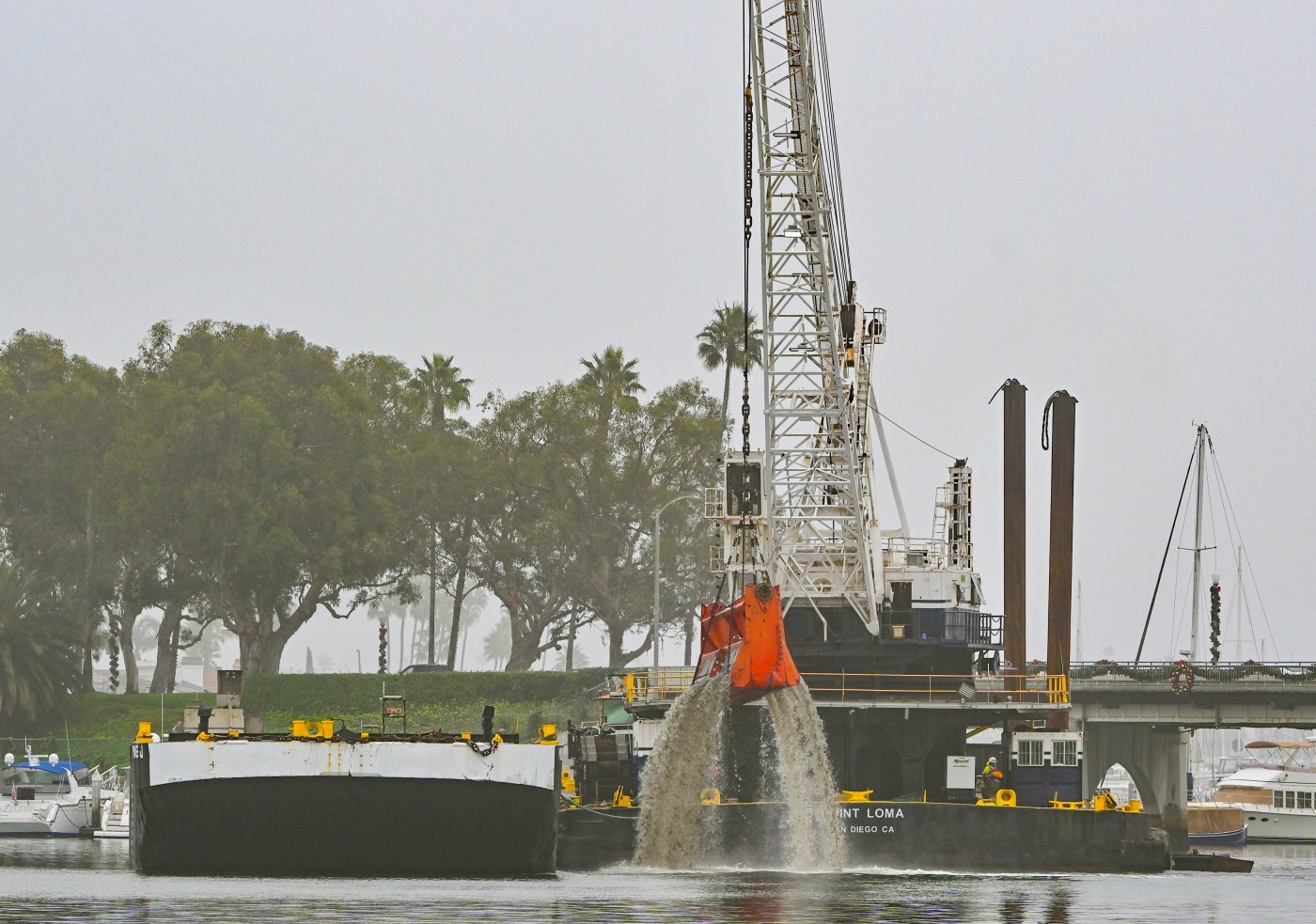
After nearly a decade of planning and delays, work to dredge sediment from the bottom of the Newport Harbor has begun.
The project, contracted through the U.S. Army Corps of Engineers and co-managed with the city of Newport Beach, will remove sediment that flows down the watershed and has built up through the decades to make navigation safer for boaters and help water quality throughout the harbor, officials said.


The dredging contractor R.E. Staite Engineering, Inc., which also did a similar dredging project in the harbor in 2012, started the effort late last week at the western tip of Lido Isle. The project is expected to take months to complete and cost an estimated $20 million.
The dredging will not impact the Newport Beach Christmas Boat Parade from Dec. 17 through Dec. 21, officials said. During the parade, the contractor will stop dredging at 4 p.m. and will relocate the dredge barge and equipment to one of the staging areas.
There could be temporary impacts to the commercial marina slips when the dredger is near those properties, but the contractor will work with those vessel owners to navigate around the work, according to the city.
Some vessels along Coast Highway extend well beyond the end of their slips and into the dredge footprint. The city is requesting that those vessels vacate their slips for the day while dredging occurs adjacent to those slips.
About 900,000 cubic yards of material will be dredged from the harbor floor over about 10 months. Most of the material will be disposed of offshore at an EPA-approved site six miles from the harbor entrance.
Dredging in the main channel areas is expected to expose some sediment that has been determined unsuitable for open ocean disposal and therefore requires an alternate disposal location, officials have said.
Those roughly 225,000 cubic yards of sediment that contain levels of mercury above the federal standard for ocean disposal will help fill a slip in an outer harbor container terminal at the Port of Long Beach. The material will be encapsulated within the existing slip to create additional shipping container storage.
The project was held up by lawsuits from environmental and local groups over where that contaminated sediment should be buried, until the solution was found at the Port of Long Beach.
Previously, a pit in the Newport Harbor was proposed for burying the contaminated sand with a cap of clean sediment to contain it. That plan had been approved by city officials and the California Coastal Commission.
Legal challenges by Orange County Coastkeeper and Friends of Newport Harbor questioned the proposal, and whether the covering layer would be thick enough to protect the water and surrounding wildlife from the potential escape of toxins if the sand were knocked loose by boat anchors.
The lawsuit was settled in March 2024 following the identification of the Long Beach port option, and as part of the agreement, there will be improved marine mammal and sea turtle monitoring to reduce environmental impacts.
The main channel has not been dredged to its original depth in 50 years. The latest effort is likely the last big dredging that will need to happen in the harbor because inland watersheds are managed better and less sediment flows down the waterways, officials have said.
When the sediment is dredged, an additional 370 million gallons of ocean water will be able to flow in and out, helping circulation and improving water quality.