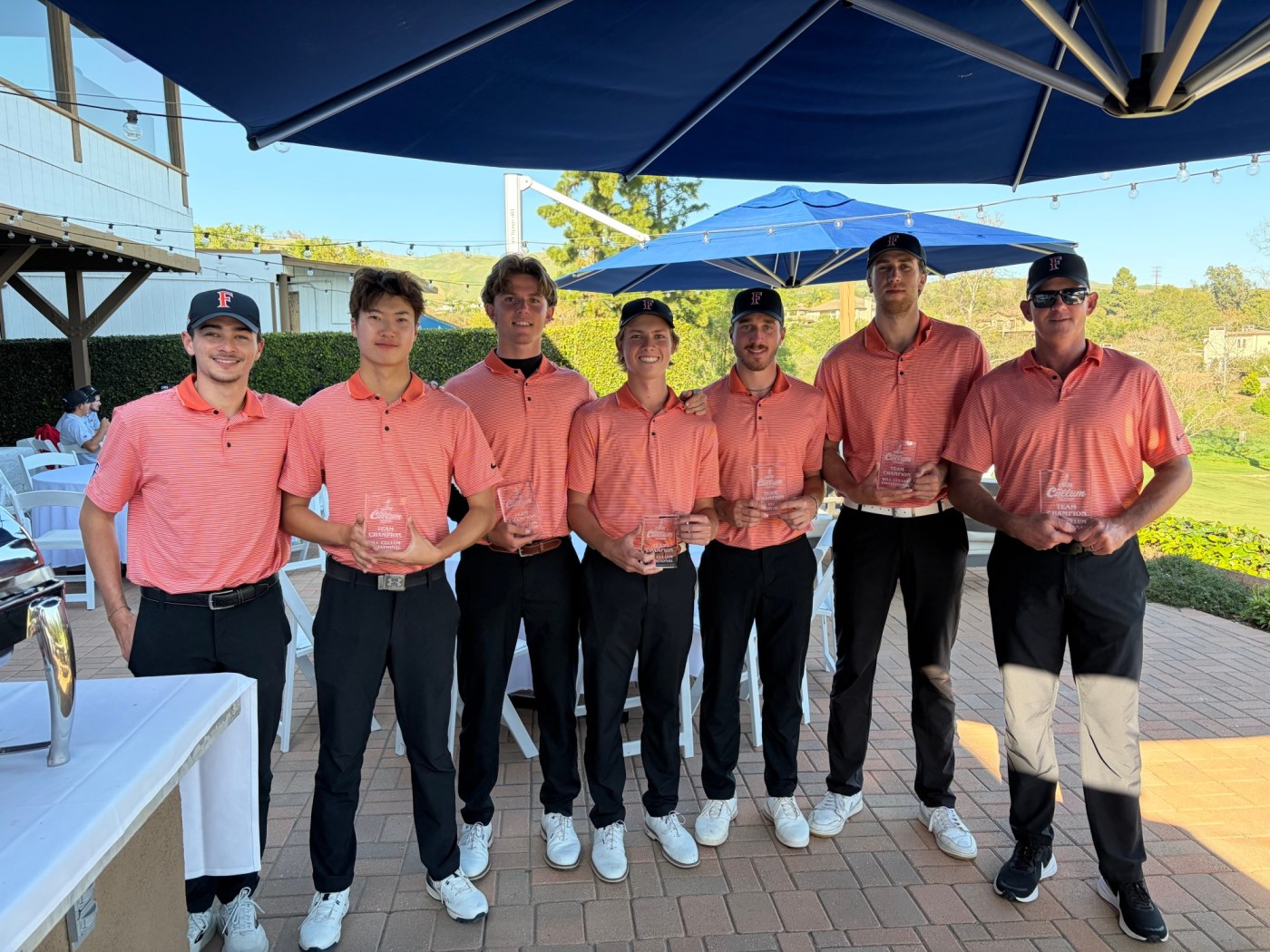
This time, Jason Drotter had a head start on being a tough guy. This time, unlike last year when he suffered through a 14th-place-out-of-15-teams finish out in the desert, the Cal State Fullerton men’s golf coach didn’t need an early-spring season tournament meltdown to bring down the hammer. This time, he knew when to formally declare war against his eternal nemesis — mental softness in his players.
No. The fall season, when the Titans finished last in the Big West, gave him all the proof he needed that even though this is a rebuilding year for the Titans, there are certain things Drotter can’t tolerate.
“Those are a couple of problems you simply can’t play with,” he said. “You can never get competitive if you’re just soft. And on top of that, we’re short hitters. You have a lack of physical strength and a lack of mental toughness, and you simply can’t be competitive in today’s golf with those two issues.”
So, after a 14th-place finish in the fall finale in Oregon, completing an autumn campaign where CSF finished 14th, 13th, 19th, and 13th in its four tournaments, Drotter had seen enough mentally soft déjà vu. He formulated an eight-hour-per-week training plan, gave it to the CSF training staff and turned them loose with one command: Make his players face adversity. And take no prisoners.
“I want you to push them to the edge. If someone’s not throwing up every day, you’re not working them hard enough,” he said.
“I challenged them, telling them, ‘If you don’t do this and if I find out one person who no-shows or doesn’t work hard, we won’t practice golf. We’ll run bleachers all day.’ But at the end of nine weeks, everyone showed up and worked hard. They all gained in their max reps on the bench-press and squats. They gained significant strength, and all of them lost body fat. They all gained weight and muscle, and the best part of it was they felt good about themselves. They were getting those beach muscles and those girl-chasing muscles.”
Those girl-chasing, beach muscles helped somewhat in the Titans’ spring-season opener, a one-stroke victory over Cal Poly San Luis Obispo on a difficult Saticoy Country Club course outside Ventura earlier this month. But Drotter credits a different muscle for the season-opening statement, one that featured top 10 finishes from sophomore Will Tanaka (third) and senior Giacomo Comerio (seventh).
The one between the ears.
“I’m proud of them, but on that golf course, you can outcoach the course. Saticoy is a very difficult golf course; it’s short, tight, and the greens are very fast,” he said. “I put together a course-management plan that was statistically correct and told them to follow it to a T. You can eliminate half the field if you play it correctly. If we do those things, follow the plan and deal with the adversity that comes on that course, we’ll be competitive. And we won.”
Make no mistake. As Drotter pointed out, this year’s Titans are a team in transition. Gone are leaders like Tegan Andrews, the 2024 Big West Individual Champion and two-time All-Big West First Team selection, and Matt Schaefer, who is now the Titans’ assistant coach. Gone is a lot of the raw distance off the tee that is a hallmark of 21st century college golf at every level. The 2026 Titans don’t have the players who can overpower some of the courses they’re going to see — like Palm Desert’s Classic Club, the site of their next tournament this week and the impetus last year for Drotter’s initial golfer boot camp. They are going to have to lean in on the power of the mind and that mental toughness Drotter endlessly espouses with the fervency of a TV preacher on a pledge drive.
“We don’t have a team of bombers who can hit it 300 yards and relatively straight, but we are getting tougher mentally,” Drotter said. “We are getting smarter on the golf course, and some of the younger guys are maturing as players and maturing as people. I feel like we’re heading in the right direction, but I had to make a serious U-turn in the fall.”
Leading that U-turn were two players who played strong supporting roles behind Andrews last year: Tanaka and Comerio. Both earned Big West Honorable Mention selections in their first year as Titans. They racked up T5 finishes with Andrews at the Big West Tournament last year, earning their second top 10 finishes of the season and finishing with near-identical stroke averages: 73.7 for Tanaka and 73.9 for Comerio.
Tanaka added 15 yards to his game, along with a higher trajectory that helps enhance his strong short game and putting skills. Along with that, Drotter said, came better course management skills that should eliminate the low-percentage, try-to-be-a-hero shots Tanaka was prone to as a freshman.
“That’s why you’re starting to see him get more competitive,” Drotter said. “He’s a tough kid who will give you everything he has. … Will is going to be solid. My expectation is after this two-year rebuild, Will is going to be the face of this program his senior year. He’s got that kind of talent, his game is maturing, and if we can get him to gain some length, he’s going to be a stud.”
Comerio is the latest iteration of the grinder on which Drotter built the Titans’ program: a hard-working, do-a-bit-of-everything-good fighter who makes up for his deficiencies with a tenacity that belies where he is on the course. You never doubt his ability to steal strokes, whether he’s 4-over or 4-under-par. He spent the offseason undergoing what Drotter described as “massive intense changes in his swing” that paid off with his seventh-place finish at Saticoy.
After those two, the question marks multiply. There’s junior Shibo Wang, a transfer from Division III University of Rochester, who was the Liberty League Player of the Year last year. Drotter said he has the best mechanics and talent on the team but poses a challenge buying into Drotter’s system.
“If I can get him to commit to playing statistically correct golf, and if I can get him to get more serious in the gym, I feel like he’s going to be pretty good. If I can get through to him, he has a good chance at being a good player,” Drotter said.
There’s redshirt senior Brenden Ashman, who has struggled to break into the lineup his entire CSF career, playing in six tournaments in his four seasons. Drotter said this is the year Ashman should finally put everything together and harness the potential he’s shown various times. If for no other reason than Ashman is one of the Titans’ few bombers off the tee.
There’s a lot of “there” there with this edition of the Titans. There’s also a lot of “if” there. But it behooves you to remember what happened the last time Drotter went thermonuclear on his team’s mental game deficiencies. And it happened last year — right around, well, now.
The Titans wound up the 2025 season second in the conference, claiming a win and six top 10 finishes.