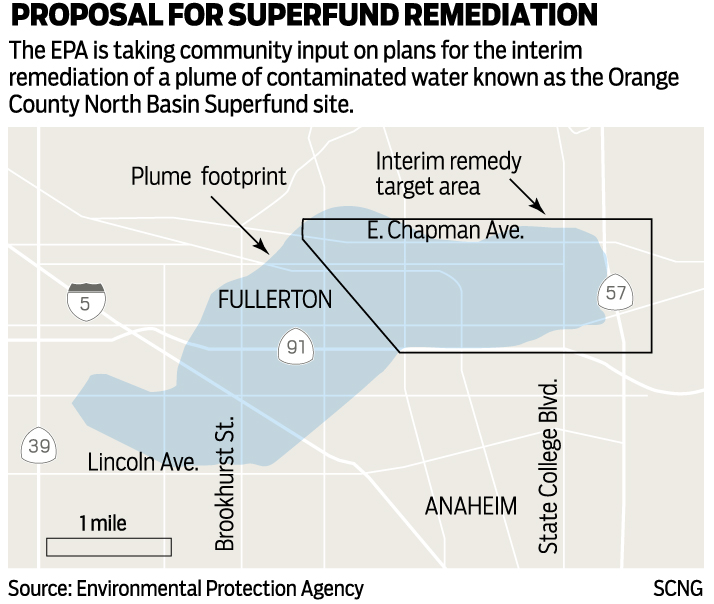
The U.S. Environmental Protection Agency is seeking public feedback on its options for cleaning up, at least in the interim, the Orange County North Basin Superfund site, where a large plume of contaminated groundwater continues to spread beneath Fullerton and Anaheim and has most recently reached into Buena Park.
Extending more than six miles long and a mile wide, the plume contains harmful volatile organic compounds resulting from decades of degreasing solvents used in local manufacturing from the 1950s through the early 1980s. In 2020, the area made the list of federal Superfund projects — a program for addressing some of the nation’s most contaminated hazardous waste sites — and has been added to the EPA’s National Priorities List, because the contamination directly affects drinking water.
About 22 cities, through the Orange County Water District, rely on the North Basin for roughly 85% of their drinking water. Six drinking water wells have already been removed from service because of the groundwater contamination, including chemicals associated with increased cancer risk, such as tetrachloroethylene, also known as PCE. But officials emphasized that the drinking water currently being served is from outside the plume and meets state and federal drinking water standards.
“The plume is continuing to migrate. It’s getting larger and deeper into zones used for drinking water production,” said Dave Mark, a principal hydrogeologist at the Orange County Water District. “It’s important that this plume be addressed so we don’t lose more wells.”
“If more wells are lost, water producers would either need to buy more imported water or build expensive treatment plants. Either option raises costs for ratepayers,” he added.
The groundwater plume spans in the basin from roughly near the 57 on the west to Chapman and Commonwealth avenues to the north, Lincoln Avenue to the south, and Magnolia Avenue to the east.
“We want to protect Southern California groundwater since it’s such an important resource,” EPA Remedial Project Manager Amanda Cruz said.
Cruz said the Orange County North Basin has “always been a very high priority site within the agency” and described the cleanup timeline as “lightning fast,” given the typically lengthy process. “The fact that we’re here with such a large project is a testament to how dedicated everyone is.”
“This is one of the fastest times we’ve gone from listing to interim proposed plan,” she added.
EPA officials plan to focus on targeting areas with the highest concentrations of contaminated groundwater, with the goal of preventing further spread. Treating the plume underground isn’t feasible, officials said, because of the size of the area and physical limitations, among other reasons. The four options considered available rely on extracting the groundwater and treating it using existing facilities or building a new plant, but vary in how that is accomplished. There are also monitoring plans.
The estimated cost ranges between $234 milllion and $301 million.
The agency said it will consider comments from the community that can be shared at three upcoming public meetings later this month before deciding how to move forward.
- Wednesday, Jan. 21, 2026 (6–7 p.m.) Buena Park Community Center, 6688 Beach Blvd., Buena Park
- Thursday, Jan. 22, 2026 (5:30–7:30 p.m.) Fullerton Community Center, 340 W. Commonwealth Ave., Fullerton
- Thursday, Jan. 29, 2026 (5–7 p.m.) Brookhurst Community Center, 2271 Crescent Ave., Anaheim
David Feldman, a UC Irvine professor specializing in water resource management and policy, said the shutdown of the affected wells was largely precautionary, aimed at minimizing potential exposure. He credited the Orange County Water District with taking a proactive approach to groundwater management, including the use of recycled wastewater for drinking.
“That’s really why this issue has come to the forefront,” Feldman said. “Because regulators and water providers are trying to be as vigilant as possible to protect the public’s health and well-being.”