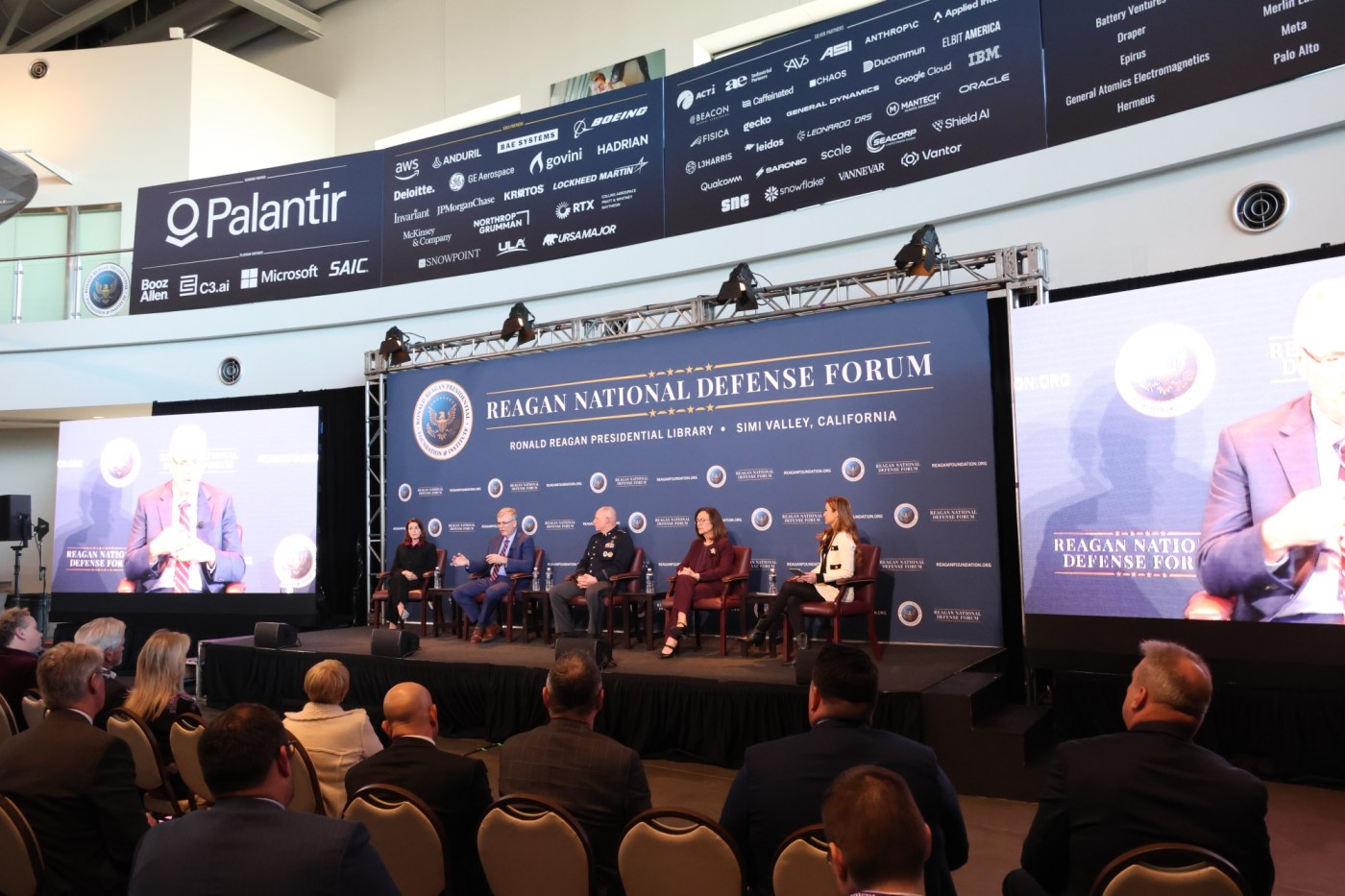
Elements of President Donald Trump‘s envisioned Golden Dome, a complex air and missile defense shield under development to protect the United States, emerged at this weekend’s Reagan National Defense Forum, and its reality might not be that far off.
“It will not be the final capability, but we will have the ability to protect and defend the nation against advanced threats by the summer of 2028,” Space Force Gen. Michael Guetlein said during a panel discussion on Saturday at the Ronald Reagan Presidential Library in Simi Valley. Guetlein’s comments, though limited, were his first in public since taking over the missile program earlier this year.
“We believe we have a solid plan and we’re on a good trajectory,” Guetlein said.
“It’s not a ‘gimme putt,’” he said, referring to a golf term about what would be considered an unmissable shot. “It’s extremely complex and a lot of risk that we’re trying to get after and mitigate.”

While in the past, the U.S. has relied heavily on the vastness of the oceans to keep the nation safe and taken the fight to the enemy, that scenario is increasingly less relevant, Guetlein said.
“We don’t have a lot of ability to defend ourselves, which makes deterrence by denial a challenge,” he said during the defense forum panel that included Sen. Deb Fischer of Nebraska, Secretary of the Air Force Troy Meink and Kathy Warden, chair and CEO of Northrop Grumman. “Golden Dome is about changing that equation.”
To get the vast, layered systems up and running, Guetlein said it will require collaboration with defense and technical companies nationwide. Southern California, which has a storied history of space and aerospace innovation, will again be at the forefront of the next generation of space superiority, experts say, with many of its companies involved in components and technology of the ambitious project.
“As the full vision of the Golden Dome project comes into focus and implementation, I think we’ll continue to see those important contributions from our region,” said Rep. Ken Calvert, R-Corona, who chairs the Defense Appropriations Subcommittee and spoke at the forum. “New and small tech companies, including many in Southern California, are advancing some of the most exciting innovations in the defense realm.”

Golden Dome, introduced by Trump’s executive order in January, would not only protect the contiguous 48 states, but also Hawaii, Alaska and U.S. possessions and close allies, military officials have said.
The concept is based on Israel’s Iron Dome, which, in geographic terms, covers about half the territory the Golden Dome would cover, experts said. Its goal is to defend the homeland against ballistic, hypersonic and cruise missile threats and drones.
Guetlein, who was previously commander for Space Systems at the Los Angeles Air Force Base, said the Pentagon is collaborating more now with defense and technology firms, along with national labs, to develop the next generation of technology needed to build the Golden Dome.
Tapping into the nation’s engineering and innovative talent, especially in Southern California, won’t be hard to do, Matt Magana, president of Voyager Technologies’ space, defense & national security division, said in an email. The San Deigo company is involved in the Starlab Space Joint Venture and also artificial intelligence for military uses, among other innovations.
“From the South Bay aerospace corridor to ‘Space Beach’ in Long Beach and down to innovative companies in San Diego, Southern California combines deep engineering talent, mission heritage, manufacturing scale, and proximity to the Department of War that few places can match,” Magana said.
“Space superiority is no longer just about launch or satellites in isolation; it’s about integrated systems like propulsion and maneuverability, resilient communications, advanced electronics, AI-enabled sensing and rapid mission execution across domains,” he said. “We’re not just a historic center of gravity, but a forward-looking hub for the next generation of space superiority.”
“Golden Dome is exactly the type of capability Voyager was designed to deliver,” Magana said.
Magana said his company’s conversations with defense leaders and lawmakers “are focused on how commercial innovation can be integrated quickly and responsibly into national programs, strengthening readiness while building durable, U.S.-based industrial capacity.”
Defense Secretary Pete Hegseth emphasized the need to get more industry involved in the Golden Dome and other U.S. defense initiatives in his keynote address to the hundreds of forum attendees at the Reagan Library on Saturday, where he laid out the pillars of Trump’s national security focus.
“Supercharging America’s defense industrial base underwrites all other lines of effort,” Hegseth said. “Our objective is simple, if monumental: transform the entire acquisition system to rapidly accelerate the fielding of capabilities and focus on results.”

Hegseth said the key to that objective is moving away from the current, prime contractor-dominated, low-competition defense industrial base to “a future powered by dynamic vendor space that accelerates production by combining investment at a commercial pace, with the uniquely American ability to scale and scale quickly.”
Hegseth visited Anduril Industries, headquartered in Costa Mesa, ahead of his appearance at the defense forum.
While, Chris Brose, president and chief strategy officer for Anduril, didn’t give specifics of how the company might be involved with the Golden Dome during a panel Saturday on “Funding the Force,” he praised efforts by Calvert on the House Appropriations Subcommittee on Defense to create a path where commercial off-the-shelf technology can more quickly be offered, with less bureaucracy, for military use.
Brose, who before moving to Anduril served as staff director for the Senate Armed Services Committee, said that because of Calvert’s emphasis on helping tech companies navigate the Department of Defense, Anduril has “multiple programs” they are doing that might otherwise never have happened.
He also gave a huge vote of confidence to the Golden Dome project, saying that a focus on protecting the homeland is a “long time coming.”

“For the first time in a long time, we have adversaries with the capability that can range and strike the homeland,” he said. “Our missile defense system is archaic. (Golden Dome) is an example of a good idea that we need to get moving on.”
He said the estimates that it would cost $200 billion to $250 billion are inflated.
“I think it’s several billion,” he said. “I think it’s something that can be fielded predominantly on this president’s watch, and I think the country will be better for it.”
Josh Martin, vice president of government affairs for Varda Space Industries, headquartered in El Segundo, said he was very interested in hearing Guetlein outline some of the details of the Golden Dome project and sees opportunities for his company.
“Considering we are already supporting other DOD programs to test hypersonic systems, there could be a role to play for Golden Dome,” Martin said.
And while Southern California will help with the project’s development, the region itself — because of its industrial base and all the military installations — will always be a high-value target for adversaries, Calvert added.
“That’s only heightened in the upcoming years as we host the World Cup and Olympics,” he said in an email. “Nothing is more important than keeping our citizens safe.”