Here’s a bit of advice from grunion guru Jim Serpa: Don’t give up.
“If they don’t run, wait an hour more. They almost always run early in the season,” said Serpa, a retired State Parks ranger who for decades has run a grunion program out of Doheny State Beach in Dana Point. “Just hunker down and wait.”
Grunion season kicks off this week with the year’s first “run,” when little silver critters surf up onto the sand during a mating ritual that gives a rare look at the fish out of water, literally. Wednesday’s run is expected between 10 p.m. and midnight; Thursday and Friday’s runs should be 25 minutes later each night.
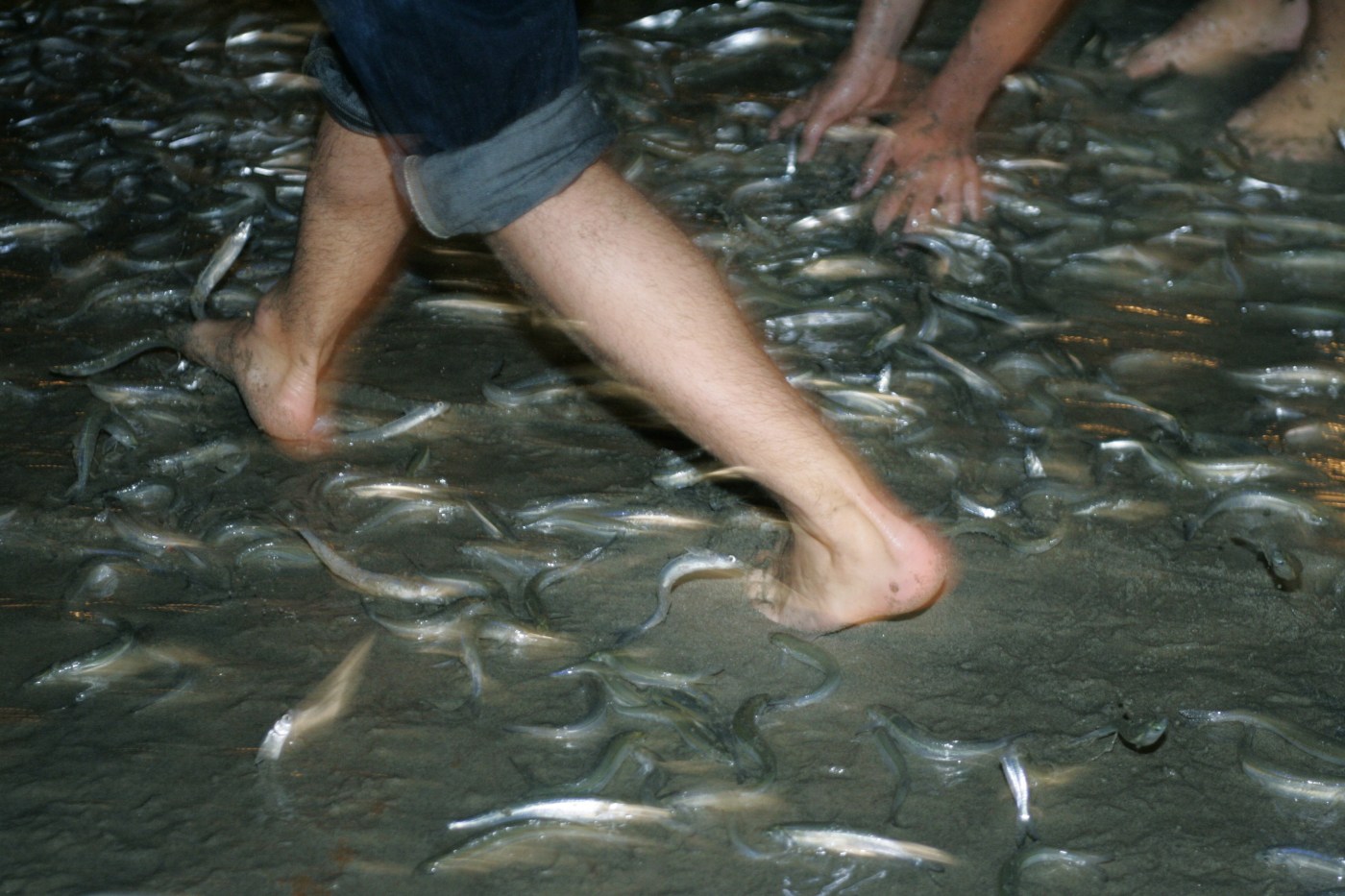
The grunion mate on the sand during a two-hour window only on certain nights throughout the year, based on the moon and tides. It is a phenomenon unique to Southern California.
For the generations who have sought out the late-night sight, it’s an up-close marine biology lesson on the sand.
“The beach is alive with wiggling little silver fish; it is amazing to see,” Serpa said. “Everyone has giant smiles on their face, they can’t believe it. It’s always fun.”
For those who want to dive deeper into the fascinating creature, gatherings and discussions throughout the year will delve more into their lives in and out of the water. The Cabrillo Aquarium in San Pedro has select grunion nights with auditorium discussions and guided observation at the beach. Pepperdine University has a “Grunion Greeter” program for citizen scientists to report on grunion behavior.


Serpa will again spearhead a gathering in June at Doheny State Beach in Dana Point, though a time and date are still being worked out. Typically, he has a show-and-tell where seawater and eggs are shaken so the babies hatch out.
Nona Reimer, a naturalist and grunion greeter, has long had a fascination with the little sea creatures that work so hard to lay their eggs on the sand.
“These little fish (are) the only ones we know that have to come ashore and lay their eggs on the shore. We know turtles do that,” she said. “They are just so unique; they are only found here on the Southern California coast.”
Reimer remembers going down to the beach as a child to see the grunion, and now likes to educate the next generation of youngsters who show up to see them. She said she makes sure to gently remind them, as they are grabbing females laying eggs, to give the fish a bit more time to finish their process.
The grunion runs happen only during high tides on select, sandy beaches — and only if they feel safe enough to come on shore.
Sometimes, they come up on the sand in the thousands; other times, just a few dozen. Sometimes they are an hour or two late, other times they don’t show up at all.
When they do show up, they create a silver blanket of slimy fish wiggling and flopping around on the sand.
March and July are open seasons, meaning grunion may be taken by hand, but anyone older than 16 will need a fishing license. The months of April, May and June are closed seasons, when grunion may be observed but not touched.
The closures are important, Reimer said, to help preserve the species. Data collected over the years showed their numbers dwindling.
“We want to give them the opportunity to build up the population of grunion around here,” she said. “With all living creatures, if we don’t collect the data over time and collect trends, we won’t know how the population is doing.”
Doheny Beach is a known hot spot that draws crowds because it has a soft sloping bottom and has protection from a nearby jetty and the harbor that keeps big waves away.
The female grunion burrows her body into the sand and lays her eggs. Then, the male is washed up and fertilizes the eggs. The eggs stay buried under dry sand for a few weeks until the next full moon cycle brings higher tides again, the wave action moving the eggs around to help the babies hatch.
Serpa said he has seen a lot of “signs” in recent days that grunion are waiting just offshore for the right time — birds bombing the ocean’s surface for a feast is an indication.
The California Department of Fish and Wildlife offers a few hints for successful grunion observing, including going to uncrowded beaches. Flashlights should be used sparingly because light may scare the fish away, and they will not come out of the water.
“Finally, plan to stay late. Many people quit an hour after high tide and miss a good run,” officials said. “To be invited out in the middle of the night to go and watch fish does sound a little ridiculous, but in reality, this is the only way to observe this natural phenomenon.”
About the grunion
- Their average length is between 5 and 6 inches.
- Early Spanish settlers called this fish grunion, which means grunter.
- Grunion are known to make a faint squeaking noise while spawning.
- The spawning season extends from late February or early March to August or early September, varying slightly in length from year to year.
- Larger females are capable of producing up to 3,000 eggs every two weeks. As the mature eggs are deposited in the sand, another group of eggs is developing that will be spawned during the next series of runs. This cycle continues throughout the season.
- Grunion may be taken by hand only — no appliances of any kind may be used, and no holes may be dug in the beach to entrap them. During the open season, the daily bag and possession limit is 30 grunion per person.
- Some of the beaches in Southern California that are known to have runs are Malibu, Santa Monica, Venice, Hermosa Beach, Cabrillo Beach, Long Beach, Belmont Shore, Seal Beach, Huntington Beach, Newport Beach, Corona del Mar, Doheny Beach, Del Mar, La Jolla, Mission Beach and the Coronado Strand.
- Source: CDFW