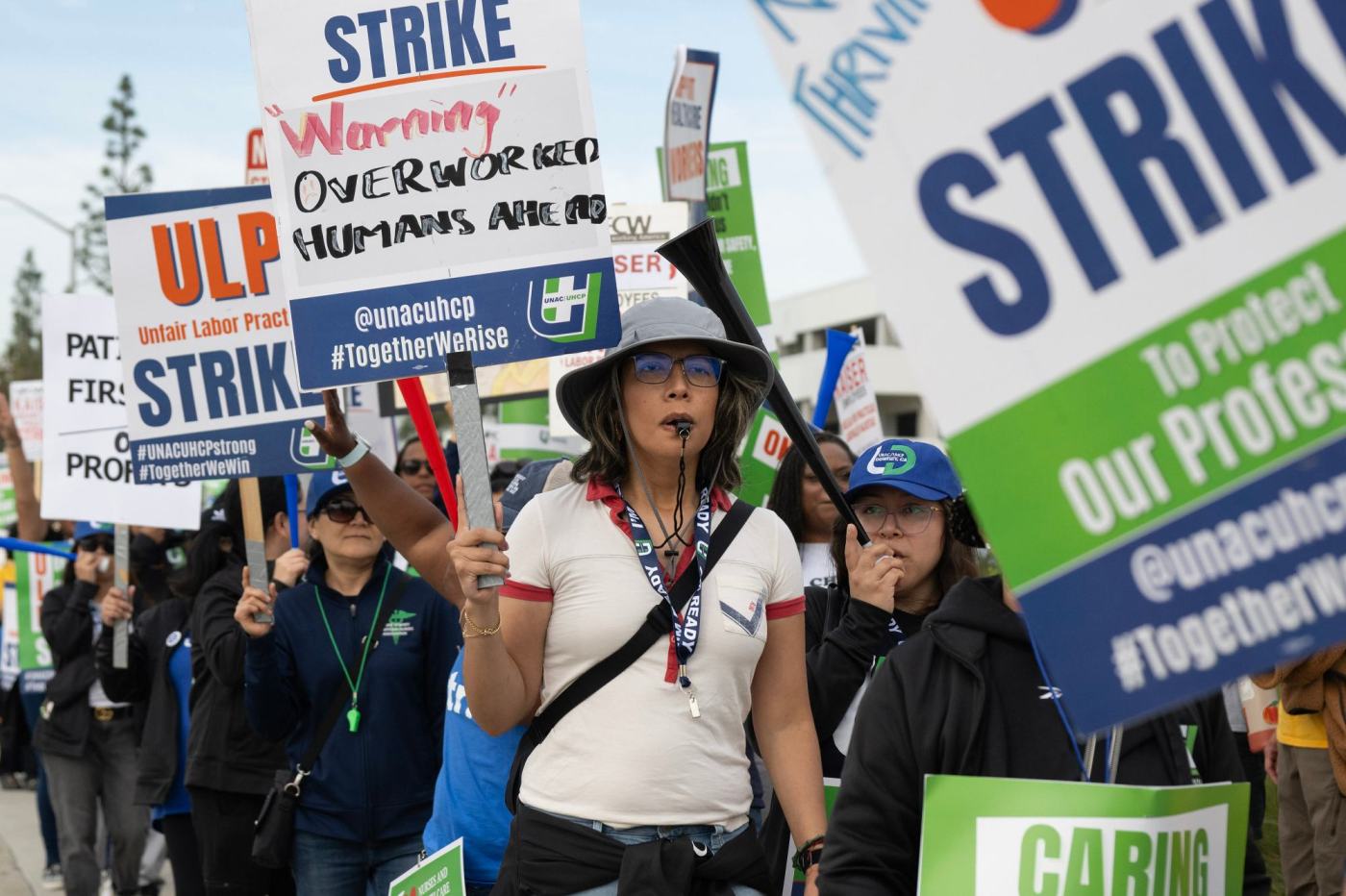
As the strike at Kaiser Permanente expands to include thousands more workers in its third week, union representatives for 34,000 employees and the health care giant remain far apart on the issues, leaving patients in a lurch.
Michael Nestor, a retired emergency room doctor with Kaiser, is upset with the company’s entire medical system. The 74-year-old Huntington Beach resident suffers from two medical conditions he characterizes as life-threatening. Neither is being treated urgently as the strike continues.
“I don’t deserve to die like this. It’s a horrible way to treat me,” Nestor said in a phone interview Monday. “How does an urgent surgery like mine get canceled?”
On Feb. 3, a few days after the strike began, a surgical procedure to remove a growth blocking his airway was postponed due to staff shortages at the Kaiser hospital in Baldwin Park — where it was scheduled after Kaiser’s Irvine hospital initially refused to take the operation, he said. That surgery has since been rescheduled for this week in Irvine.
An alliance of some 31,000 workers — the United Nurses Association of California/Union of Health Care Professionals — walked off the job on Jan. 26. The strike is open-ended until the healthcare giant and union alliance reach a contract agreement.
In the past week, Kaiser reported that some of its pharmacies and labs were temporarily closed due to the strike.
The Oakland-based healthcare giant this week said that more than 35% of the striking nurses and healthcare professionals — or just under 8,000 — have returned to work, with as many as 55% of strike staff back at work in some locations.
Kaiser spokesman Terry Kanakri declined to identify the medical facilities where the highest volume of returning workers are located.
The union disputed Kaiser’s claims that its members had crossed picket lines and returned to work, but had not responded Monday afternoon to requests on its estimate of workers who have returned — some of whom talked about the financial hardships of striking last week.
Kaiser also claims that some of the striking employees are afraid to return to work, as they are being threatened by their union with fines.


“That claim is false,” according to a UNAC/UHCP statement. “Our union has not threatened, intimidated, or retaliated against caregivers. Suggesting otherwise is inaccurate and designed to create fear and confusion rather than address the conditions that forced caregivers to take this lawful action.”
Claudia Mayorga, a pharmacy assistant at a Kaiser facility on Dalen Street in Downey, doesn’t buy Kaiser’s claims that striking nurses are returning to work.
“I haven’t heard anything like that happening in our facility,” said Mayorga, who joined the strike this week. “No one has crossed picket lines. The strike is important for all of us, for our future. I’m very disappointed that Kaiser isn’t coming to the bargaining table.”
The central refilling facility where she works employs roughly 200 people and handles mail orders and other prescription refill orders for Kaiser facilities in the western United States.
Also see: 3,000 pharmacy and lab workers will join Kaiser’s nurses strike
Ahead of the walkout by 3,000 pharmacy and lab workers represented by the United Food and Commercial Workers on Monday, Kaiser sent out text messages to its members in California and Hawaii saying the strike would affect lab services and cause delays in patient care.
Some members have become frustrated with long lines forming at the Kaiser pharmacies.
One interaction shared in a TikTok video posted last week showed a pharmacy customer questioning a Kaiser employee at the Riverside Kaiser pharmacy in an exchange that grew so tense a security guard was called to calm the situation. Another video on Instagram at Kaiser Baldwin Park showed long lines at the facility’s pharmacy.
Also see: Nurses dig into rainy day funds to keep Kaiser strike going
The striking UFCW locals in Southern California, who gave a 10-day notice of their intent to strike on Jan. 29, represent Kaiser employees who work as pharmacy assistants, pharmacy technicians, clinical lab scientists, medical lab technicians, and clinical and administrative workers at Southern California medical facilities.
The contract covering UFCW pharmacy employees in the region expired Nov. 1, while the contract covering UFCW clinical and medical laboratory specialists expired Feb. 1.
Kaiser and the UNAC/UHCP are negotiating to replace a five-year contract for 31,000 members that expired Sept. 30. The union is striking for higher wages and benefits, and wants more employees hired to fill staffing shortages. It initially sought a 38% pay hike over four years and is now seeking a 25% raise. Kaiser has offered a 21.5% hike over four years.
