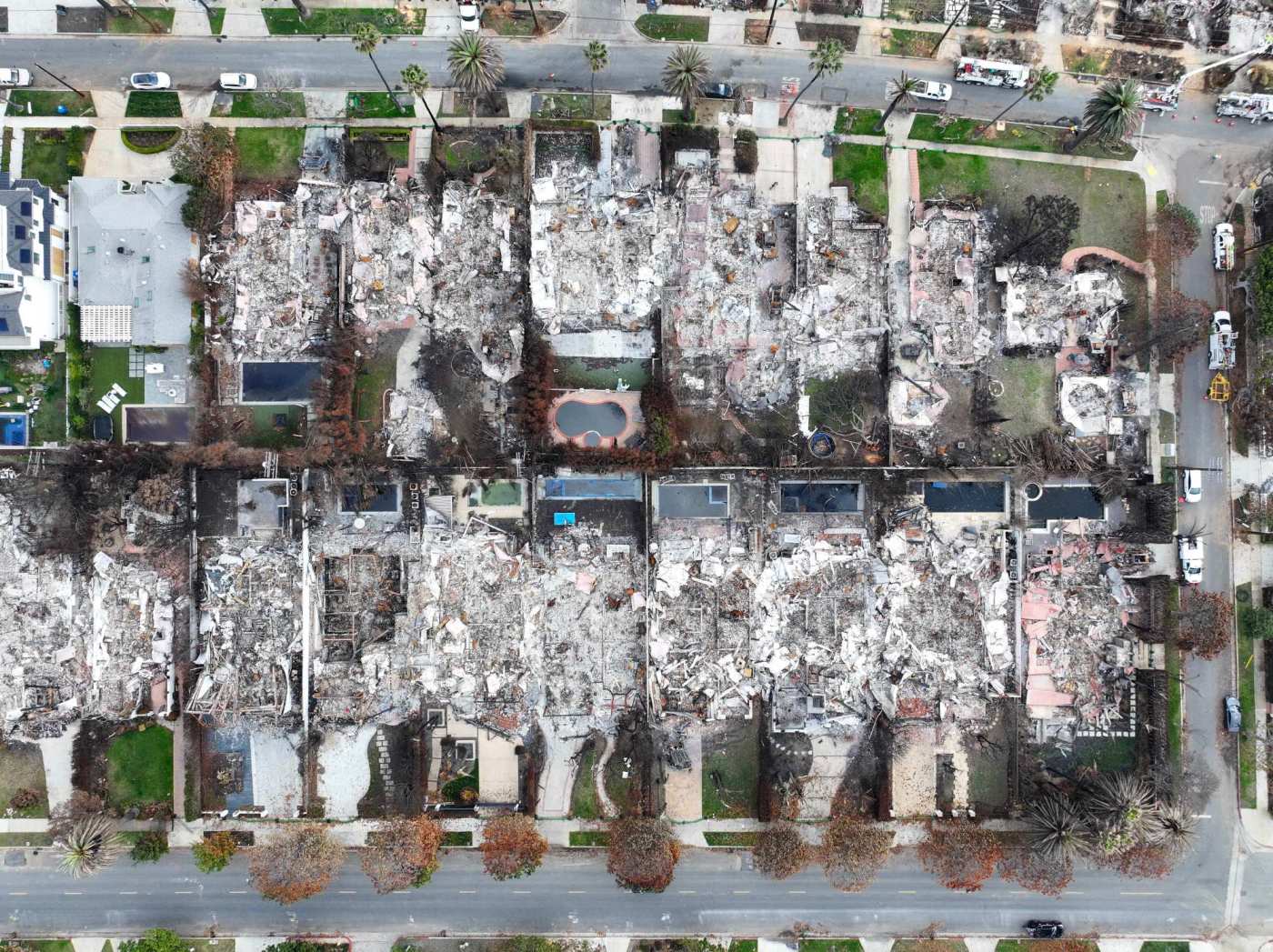
Billions of dollars have flowed into the Los Angeles area since the January 2025 wildfires exploded across the region.
The precise figure is difficult to quantify, but the money has come from nonprofits, federal agencies and local governments and higher insurance premiums sought by providers to cover losses and pay out claims to rebuild from the firestorms.
Then there’s litigation and regulation that could drive the payout even higher — or lower — depending on fate of lawsuits and the red tape-making before state agencies that are drafting administrative rules.
In the Los Angeles area, the U.S. Small Business Administration and Federal Emergency Management Agency have pumped billions into disaster assistance recovery, along with the city and county of Los Angeles, and the state.
A year ago, shortly after the fires, Gov. Gavin Newsom signed two bills sending $2.5 billion in disaster assistance to jumpstart recovery and rebuilding in the L.A. area. As of Dec. 15, the Los Angeles County Department of Economic Opportunity awarded $23.4 million to small businesses, nonprofits and workers in wildfire areas.
It’s difficult to say how much money may come to the region. After all, the economic impact of the Los Angeles wildfires could range between $76 billion and $131 billion, with insured losses estimated up to $45 billion, according to a report from the UCLA Anderson School of Management.
As of Dec. 9, 2025, the SBA has offered $3.1 billion to individuals and businesses affected in the Pacific Palisades and Altadena areas, with $790.5 million disbursed to more than 8,903 applicants at an average loan size of $88,789, according to figures provided by Corey Williams, a spokesman for the SBA’s office of Disaster Recovery and Resilience in Citrus Heights.
SBA offered three kinds of disaster loans: home disaster loans, business physical disaster loans and economic injury disaster loans. The loans helped small businesses meet financial obligations that can’t be met as a direct result of the disaster, and replace inventory, real estate and machinery. The agency also offered loans to homeowners or renters to repair or replace disaster-damaged real estate, cars and personal property.
Homeowners applied to borrow up to $500,000 while renters could go seek up to $100,000 to replace or repair personal property like clothing, furniture, cars and appliances damaged in the disaster.
As of Dec. 15. 2025, FEMA also has offered billions in assistance, according to Brady Penn, a Region 9 spokesman in Oakland. The disaster agency has provided money for:
- Debris removal: $2.4 billion to the Environmental Protection Agency and U.S. Army Corps of Engineers. The federal debris removal mission removed nearly 2.7 million tons of debris, or 228,000 truckloads from the burn areas.
- Individual assistance program: Nearly $163 million went to 35,000 households in the burn areas to assist with necessary repairs and housing and “other urgent needs.”
- Public assistance: FEMA has received requests from 133 applicants with estimated funding of “hundreds of millions of dollars” to reimburse state and local government agencies as well as certain nonprofits and houses of worship for their eligible disaster response and recovery costs. A determination on funding is expected by early 2026, Penn said.
Other funding areas affecting the region since the January 2025 wildfires include:
Philanthropy
- FireAid: The nonprofit, which was created in response to the January 2025 wildfires to prove relief to the victims, raised about $100 million and has distributed $75 million in grants to more than 170 frontline nonprofits, schools and community organizations.
- California Community Foundation: Since the launch of the Los Angeles-based nonprofit after the wildfires, the foundation has raised more than $100 million for fire victims.
- Milken Institute: The Santa Monica nonprofit, in a newly released Jan. 5 report, estimates charitable commitments to relief and recovery for the Los Angeles area fires amounted to $860 million to $970 million in 2025.
Insurers raising rates
Following the January fires, six of the top 10 insurers in California sought to increase their rates for homeowners by $1.614 billion as of Dec. 18, 2025.
This does not include a rate hike of 35.8% sought by the Fair Access Insurance Requirements Plan, or FAIR Plan, filed Sept. 29 with state regulators. The FAIR Plan provides basic fire insurance as an provider of last resort for homeowners and businesses unable to find coverage in the standard market, particularly in high-risk wildfire zones.
Insurance costs under the FAIR Plan would increase for about four in five of the plan’s more than 550,000 homeowner policies across California, according to FAIR’s regulatory filing. The large majority of rate hikes would range from 5% to 60%.
The remaining roughly 97,000 policyholders would see a rate cut, with most deductions no more than 50%. If approved by the state insurance department, the changes could go into effect as soon as April 1, 2026.
A list provided by Consumer Watchdog, drawn from data maintained by the National Association of Insurance Commissioners, shows the following requests for pending rate hikes:
- California Automobile Insurance Co. filed Aug. 15, 2025 for a 6.9% rate change to collect an additional $85.3 million from homeowners.
- California State Automobile Association filed Aug. 26, 2025 for a 6.99% rate change to collect an additional $71.46 million.
- United Services Automobile Association filed Sept. 22, 2025 for a 6.9% rate change for $156.7 million.
- Pacific Specialty Insurance Co filed Aug. 28, 2025 for a 6.8% rate change for $11.8 million.
- Farmers Insurance Group filed Nov. 21, 2025, for a 6.99% rate change, for $150.49 million.
- State Farm General filed June 28, 2025 for a 31.4% rate change for $1.13 billion. This is separate from State Farm’s emergency 17% rate increase for homeowners approved in May. That hike was made contingent on State Farm meeting conditions like a cash infusion and stopping non-renewals. State Farm also received an immediate $400 million cash infusion from its parent company to address its serious financial condition.
Four of the 10 top insurers have not filed rate increases: Costa Mesa-based Interinsurance Exchange of the Automobile Club, Allstate Insurance Co., Standard Fire Insurance Co. (Travelers) and General Insurance Co. of America (American Family Insurance).
Major litigation and regulation
The wildfires led to multiple lawsuits and major changes in the regulation of insurance in the state, including the following:
FAIR Plan: In July, the Los Angeles-based nonprofit Consumer Watchdog filed a suit against state Insurance Commissioner Ricardo Lara to prevent insurance companies from charging homeowners across the state for losses from the FAIR Plan. Consumer Watchdog alleges that Lara’s controversial plan permitted insurance companies to impose wildfire-related surcharges on homeowners and businesses — even though those costs are supposed to be shared among insurers, not policyholders — under state law.
The court rejected the department’s attempt to throw out the core of the lawsuit, finding that Consumer Watchdog may proceed with its claim that the pass-through surcharges violate California’s FAIR Plan statutes. A hearing is set for summer 2026.
In February, the insurance department agreed to allow the FAIR Plan to collect $1 billion in emergency payments from other insurers, who are expected to pass on a significant portion of those costs to policyholders statewide. In July, a judge upheld Lara’s authority to stabilize the FAIR Plan.
Los Angeles County: In November, the county announced its investigation into insurer State Farm’s handling of claims filed by policyholders affected by the January 2025 fires.
The investigation focuses on potential violations of California’s Unfair Competition Law and follows growing complaints from residents about delays, underpayments, and denials of legitimate wildfire claims. The county stepped into its investigation, in part, because “nothing public” had happened in Lara’s investigation, which was announced in June in response to survivor demands.
Department of Insurance: In July, Lara sued the FAIR Plan for “systematically denying and limiting smoke damage claims from wildfire survivors.”
Consumer Watchdog maintains that the filing made by the department in the case has yet to stop the FAIR Plan from illegally denying smoke damage claims, and has not done anything to fix the situation. Lara has proposed a regulation that would cut organizations representing consumers out of rate reviews.
Consumer Watchdog says it has used the regulatory process to save homeowners and drivers $6.5 billion over 22 years. At the regulation’s first hearing in November, more than three dozen public interest groups opposed the rules, while the insurance industry supported the rules.
Also in July, Lara established a new smoke claims and remediation task force to recommend science-based insurance standards for safely restoring homes and personal property.
In early December, a state appeals court blocked a state insurance department regulation issued in 2021 that would have required the FAIR plan to offer additional coverage beyond basic fire policies. The court ruled that the department’s plan to have the FAIR Plan offer liabiity insurance was not the intent of the legislature when it established the insurer of last resort in 1968.
“I’ve been fighting so people can have access to all of the coverage the FAIR Plan is required by law to provide. I’m not about to give up now and I’m looking at all available options,” Lara said.
A spokeswoman with the FAIR Plan said that the insurer appreciated that the court confirmed the California FAIR Plan is “designed and intended to operate as California’s insurer of last resort, providing basic property coverage when it cannot be obtained in the voluntary market.”