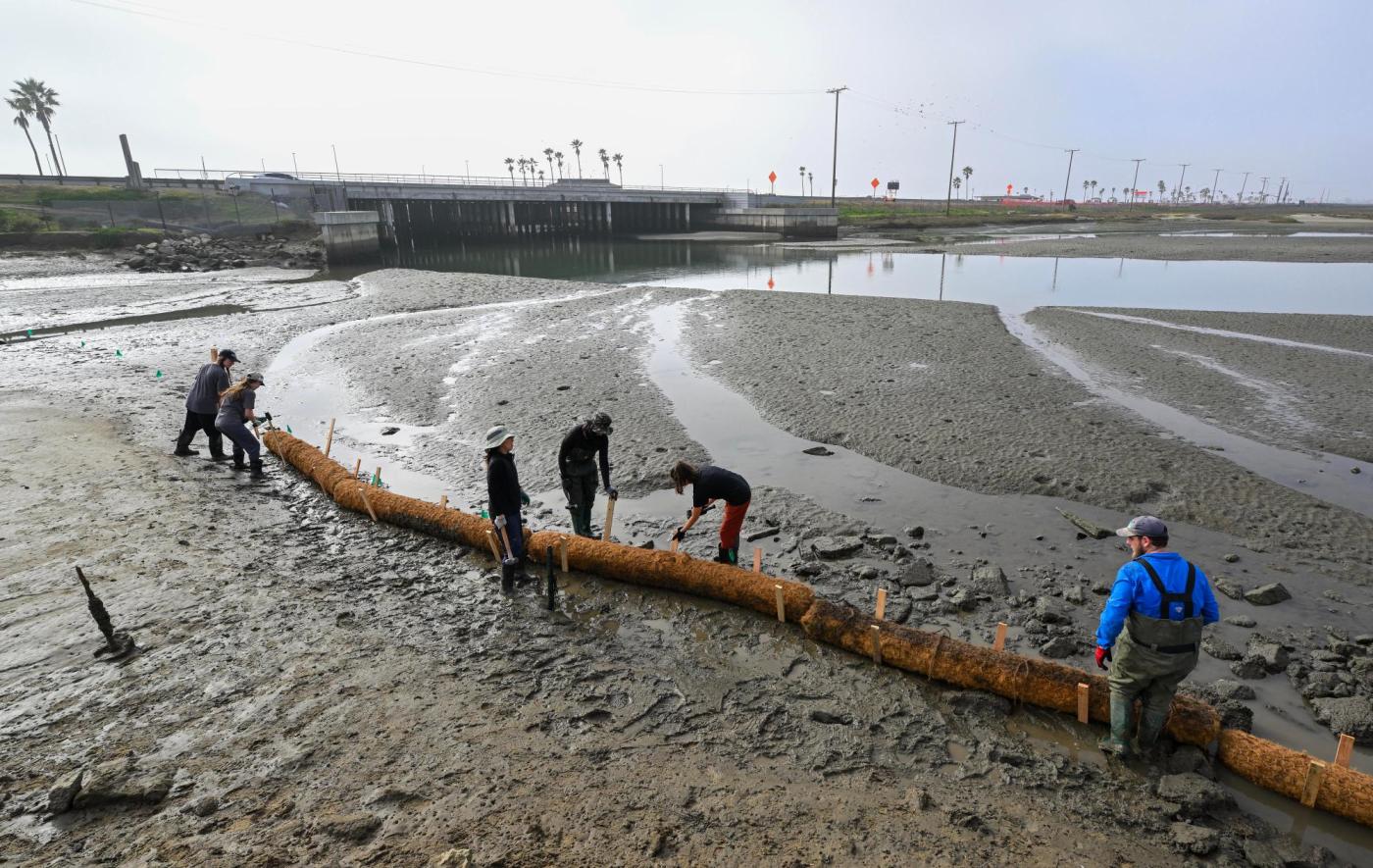
Just inland of the ocean and the cars zooming past on the busy Pacific Coast Highway, a wetland oasis is threatened.
Erosion is chipping away at sensitive and critical habitat inside the Talbert Marsh, at an island area where endangered birds nest each year. Nearby, the loss of sediment is also worrisome for an electric pole that powers a street light at Brookhurst Street and PCH, where damage could cause a nightmare for drivers who use the busy roadways.
But work is underway to slow the erosion, with volunteers kicking off efforts this week to build a living shoreline made of coconut fiber logs and wooden stakes to act as a barrier to the salt water, with hopes that the nature-based solution will hold sediment in place. And if all goes well, other creatures such as mussels and clams could create habitats and call the created shoreline home.


“This is going to be our test case — what works, what doesn’t work, what do we have to change,” said John Villa, executive director for the Huntington Beach Wetlands Conservancy.
While dumping rocks and building walls has often been the quick solution for keeping erosion under control, the use of natural resources are being more frequently explored over hardscaping that can have longterm negative impacts. In the Newport Back Bay and Huntington Harbour, for example, oyster shells are being used to combat erosion.
The coconut fiber logs have also been used in the Newport Back Bay, and OC Public Works installed a few not long ago in the same area of Talbert Marsh. The new project led by HBWC will bring in 120 coconut fiber logs — this week, the first group of 36 were installed in the muddy marsh.
Then, native plants will be put on top to grow and spread, which will also help with slowing erosion.
“The plants themselves will hold back some of the sand and silt as it sits there, and it holds it all in place so it doesn’t melt away again,” Villa said.
The latest effort by HBWC will take months, with more volunteers out on Wednesday and upcoming sessions planned in the next three months. Work has to be done during low tides, so the hours will vary. The project must be completed before next March due to the nesting season, Villa said.
More than 90 bird species have been observed at Talbert Marsh and in the adjoining Huntington Beach wetlands. In addition to year-round residents, thousands of migratory birds use the natural area as a rest stop along the Pacific Flyway as they journey from their nesting grounds in the north to their southern wintering grounds.
Stacey Chartier-Grable, CEO of OC Habitats, helped rally volunteers for the effort, noting that the wetlands are important habitats for the local and migratory species.
About 10% of the wetlands that once existed remain, she said, with habitat lost to urbanization and erosion.
“This is us trying to preserve and upgrade what’s left,” she said.
The water in the marsh is mostly seawater entering from the ocean inlet crossing under the Pacific Coast Highway. Twice daily, water flows in and out with the tide, rising and falling as much as 7 feet.
During winter rains, fresh water also washes down storm drain channels, helping to filter the dirty water, Chartier-Grable said. “The pollutants that come with all the runoff can filter through all the plants and come through the wetlands before it enters the ocean.”
Brian Zitt, biologist with the HBWC, called the nature-based solutions a “novel idea.”
“We deal with issues concerning the marsh, protecting it and trying to minimize impacts in a non-invasive way,” he said. “It’s a pretty cool idea. Time will tell, we’ll see how it goes. It’s been a long time in the works, it’s good to finally get it going.”
There are criteria that will be looked at to determine the success of the project, he said, such as measuring soil retention and tracking the return of native species.
“Part of the permit process has been a restoration and monitoring plan, removing non-natives, planting natives and making sure erosion is controlled,” he said.
The hope is that the island will stop sloughing away, and heavy machinery won’t be needed in the sensitive habitat to protect the power pole.
“This is a more natural process,” Zitt said.
Volunteer Diane Biggs showed up this week to get her hands dirty, figuring it would be a good afternoon to get out in nature.
Biggs said she frequently volunteers to help pick up trash or plant native species in the Newport Back Bay, recalling a lesson her mom taught her growing up.
“Like my mother always said, your environment is important,” she said. “It all matters.”