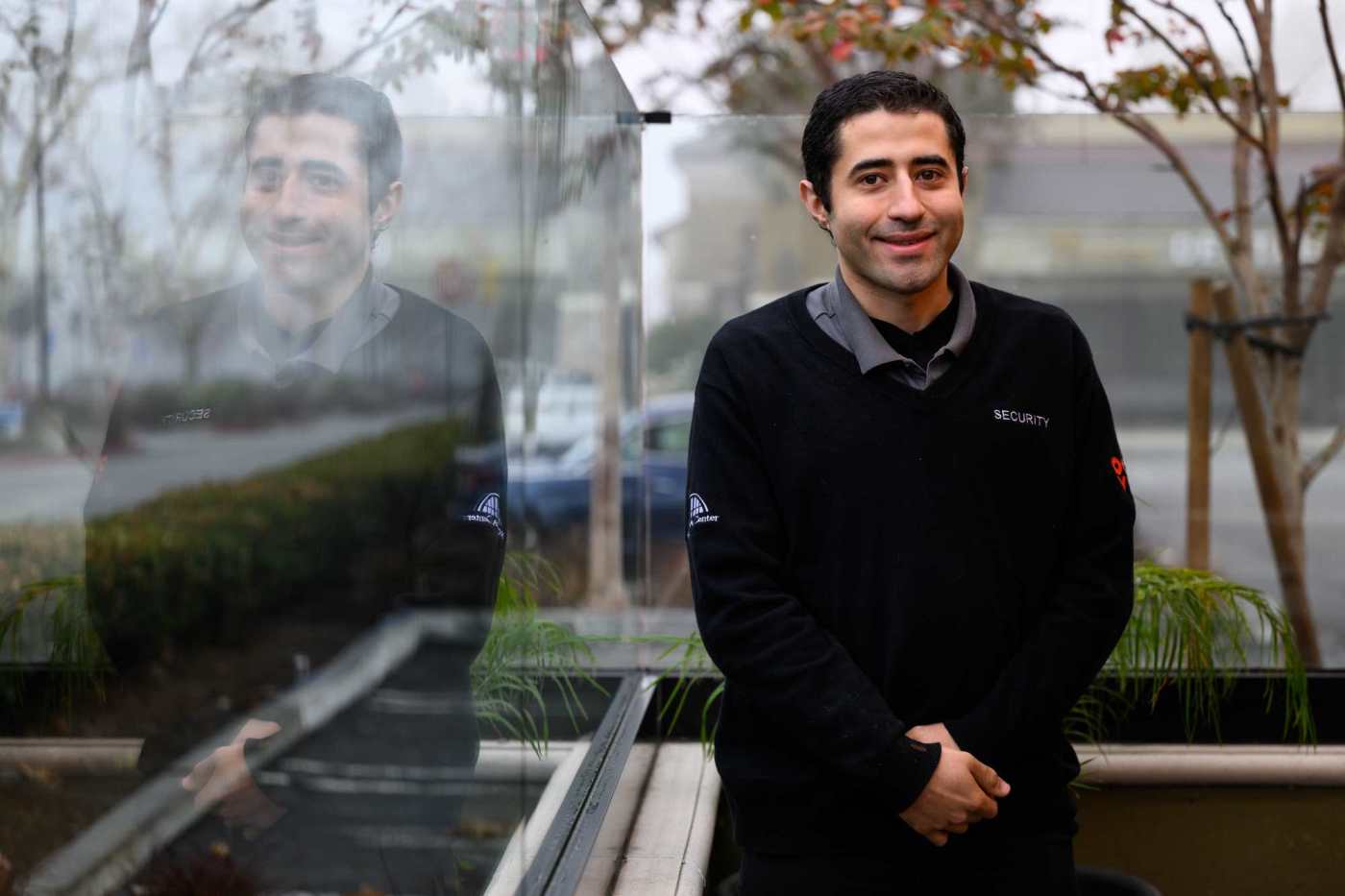
Adán Correa is just trying to get Honda Center visitors through his security line safely and efficiently. But there’s a bit of a holdup when people recognize the celebrity in their midst and ask for selfies.
Correa, 29, is a breakout star from Netflix’s “Love on the Spectrum,” a reality program that follows young people on the autism spectrum as they navigate the dating world.
Fans of the Emmy Award-winning show have followed along with Correa from the first season, when he met Dani Bowman at a speed dating event. They watched the pair bond over their shared interest in animation and navigate differing beliefs about sex and intimacy, eventually breaking up in a heartbreaking season 3 finale.
So now Correa is recognized. Fans ask for selfies. And, perhaps even more so, they ask for advice.
“I take that very seriously, a badge of honor,” an affable Correa said during a recent interview over breakfast in Cerritos. “Because one of the greatest gifts in life is not recognition but being a role model and encouraging people in the right direction.”
Growing up in Santa Ana, Correa was considered to be a very energetic child, his father, Rep. Lou Correa, said. It wasn’t until he was about 5 years old that he was diagnosed with autism, a neurodevelopmental condition that affects communication and social skills, as the Mayo Clinic describes.

It hasn’t been an easy journey, both father and son noted. Adán Correa struggled with focus in school and was often bullied, at times beaten up. But his Catholic faith, along with some lessons in wrestling, helped, they said.
The reality of reality television
Adán Correa studies graphic design at Cal State Fullerton — he’s tempted to turn his cinematography minor into a second major, he said — and wants to one day work in the entertainment industry, whether that’s acting, graphic design or something else.
For now, Correa works security for OCVibe at Honda Center, a job he secured through the Regional Center of Orange County, a nonprofit that provides a range of services to help people with developmental disabilities.
It was the Regional Center, too, that propelled Correa toward “Love on the Spectrum.” The nonprofit serves some 28,000 individuals, executive director Larry Landauer said, and will flag various opportunities — including when producers from “Love on the Spectrum” were looking for people to feature — to appropriate clients.
“He’s perfect for the show because he’s got all kinds of potential,” Landauer said of Correa. “He’s making the most of his life, and it’s thrilling to see.”
Having cameras follow Correa around as he navigated his first relationship wasn’t difficult, he said, but rather inconvenient at times.
The show follows several people and couples around the country in various stages of looking for love — some are going on first dates; Abbey Romeo and David Isaacman, who met during the first season, are reportedly planning to marry.
Correa, a “Star Wars” aficionado who makes costumes, toys and jewelry on his 3D printer, appeared in the first season as a potential suitor for Bowman. The show followed their budding relationship, from trips to the Pasadena Comic Con to a romantic one-year anniversary dinner.
But it also caught the two conflicting over intimacy, having difficult and honest conversations about sex. A sexual relationship was important to Bowman; Correa, meanwhile, stood fast in his belief to wait until marriage. In one episode, Correa FaceTimed his father, who was working in Washington, D.C., to seek out his advice.
“I told him, ‘I’m going to give you my advice,’ and that’s just be honest with each other,” Lou Correa recalled of the conversation. “I think when you’re in a relationship, if you’re not honest with each other, then you’ve just created a train wreck in the future.
“Just let people know who you are, and hopefully they let you know who they are, and if it works, it works, and if it doesn’t, you just move ahead.”
The younger Correa said that’s the advice he gives to those who reach out to him, in person or through his social media accounts, asking about love.
“Be honest, find a partner and not rush things,” Adán Correa said. “Compromise should never involve your character, your beliefs, your faith.”
The beauty of representation
While Correa and Bowman’s relationship ended — Correa is currently single — he has been able to parlay his platform into advocacy for the neurodivergent community.
With some 77,000 followers on Instagram and more than 90,000 on TikTok, Correa showcases his life and travels to various comic-related conventions. He also engages his followers on faith and autism awareness.
In one post, Correa demonstrates how a sensory lamp has helped him with sleep and relaxation. In another, he takes followers with him to the California Democratic Convention, where he dispelled comments made by U.S. Health and Human Services Secretary Robert F. Kennedy regarding people with autism. (The Trump administration official has been largely criticized for comments he has made linking vaccines to autism without proof and claiming that children with autism will never “hold a job,” among other things.)
The show, and Correa’s continued advocacy and allyship, is incredibly important, said Martina Baldwin, a professor in Cal State Fullerton’s Department of Cinema Television Arts who has taught a “resilient” Correa in multiple classes this year.
“When we talk about representation (in television) in our classes, we talk about the reason that it matters is because visibility on screen equals power in society,” Baldwin said. “The more visibility a marginalized group has, the more acceptance they might have in society.”
Typically, neurodivergent people in television or films have been largely underrepresented or presented in a heavily stereotypical way, Baldwin said, which leads to fear or misunderstanding of the community.
“If we had more representation of neurodivergent folks, we’d have more understanding and more support because they can function in society just fine when given support,” said Baldwin. “But they aren’t given enough support because people don’t understand.”
Lou Correa said fellow lawmakers have approached him to offer support for his son since the show has aired. There was also a trip to Mexico City to meet with Claudia Sheinbaum before she was sworn in as Mexico’s president in 2024; a staffer to Sheinbaum ran up to Correa before the delegation of American lawmakers left: “Tell your son we’re his fans,” the staffer said.

“When we found out he (Adán) had autism, it was something new to us, and it led us on this road of what it is, how prevalent it is, how do people deal with it,” said Lou Correa. “The first thing we ran into is the stigma attached to it.”
The Correas want to put an end to that stigma, together.
In October, they hosted an event at Santa Ana’s Delhi Center they called “Together on the Spectrum.” The idea was to bring neurodivergent people and their families together in a safe space, to eat and to socialize.
They plan to hold more such events, the congressman said.
Adán Correa, meanwhile, described the platform he’s been given through the Netflix show as a blessing.
“Every time I hear, ‘You’re a role model, you’re an example,’ I don’t take that lightly,” Correa said. “Being a role model or example for people on the spectrum, it’s a joy. It’s beautiful.”
“Love on the Spectrum” has been renewed for a fourth season. Whether Correa will again look for love on the reality show remains to be seen; he recently auditioned, his father said.