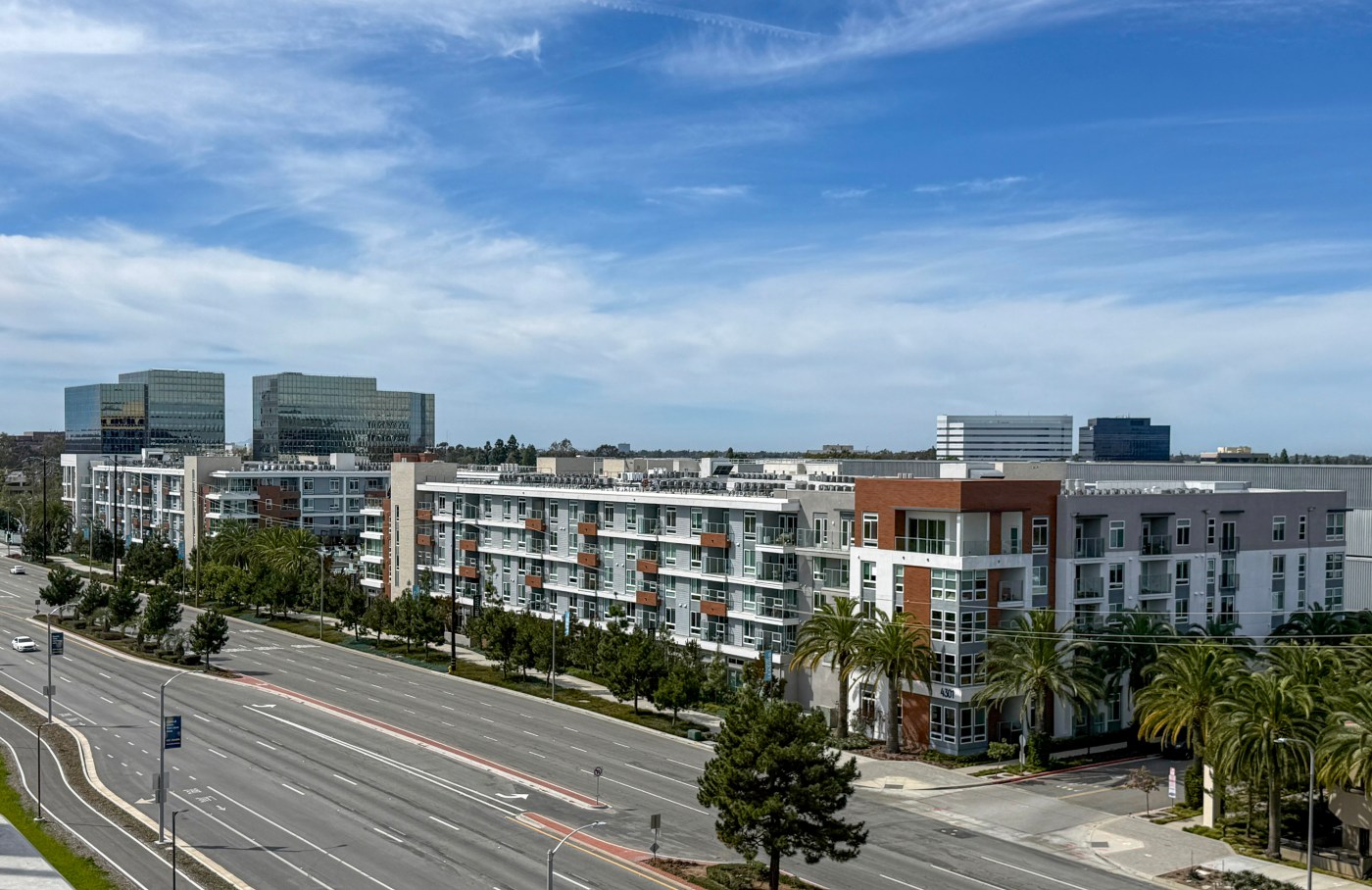
Newport Beach officials are looking at how the city can continue its theme of unique villages, each with its own identity, restaurants, gathering spots and services, in a host of new housing developments planned near John Wayne Airport.
The airport area has been identified by city leaders, along with West Newport Mesa, Dover-Westcliff, Newport Center and Coyote Canyon, as an area where development could happen to help Newport Beach meet state mandates that the city plan for 8,174 new homes, including options affordable to those with lower incomes, to help meet regional needs.


Now the city is hiring a consulting firm to work with city staffers over the next two years to create a specific plan — the guidelines for builders that would help develop the largely industrial and commercial airport area as a unique and livable location in Newport Beach.
“How can we develop the space, parks, sidewalks, bike lanes and landscaping,” Councilmember Erik Weigand said are among the questions Orange-based Kimley-Horn and Associates will help the city answer. “Just how do we make it into a village? We have this blank canvas now.”
To do that, the consulting firm will look at existing conditions and devise a plan to revamp zoning to integrate residences, said Jaime Murillo, the city’s interim director of community development. The contract is for $610,000 for two years, with an option to renew for a third year.
“We need to make sure there are restaurants, grocery stores and retail,” Murillo said. “Now there are these big super blocks. We need to make sure people can bike and walk through the area. The goal is to create a vision, and part of that is changing the name so it has its own identity. How do you know you’re in this new neighborhood?”
“We want people to be proud of the airport area,” he added.
Starting this spring, there will be community workshops and meetings where the public can give input, Murillo said. The opportunity is there for residents citywide, but mostly the consultant and city officials want to hear from people who already live there and business and property owners. Notifications will be sent to property owners, and meeting news will be shared through social media and other channels.
The mission, officials said, is to make 4,845 units fit in a way that creates a vibrant place to live. In the airport area, about 773 units would likely be available at below-market rates, Murillo said.
The airport area is generally located southeast of the John Wayne Airport and bound by Campus Drive to the northeast and northwest, Jamboree Road to the southeast, and Bristol Street to the southwest. It was first identified as a place for additional housing options in 2006, when city officials updated Newport Beach’s general plan.
At that time, its mix of office, technology, industrial and commercial uses seemed well suited to evolve from business parks to a mixed-use district, Murillo said. The expectation then was up to 2,200 residential units would be developed. Of those, about 1,877 have been entitled or are already under construction, Murillo said.
As the state mandated Newport Beach plan for more new housing, the airport area was reviewed again, he said.
In 2020, a group of planners reviewed possible sites that met a specific criterion, and the owners of those properties were sent letters asking whether they wanted to switch from commercial to residential use and be included in the city’s new housing overlay, which was rezoning the area.
City officials identified opportunities for up to 2,577 additional dwelling units, Murillo said
Some of that housing has been built, including the Uptown Newport apartments and the next-door Park House condominiums, both along Jamboree Road. Another 350-unit apartment project at Newport Crossing, at the intersection of Dove Street and Scott Drive, is having its final plans checked by planning staff now and the site has been graded.
And, there are other projects such as The Residences at Newport Airport Village, a development of 444 units at Birch Street and MacArthur Boulevard that are also underway.
At 1400 Bristol St., plans call for 229 apartments, and across the street at 1300 Bristol St., a 193-unit apartment development is planned. At 1401 Quail St., a 67-unit condominium project is underway, and at 1600 Dove St., 282 apartments are proposed.
MacArthur Court, at MacArthur Boulevard and Campus Drive, has a 700-unit apartment project in the works, and 1500 Quail St. has 100 condominiums planned.
“Those are all the active projects that have received entitlement and are awaiting construction,” he said.
In a handful of cases, the council had to override objections from the Orange County Airport Land Use Commission, which argued that “aircraft noise” would be incompatible with the welfare of inhabitants and reminded the city that airport zones were established to allow the airport to continue operating while also reducing hazards to people living nearby.
Murillo said the understanding of the airport zones is built into the city’s regulations for the area. For example, projects can’t be built where noise levels are too high or where they would fall in areas that are unsafe.
“We have built in as part of our development regulations, standards for residential development to ensure they are built to a level that attenuates noise, and we allow for interior recreational uses so that we’re not forcing outdoor recreation,” he said. “When you step up to 65 decibels, that’s normally not allowed.”
The area with higher than 65 decibel levels is mostly along Campus Drive to Birch Street, which is the area closest to the airport, he said.
Weigand said he expects there to be a lot of interest from residents throughout Newport Beach in planning for more development in the airport area.
“For a lot of residents who are concerned with traffic and impacts, the airport area was the ideal place for the allocation (of additional housing) initially mapped out by several city councils ago,” he said.
“We have this blank canvas, let’s map it out in a way where you can have this live, work, play village, that we have so many great ones already of, and map it out in the most thoughtful way possible,” Weigand said. “Let’s take something as challenging as housing and a requirement from the state and make something really neat out of it in an area that would otherwise be an airport or commercial-serving industry.
“We’re on the right page, he added, “to take a tall task given to us from the state and make something better for our city.”