A recent series of winter storms that dumped rain across Southern California and snow in the Sierra Nevada has recharged local reservoirs, leaving many water agency officials confident in their supplies and the state officially drought-free for the first time in a quarter century.
The days of rain may have dampened some of the holiday season, but they also left 14 of the state’s 17 reservoirs filled to more than 70% capacity, with water officials hopeful for new storms still on the horizon.
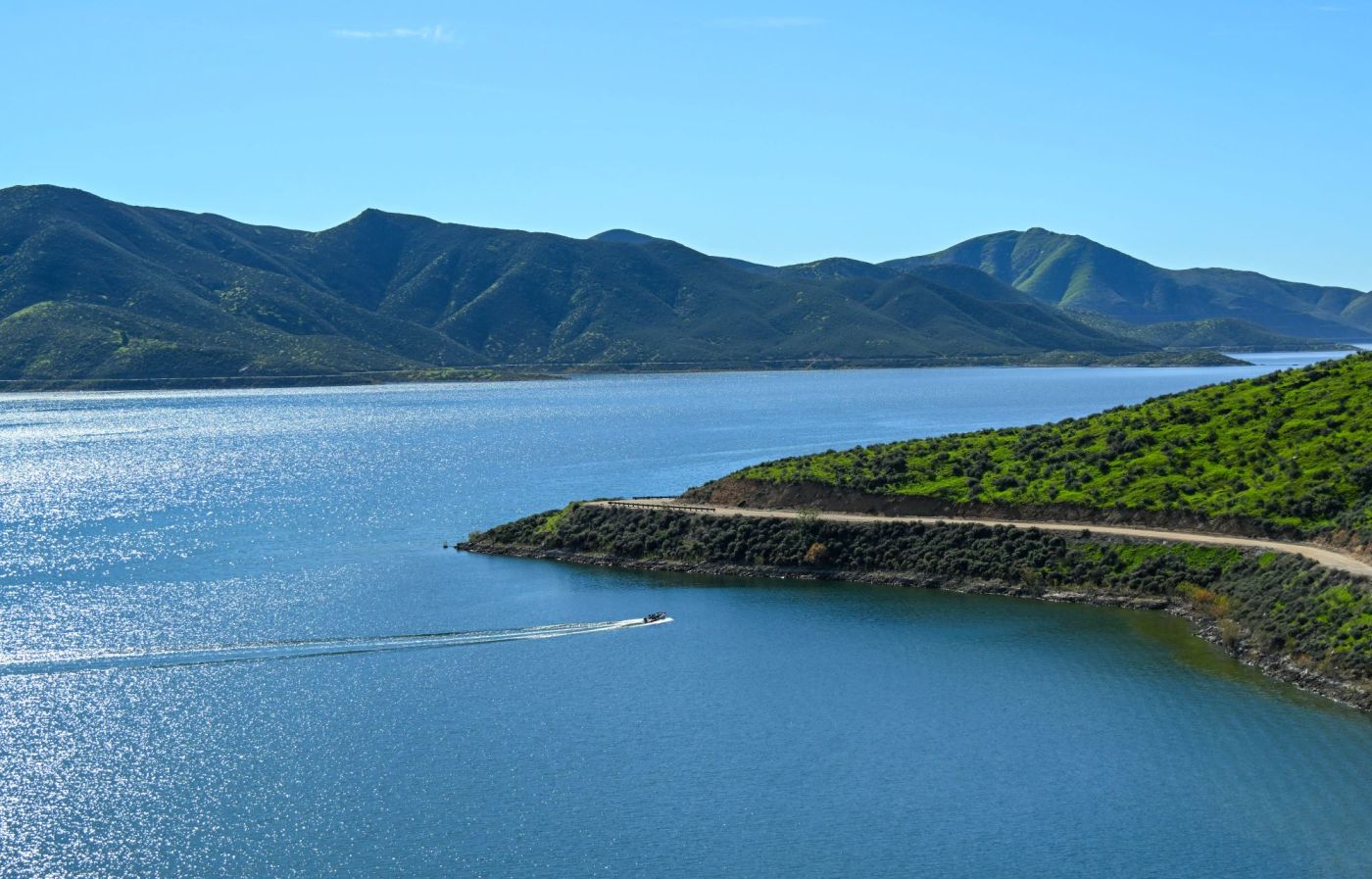
The Diamond Valley Lake reservoir in Riverside is nearly full, Prado Dam in Corona collected enough water to serve more than 37,000 households for a year and in Los Angeles County, the back-to-back storms dumped 10 billion gallons of water into local supplies.

“This storm season, we’ve already captured 14 billion gallons of water, so it’s significant,” said Denis Bilodeau, president of the Orange County Water District board, an agency that manages groundwater basins in the northern parts of the county.
It can be a matter of luck — some of the heavier rain to fall in San Bernardino County was over areas just west of its Seven Oaks Dam near Highland and instead ran downstream to collect at Prado Dam. But that is why agencies rely on multiple sources.
To top off the good news, scientists with the U.S. Drought Monitor reported Jan. 6 that 100% of the Golden State is free of “abnormally dry” conditions, meaning no signs of drought.


The last recorded drought — in which 7% of drought mapping in California recorded abnormally dry conditions — lasted from February 2020 to October 2023. And, the last time the state was considered drought-free was in 2000.
“We did see a good amount of precipitation come through during the holidays, which helps our agencies with their local supply conditions into this next year, but we’re also looking at conditions in Northern California with the delta,” said Noosha Razavian, a resource specialist for the Metropolitan Water District, which serves 26 public water providers in Southern California. “We’ve seen well above normal precipitation in Northern California as well as some good snowpack accumulate in the end of December into January. That’s helping us be in a pretty good position going into this next year.”
Metropolitan Water District, which through its supply contracts, indirectly delivers water to 19 million people in Los Angeles, Orange, Riverside, San Bernardino, San Diego and Ventura counties, reports that Diamond Valley Lake in Hemet, its main storage reservoir for the region, is at 94% of its capacity and other storage sites at Lake Castaic near Magic Mountain and Perris Lake are well filled.

The agency also gets about half of the water in the California Department of Water Resources’ State Water Project, a water storage and delivery system that is connected across 780 miles by canals, pipelines, reservoirs and hydroelectric power facilities, Razavian said.
Reservoirs feeding that system rose by 69 feet during the November and December rainstorms. Lake Oroville, the state’s second-largest reservoir and one that feeds the Metropolitan Water District, is 73% full and at 134% of its historical average.
“The good news is we’ve seen really healthy reservoir conditions throughout the state with Lake Oroville’s main reservoir that is well above normal right now,” Razavian said. “That is putting us in a really good position in this calendar year.”
The total storage at Lake Oroville is 3.4 million acre-feet, and the reservoir is currently at 2.7 million acre-feet.
The State Water Project’s share of the San Luis Reservoir, another source MWD relies on for serving Southern California, is about 100,000 acre-feet shy of full and is nearing capacity, Razavian added.
“Compared to last year, they’re both — Orovile and San Luis — above where they were at this time,” she said, adding that favorable conditions have existed in the state’s reservoirs since 2023, allowing for the buildup of reserves.
One potential concern: The snowpack, which also provides runoff to fuel the reservoirs, is not as dense as in past years, Razavian said.
Recent measurements from the Department of Water Resources found it at 89% of the average for this time of year.
“We’ve seen in the past the snow pack may rebound and start to pick up as months continue,” Razavian said, adding that typically “hydrologic conditions” that can benefit the snow pack continue until May or June.
“Given that we started this year with a record amount of storage in our reserves, we’re in a good position to face whatever various conditions arise. We’re in a very good spot operationally to be able to handle what may come this year,” Razavian added.
Jeffrey Mount, a senior fellow at the Public Policy Institute of California Water Policy Center, said the variable weather conditions that dictate the state’s water supply can make it difficult to predict accurately what will happen in any given year.

There is a small window between December and February when, ideally, there should be between five and seven storms to replenish the water supply. Even in years that start strong, as this one has, he said things can change drastically, and drought conditions arise.
But so far, so good, he said.
“When you’re getting 200% of average rainfall, it’s a good thing,” he said, adding that it significantly reduces the need for irrigation – helping conservation efforts – and it recharges the groundwater supply.
That’s true for the Orange County Water District, where Bilodeau said his agency has already captured $25 billion worth of water that would otherwise have had to have been purchased from MWD.
“It’s a significant cost-saving for our rate payers in Orange County,” he said, adding that storms in December and January delivered 5.77 inches of rain. “That water will be put into the ground and supply water for 2.5 million people in north and central Orange County.”
The district works with the Army Corps of Engineers to capture the water behind Prado Dam, off the 91 freeway.
“There’s a lot of water behind that dam right now,” Bilodeau said – the recent calculation was 18,489 acre-feet of water. “They’re slowly releasing that for us.”
The water flows along the Santa Ana River where the district has a series of lakes at the 91 and 55 freeways that are perculation basins. The lakes overlay sand that rapidly infiltrates water, carrying it into the ground or into the district’s 30 storage basins.
“Over the next three weeks, we’re going to empty the water behind the dam and put it into the ground,” Bilodeau said. “We’re hopeful we’ll get another storm after that that will do the same thing again and we’ll refill the basin.”
He noted the district is at 75% of the water typically captured within the annual window.
“We’re way ahead this year,” he said, citing that year-to-date, starting in July, the area has received 12.13 inches of rain, which is 87% of the average year. “We’re not in a drought.”
Heather Dyer, general manager of the San Bernardino Valley Municipal Water District, said planning for a future with big weather swings between heavy storms and protracted dry spells will be key for agencies and is something the water wholesaler serving approximately 700,000 users is focusing on.
“We’re trying to figure out how do we take advantage of the storm events and storm water, when and how it’s falling, and where it’s falling, in a way we can get it into the aquifer in the same way that Orange County Water District does, but just up here in our groundwater basin,” she said. The recent rain the Seven Oaks Dam missed out on flushed down Lytle Creek to the Prado Dam. “How do we capture it, what facilities do we need to capture it, so that it will be available in those later dry years and even multi-year droughts that we know are inevitable over time.”
“It’s a real challenge when your planning documents are based on the past,” she added, “but you also know the future is not going to look like the past just because of changed climate variables.”
Dyer said the variables are evident in just the numbers recorded in San Bernardino County during the recent rains: At Big Bear, for example, there were 13 inches recorded at the mountaintop, at Mill Creek near Redlands there were 9 inches recorded, but at Lytle Creek, there were 21.5 inches recorded in just December. That number, Dyer said, is more than the district’s entire watershed got in 2020.
The district, she said, is now shifting its thinking about what needs to change to capture the water of the future.
“This is where water agencies need to adapt their planning to future conditions rather than relying on past averages,” she said. “Without Seven Oaks Dam, we would have a hard time relying on future precipitation patterns. I believe future events will become more like we saw in December, huge rain events followed by short, hot, dry periods.”
The agency has 14 projects being planned that could help divert the flow across the front of the San Bernardino Mountains to the dam for storage. Until those are in place, though, Dyer said the 27 district basins near the dam can capture 80,000 acre-feet of stormwater each year.
At the Los Angeles Department of Water and Power, the nation’s largest municipal utility delivering an average of more than 399 million gallons of water per day to the city of Los Angeles’ approximately 4 million residents, water levels are looking good.
The department gets half of its water from the Metropolitan Water District, which draws from the State Water Project and the Colorado River, and the rest from the Los Angeles Aqueduct, which brings its own water from the Eastern Sierras. It’s also working to make recycled water a key component of its water resources – last year, 7% of its water came from recycled sources.
Since Oct. 1, Los Angeles County has captured 62.3 billion gallons of stormwater, the Los Angeles Public Works Department reported.
This milestone underscores the importance of Los Angeles County’s long-term investments in stormwater capture and flood protection infrastructure, which help increase local water supplies, reduce reliance on imported water, and strengthen the region’s resilience to climate-driven extremes, department officials said.
The county’s flood control system, operated by the DPW, includes 491 miles of open channels, 3,400 miles of underground storm drains, 97,466 catch basins, and 189 debris basins, the department reported.
A year ago, when fire was raging in parts of Los Angeles County, the 117-million-gallon Santa Ynez Reservoir in Pacific Palisades was out of commission because it was closed for repairs. The reservoir was back in service in June, and since then, the agency has been making improvements, including replacing the floating cover that protects the drinking water supply. Design for a permanent cover is underway.
Since the water year began in July, the Los Angeles agency has captured 12.43 inches of precipitation in downtown Los Angeles and 17.33 inches in the San Fernando Valley.
That translates to 5.21 billion gallons of cumulative capture, which would be enough to serve 186,833 households for one year or could fill 23,036 Olympic-size swimming pools, said Riana Basuel, a district spokesperson.
But the current 80-degree temperatures in Southern California could turn conservation efforts around, using up some of the water saved during the rainstorms, Mount said.
“We’ve just hit 80 degrees, so local demand will go up,” he said. “We’re dry as a bone in Northern California. The switch that turned on is off now.”
And, he cautioned that while the drought monitor maps look good now, there have been years that began in the same way and then turned into droughts.
“It’s a game of inches whether you’re in a drought. We won’t know what kind of year we’ve had until April 1, that’s when the snowpack melts,” he said. “It’s halftime, we’ve got a long way to go in this game. The good news is we’ve rolled up a bunch of points in the first half, so we’re starting the second half in pretty good shape.”
What makes a difference now, he said, is how full the reservoirs are.
“We’re unlikely to see significant shortages come this summer even if it remains a pretty dry winter,” he said.
That’s the good news.
“However, we still could by summertime be looking at being careful with water,” he added. “This is what water districts eat, sleep and breathe every day. How to store as much water as they possibly can.”
Staff Writer Steve Scauzillo contributed to this report.