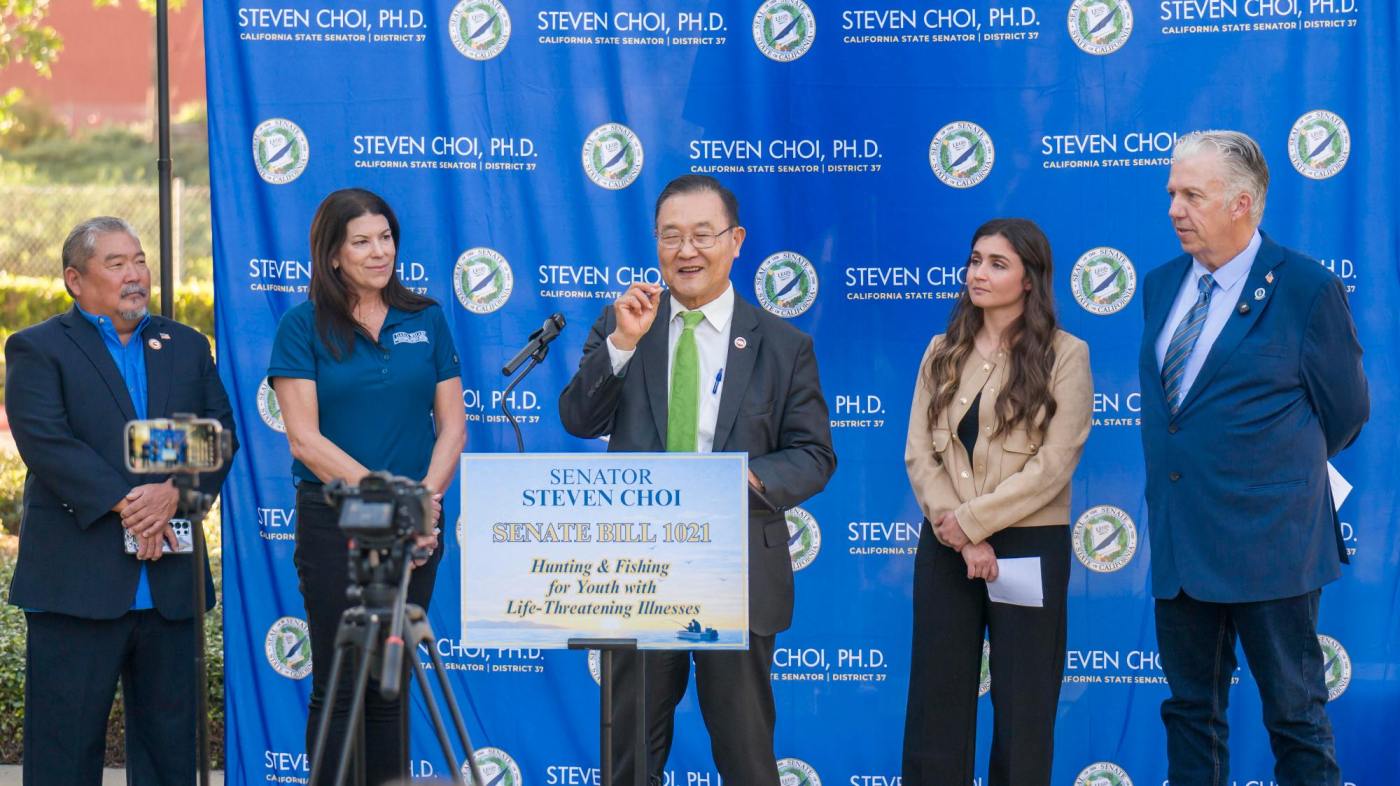
An effort is underway in California to expand opportunities for hunting and fishing for youth with life-threatening illnesses or who have lost a parent in service to the state or country.
Sen. Steven Choi, R-Irvine, last week introduced legislation that would task California’s Fish and Game Commission with establishing a program to help these youth access more opportunities to fish and hunt big game or upland or migratory game birds. Examples of upland game birds are pheasant, quail and wild turkey; migratory game birds include band-tailed pigeons and mourning doves.
“For some young people facing serious illness, time is not a luxury they have,” said Choi, calling Senate Bill 1021 a measure “about compassion and responsible stewardship.”
“This bill creates a narrowly tailored and carefully supervised opportunity for them to experience the outdoors while fully respecting California’s conservation framework,” he said.
According to the bill’s fact sheet, youth generally have a difficult time obtaining the needed permits to hunt in California, given the limited number that exist. It said some 1,880 youth applied for the 16 big game tags available to them in 2018.

“This will create unforgettable experiences for youth with critical diagnoses and their families,” the fact sheet said. The bill “will bring awareness to the vital role hunting plays in managing California’s wildlife resources, and it will aid in the recruitment of the next generation of our state’s declining conservationists.”
While eligibility could vary based on a case-by-case medical review, Choi’s office said someone who is between 5 and 18 years old at the time of a referral could qualify for the program, although it would be possible to fulfill someone’s hunting or fishing request after turning 18 because of planning timelines.
The proposed legislation mirrors a similar law in Georgia, where the state is able to give authorization for terminally ill people who are 21 years or younger to hunt big game or alligators.
Choi’s bill, though, would open the program to youth under 18 years of age who have a life-threatening illness, defined, his office said, as a “progressive, degenerative or malignant (cancerous) condition that places the child’s life in jeopardy,” Choi’s office said. Diagnoses could include chronic lung diseases, cystic fibrosis or sickle cell anemia, among others.
And since the program is to be established by the Fish and Game Commission, it would also need to utilize existing wildlife management tools and be supervised by qualified instructors and guides, according to Choi’s office, and not weaken existing conservation protections.
Senate Bill 1021 counts Sen. Tony Strickland, R-Huntington Beach, as one of its co-authors. Sens. Christopher Cabaldon, D-Yolo, and Caroline Menjivar, D-San Fernando Valley, are also among the co-authors.
The bill is sponsored by Field of Dreams, a California-based nonprofit that helps children with serious medical diagnoses or special needs, as well as military and veteran families, to experience nature and outdoor activities.
Tom Dermody, the nonprofit’s founder, said the group is backing the bill “because it (Field of Dreams) recognizes that some kids cannot wait years for an opportunity that may never come. This bill gives them hope, dignity and a chance to create meaningful memories, all while respecting wildfire and conservation.”
In other news
• Gov. Gavin Newsom last week signed into law a bill meant to protect veterans. From Sen. Bob Archuleta, a Democrat whose district includes Brea and Placentia, the bill is designed to protect veterans from predatory and deceptive people or companies that claim to help them access their benefits.
“This is a clear victory for veterans and their families,” Archuleta, a U.S. Army combat veteran, said after the bill’s signing. “California is sending a strong message that exploitation of those who served will not be tolerated.”
The veterans bill had deeply divided legislators in the statehouse. Opponents, including Sen. Tom Umberg, a Santa Ana Democrat and a retired U.S. Army colonel, had expressed concerns that, while well-intentioned, it could create a system in which veterans are not allowed to choose how they file benefits claims.
• Newsom also signed legislation from Umberg last week: In this case, it was an antitrust bill meant to protect consumers and businesses with more clarity during merger reviews.
The new law will give the California attorney general earlier access to federal HSR merger filings, so the office will have more time to review and challenge anticompetitive mergers and give businesses earlier notice to address any potential concerns, according to Umberg’s office.
Umberg called the effort “a first-of-its-kind measure in the antitrust space, creating a fairer, more efficient merger review process that balances the needs of businesses while protecting consumers.”
• Assemblymember Tri Ta, R-Westminster, is behind a new bill to ensure genetic data is protected.
Assembly Bill 1727 would make it illegal to intentionally sell or transfer someone else’s DNA sample or genetic data to a third party without their consent. An example Ta’s office used in a statement: Someone could throw away a used straw; the bill would make it illegal for someone to pick up that straw and extract their genetic data without knowledge or consent.
“Taking a person’s DNA is not a lighthearted act,” said Ta. “It is a planned and malicious crime to steal someone’s genetic material and use it for any reason. That is why it is critical that there be real consequences.”
The bill does exempt law enforcement and higher education institutions from its provisions.