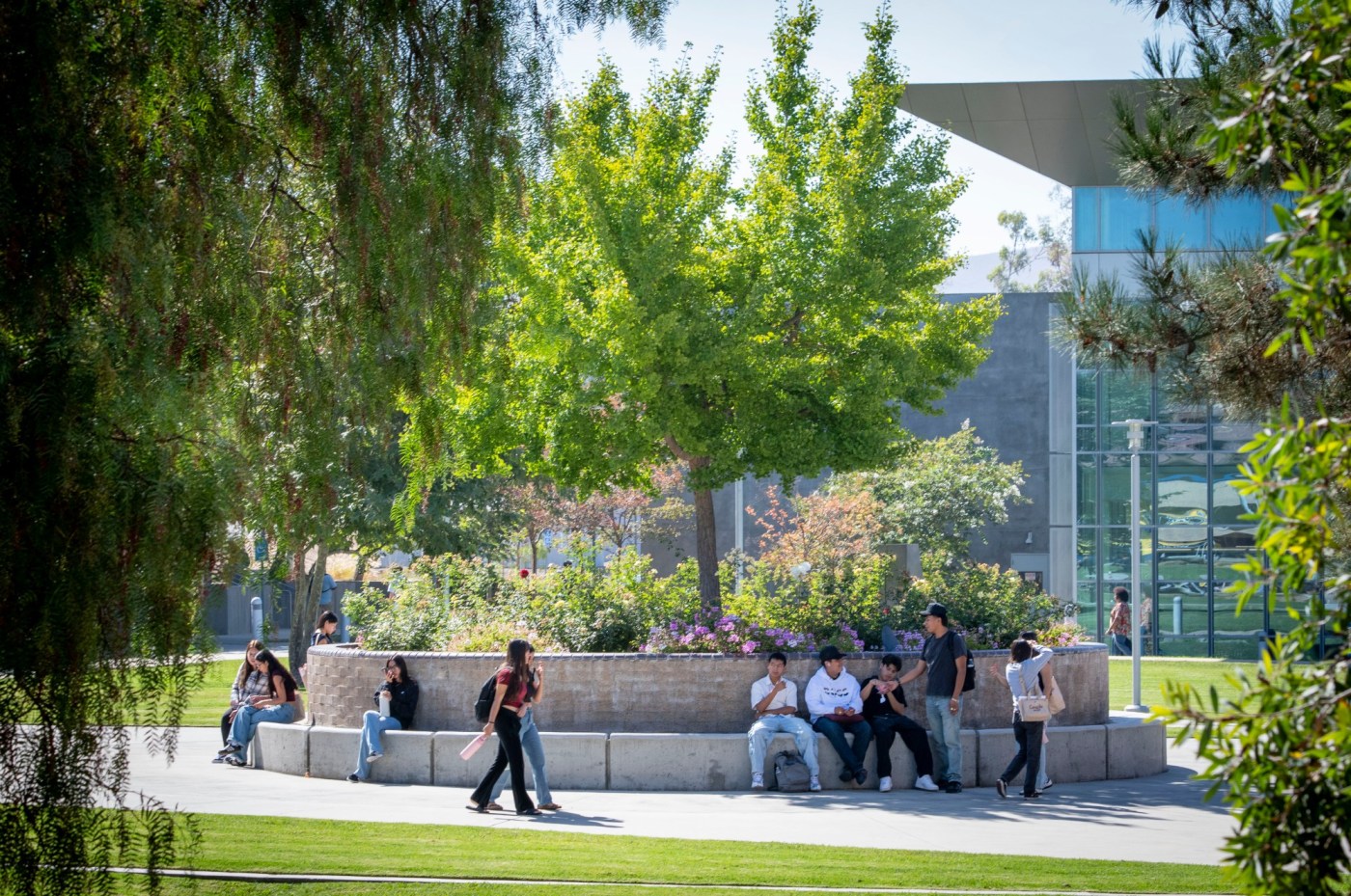
Jason Parks is staring at a problem with a moving target of a solution. A problem that not only promises to get worse but comes with the chaser of potentially taking a wrecking ball to his institution’s purpose, mission and reason for being.
Scott James is trying to be the solution to that problem. It’s a job with a moving target of answers that is the academic whack-a-mole of the 2020s. And James finds himself holding the mallet and wondering where and what he’s going to smack next.
The problem is artificial intelligence, or AI, which is turning the world upside down. And as AI flips industry after industry on its head, few industries find themselves dealing with the falling debris and attack on purpose more than academia. This is why Parks, the vice president of academic affairs at Santiago Canyon College, and James, a professor and distance education coordinator at SCC, are trying to get ahead of the AI craze and turn the debris field into an intellectual garden.
They applied for a $4 million grant through the Department of Education that would allow SCC to establish an on-campus AI Innovation Center. The center would allow SCC to pay for a full-time position that James said would help revitalize the curriculum for teaching programs that include AI, provide funds that support research on how neurodivergent people can use AI and establish a fellowship program that teaches people how to use AI for research and measures the impact of that program.
“This is one of the most challenging parts of my career — trying to figure out how we’re going to do this,” Parks said. “I was a grad student when Wikipedia was a thing, and I remember the hysteria. It’s become a part of life. I imagine AI is going to be that space now, but it’s so much harder because it’s changing so fast. It’s so scary and it’s controversial. …
“It’s challenging living in a world where the people who invented AI haven’t thought of the consequences of this product, and we’re dealing with it. Now that it exists and we’re dealing with it, we’re saying, ‘What are we going to do with this?’ ”
If approved for the grant, which consists of $1 million paid yearly over four years, SCC would begin work on the center by late February or early March. James said if they don’t receive the grant, they’ll reach out to community partners in an effort to raise the needed funds.
The urgency is due to tight deadlines that gave applicants only two weeks to submit grant proposals; James wrote the grant proposal in less than two weeks. AI’s indiscriminate, blitzkrieg path through academia has professors rending garments in frustration and questioning every assignment coming across their desks with what has become a standard query: Is this the student’s work? Or ChatGPT’s? Or Claude’s? Or Fill-In-The-AI App Here?
“AI has kind of been the topic du jour over the past couple of years,” Parks said. “We have faculty at both extremes loving it and hating it — and a lot living in the middle trying to figure out how to deal with this new technology. We need to give our faculty a place to play and to experiment, because what I’ve heard from many of them is you need to bring in someone to teach us how to use this.”
Enter James, who was already in the building, trying to figure out strategies to minimize AI’s disruptions and turn the tool into a learning tool, not a cheating one. Along with being SCC’s point person on the Innovation Center, James is also one of 12 AI Fellows in the state of California, a distinction bestowed on him by the California Community College Chancellor’s Office, based on his work.
That work is considerable and the reason Parks said James is the right man at the right place at the right time to get SCC ahead of the AI steamroller.
“He’s raring to go,” Parks said. “I have so much respect for the man because he really loves AI and understands what it has the potential to do.”
James started using AI after putting his degree in educational technology to use, helping blind students increase their reading speed from 120 words per minute to 400. He also received a grant from Axim Collaborative, a joint endeavor by Harvard and MIT created to advance digital learning technologies and increase access to high-quality learning opportunities.
Through that, James and others introduced Playlab, a custom chatbot tool created by a nonprofit that doesn’t use student data on training, doesn’t violate copyright laws and doesn’t include bias in its outputs. Instead, Playlab allows users to train chatbots to use customized prompts that don’t plagiarize or include bias.
James and other Fellows offered a three-week learning program in Playlab that drew more than 800 instructors from around the state.
“I see AI differently than others do. It’s an ability amplifier,” he said. “I noticed really quickly that AI helps students with neurodivergence. I have ADHD and it clicked for me. I use it now because it elevates me, makes me read at a higher rate and helps my focus on reading.
“When I started using AI, I had an epiphany. We can use it for the same thing: converting text to speech. AI helped me, but I wasn’t using it the same way as students who were having it do the work for them were. I used it as a thought partner and as an employee working for me. But I saw the benefits and the drawbacks right away, and the impact it was having on our teachers.”
This is the urgency in getting SCC’s Innovation Center up and innovating, even as the center is literally a work in progress. Parks said they have a space for it that is adaptable, but he says he still doesn’t know the exact form of that center. All he knows is SCC needs a place, an intellectual garden, so to speak, that helps turn AI from a menace to a machine.
“Our faculty has some of the most brilliant people I’ve ever met, and they need a space where they can let that brilliance out with each other,” he said. “They’re going to figure out how to do this; that’s going to happen, and I’d love for SCC to lead the way in that space. …
“The biggest part is we’re in the plane, but maybe the wings aren’t formed yet. We’re building this plane as we fly.”