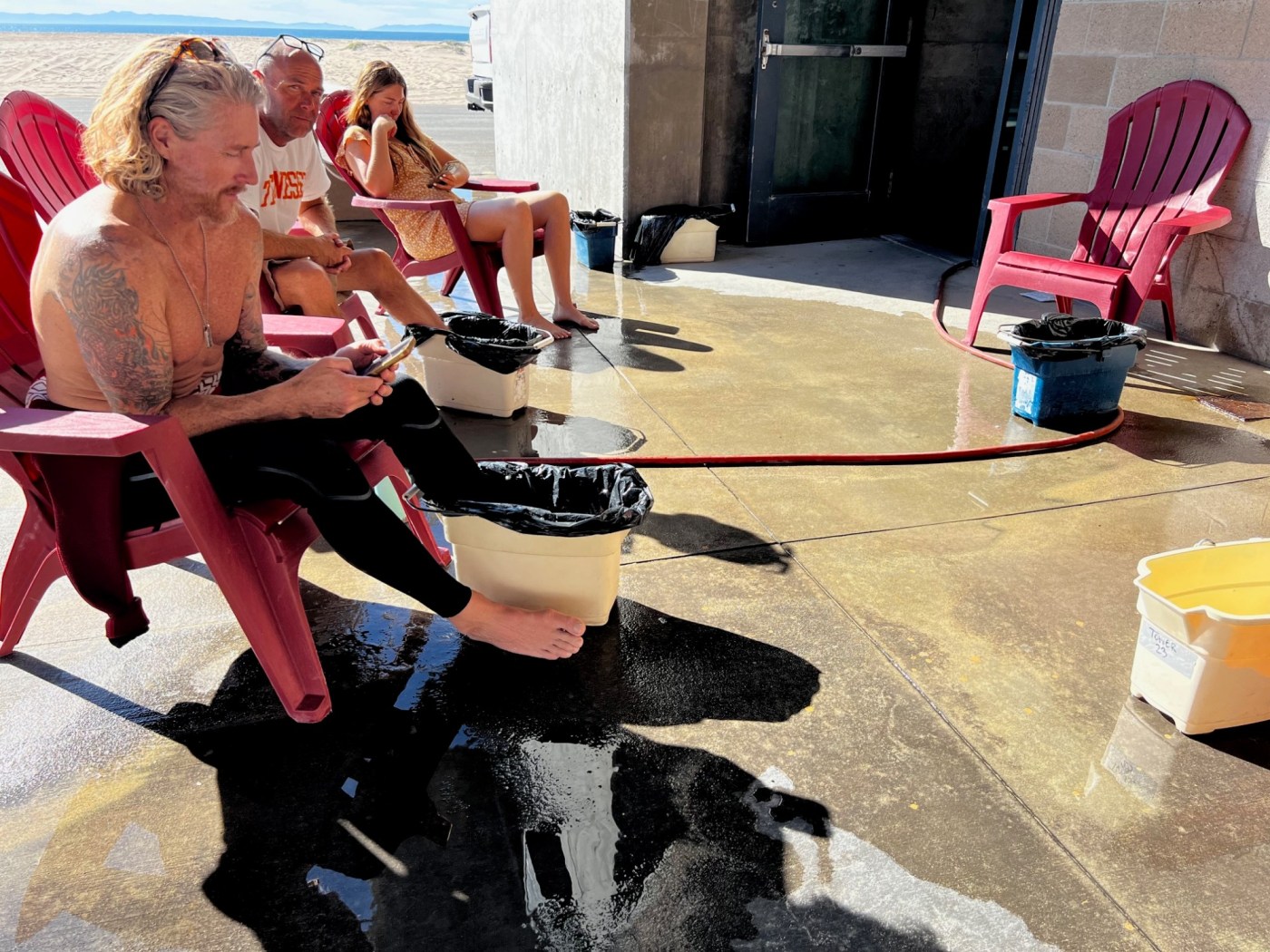
Roland Sands was just wrapping up his surf session at Bolsa Chica State Beach when he got nailed.
He knew instantly what the sharp pain was — just a week earlier, he had been hit by a stingray on his other foot. So he knew the drill, hobbling up to the lifeguard headquarters to stick his foot in a tub of piping hot water.
“It’s like a party,” he said of the group of about eight surfers sitting around on Monday morning, all hanging out and waiting until the stingray’s venomous effects started to ease.
Surfers have been out in great numbers at this popular surf spot, thanks to smallish surf, somewhat warm water — by winter standards — and sunny skies after days of rain, meaning more beachgoers came across the stingrays and their pointy barbs.
“I’ve always noticed an uptick in sting ray victims when we have surf, when there’s people riding waves,” Bryan Etnyre, State Parks public safety superintendent for the Orange Coast district, said. “More visitation in the water equals more victims for sting rays.”
On Sunday, there were 12 reports of people who needed to be treated at Bolsa Chica, Etnyre said.
While it’s not the big numbers that can be seen in summer months — when 30 people at a time can be waiting for their turns to soak their puncture wound — the uptick has surfers on edge at this stretch of beach.

Laurie Haller, of Costa Mesa, was soaking her foot Monday morning to ease the pain following her seventh stingray hit that happened just four feet from shore.
This time didn’t seem too bad, she said, especially compared to the double hit she got last summer, a stingray injury that needed antibiotic treatment because it got so bad.
On Monday, it was a lower tide with shallow water, and she was trying to step as lightly as possible, shuffling with small steps, over the shells and rocks under the ocean’s surface, when she felt the sting.
“I did everything humanly possible,” Haller said.
Lifeguards warn those in the water do the “stingray shuffle,” moving their feet in quick strokes as close to the ocean floor as possible. But even that doesn’t always work, said Etnyre.
“I would tell them what I tell myself, try to touch the ground as little as possible,” he said. “As soon as you’re in knee-deep water, get on your board.”
Even the most experienced professionals can find themselves in hot water.
“Nobody is impervious,” Etnyre said. “Stingrays don’t discriminate. When you run into a stingray, it’s either going to get you or you’ll get lucky.”
Stingrays typically split from shallow waters when water temperatures drop into the 50s or big surf drives them further from shore. But with water temps lingering in the 60s, and small waves in the forecast for the coming days, beachgoers should enter the water with caution, Etnyre said.
“I think the stingrays,” he said, “will still stay around.”