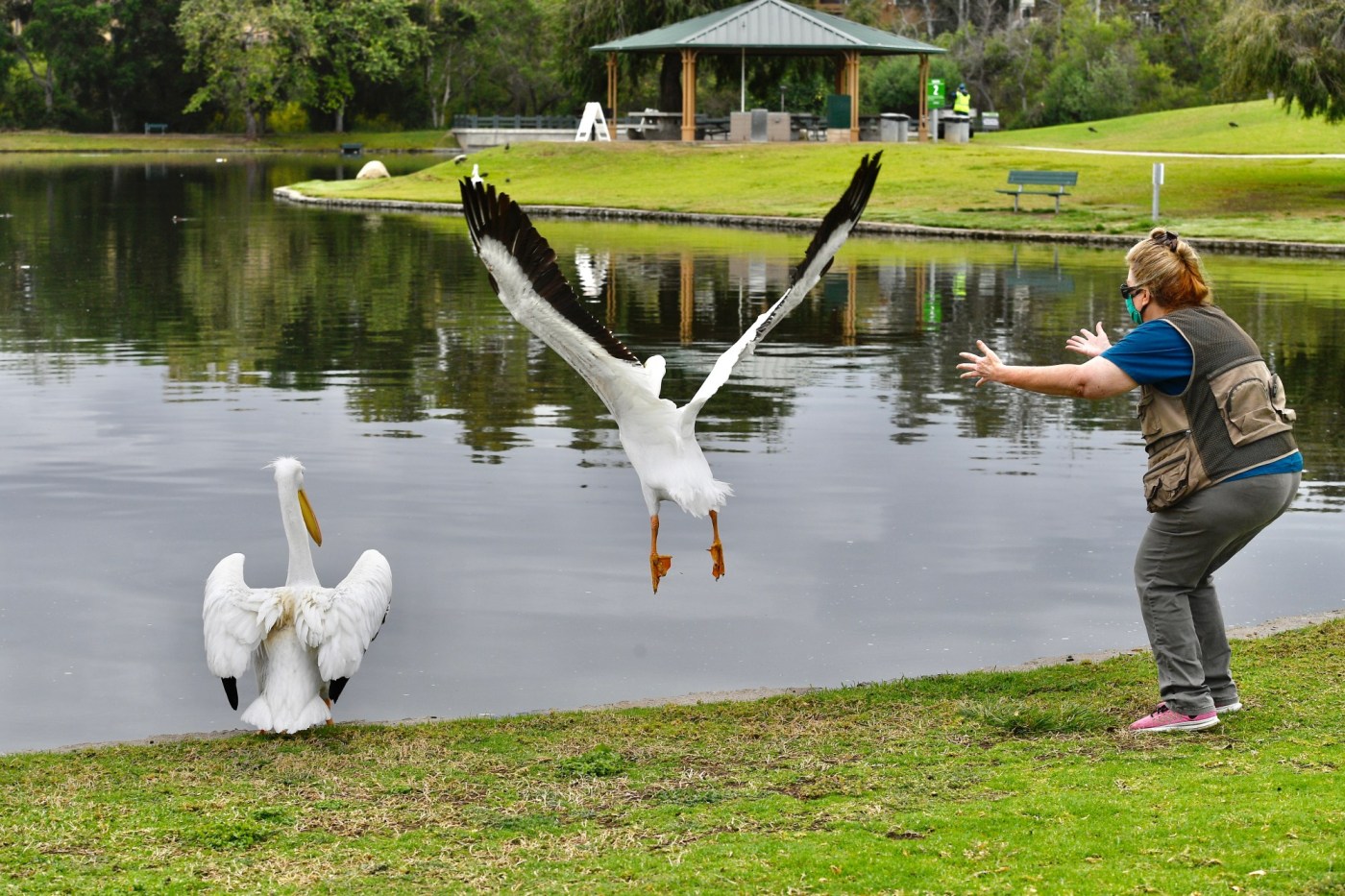
Debbie McGuire will never forget the memory of the little seabird peering back at her, she said, only the tiny eyes visible through the thick black oil covering its feathers.
“My heart was just crushed. It was such a heavy feeling and haunts me to this day,” McGuire said of that moment in 1990 that sparked a long career helping injured and sick wildlife. “It was alive, and all I could see was its eyes.”
The tanker American Trader had run over its anchor, puncturing its hull and spilling an estimated 416,598 gallons of crude oil into the ocean.
Volunteers, including McGuire, sped to the shores of Huntington Beach to help. The Exxon Valdez oil spill in Alaska the year before was fresh in their minds.
“I think the whole world was a little hypersensitive to the effects of oil, not only just to the ocean and animals, it was a horrific environmental disaster,” said McGuire. “So when the oil spill happened locally, we all went to the beach to see what we could do to help.”
McGuire became a founding member of the Wetlands and Wildlife Care Center in Huntington Beach. Now, after more than three decades, she has retired as its executive director.
Those responding to the oil spill were using a small junior lifeguard trailer and often took the struggling creatures to the homes of volunteers to heal before being released back into the wild.
McGuire and other environmental advocates, Greg Hickman and veterinarian Joel Pasco, recognized the need for a place to take the sick and injured creatures.
Someone suggested building at a parking lot being leased by the Huntington Beach Wetlands Conservancy, another newly formed nonprofit that was spearheading efforts to rehab the local marshes along the coast.
With nearly $200,000 awarded from the state, they built a 5,000-square-foot building, pools and flight cages for the animals at Newland Street and Pacific Coast Highway, just across from the beach.
In March 1997, the center opened its doors, just across the street from where McGuire first pitched in to scour the sand for birds caught in the oil spill.
“Our vision was we would have a place to help injured, orphaned and oiled wildlife,” she said. “We really felt like they deserved dedicated medical care.”


The grassroots effort turned the center into the region’s “environmental safety net,” she said.
Through the years, there have been more oil spills, but also toxic algae blooms poisoning sea creatures with domoic acid and disease outbreaks, unusual stranding events that would fill the center to maximum capacity. There have been pelicans injured in attacks and sick animals brought in by good Samaritans and city crews.
“Thank god we were there,” she said of the center. “I think we are now, hopefully, considered a trusted resource for agencies in Orange County and beyond.”
Much has changed since the oil spill in 1990. Back then, the volunteers simply showed up and were put to work with little protection, just gloves. When oil spilled from a cracked pipeline off the coast of Huntington Beach in 2021, untrained volunteers were not allowed anywhere near.
“It was all so new at that time, now it seems like part of my DNA,” McGuire said.
And the early founders didn’t just want a place to care for creatures, but a place people could learn. A teaching hospital with one-way glass was built, so they could share expertise and train others to be ready for an environmental disaster.
“People could walk through and watch what we were doing to observe what actually happens,” McGuire said.
An interpretive center has taught generations of young children about the importance of the ecosystem and how disasters can create a chain of impacts.
“We need the insects, birds, mammals and clean water for all of us,” McGuire said. “A healthy ecosystem makes it healthy for us as well.”
These days, anywhere from 5,000 to 8,000 animal patients are cared for each year, she said. In the span of 30 years, more than 150,000 creatures have been cared for, about two-thirds released back into the wild.
“We want to save everything,” she said, “we want to be able to heal anything that comes in (so it can) go back into the wild.”
But the reality is, about a third don’t make it.
In a memo announcing McGuire’s retirement, the nonprofit’s board chair, Andrea Jacobs Takla, said McGuire is known for her empathy and being an “advocate for our native birds and animals injured or in crisis.”
“The Wetlands and Wildlife Care Center is grateful for Debbie’s years of service and countless lives touched along the way.”
The center will continue its mission of caring for native birds and wildlife, officials said, and begin searching for a new executive director. In the meantime, Wildlife Care Manager Teal Helms will temporarily step in to take on the role.
Threats to the environment and wildlife are still ever-present — a new highly pathogenic avian influenza has just hit the state, McGuire said, making birds and now elephant seals in Northern California sick.
“As a wildlife center, we become vanguards for the environment and public health,” she said about experts keeping a close eye to see if the virus jumps from animals to humans.
There are two big projects McGuire started that she said she hopes the center will still complete: a 100-foot flight cage and a new two-story building, a project that could cost upward of $5 million.
As she looks back on her long career, McGuire said she’s proud of every animal that has been released into the wild, and the institution that a group of environmentalists decades ago built with just an idea.
“I think we’ve become part of Orange County’s safety net, so a lot of the cities and agencies, the residents, now know where to turn when they have a wildlife crisis,” she said. “I think we’ve become a trusted institution to our neighbors and the public.”