Every name tells a story.
Throughout Orange County, place names pay homage to people, geography and even local lore.
There are the namesakes that are well known, such as the famous surf break, the Wedge, named because of how the wave refracts off the rock jetties and meets up with another wave, forming a “wedge.”
And just how holy was Holy Jim? Well, let’s just say Jim Smith was first dubbed Cussin’ Jim in the 1880s before his name evolved to “Holy Jim,” a whole canyon area now bearing his nickname.
But, sometimes the backstories have become murky with time and maybe you, too, have driven by and wondered: Where did that name come from? Here are five we were curious about — maybe a little trivia you can use at your next holiday gathering:


1. Black Star Canyon
This tucked-away nature preserve got its name from the Black Star Coal Mining Company, said Chris Jepsen, president of the Orange County Historical Society.
In 1877, the Black Star Coal Mining Company found coal deposits and opened a mine near the mouth of the canyon.
The mine, which gave Black Star Canyon its name, operated on and off until it was completely shut down in the early 1900s.
There were actually several mines out in the area, and while the canyon didn’t produce high-quality coal, it was cheap and didn’t have to be transported. Santa Ana Laundry used the mine exclusively for a while, Jepsen said.
Some of the mines still exist, though some of the shafts have been flooded in, and others sit on private property.
“If you go poking around, there’s still places where there’s surface coal, you can just walk on ridges and see coal under your feet,” Jepsen said. “Not real pure coal, but it’s definitely what it is.”
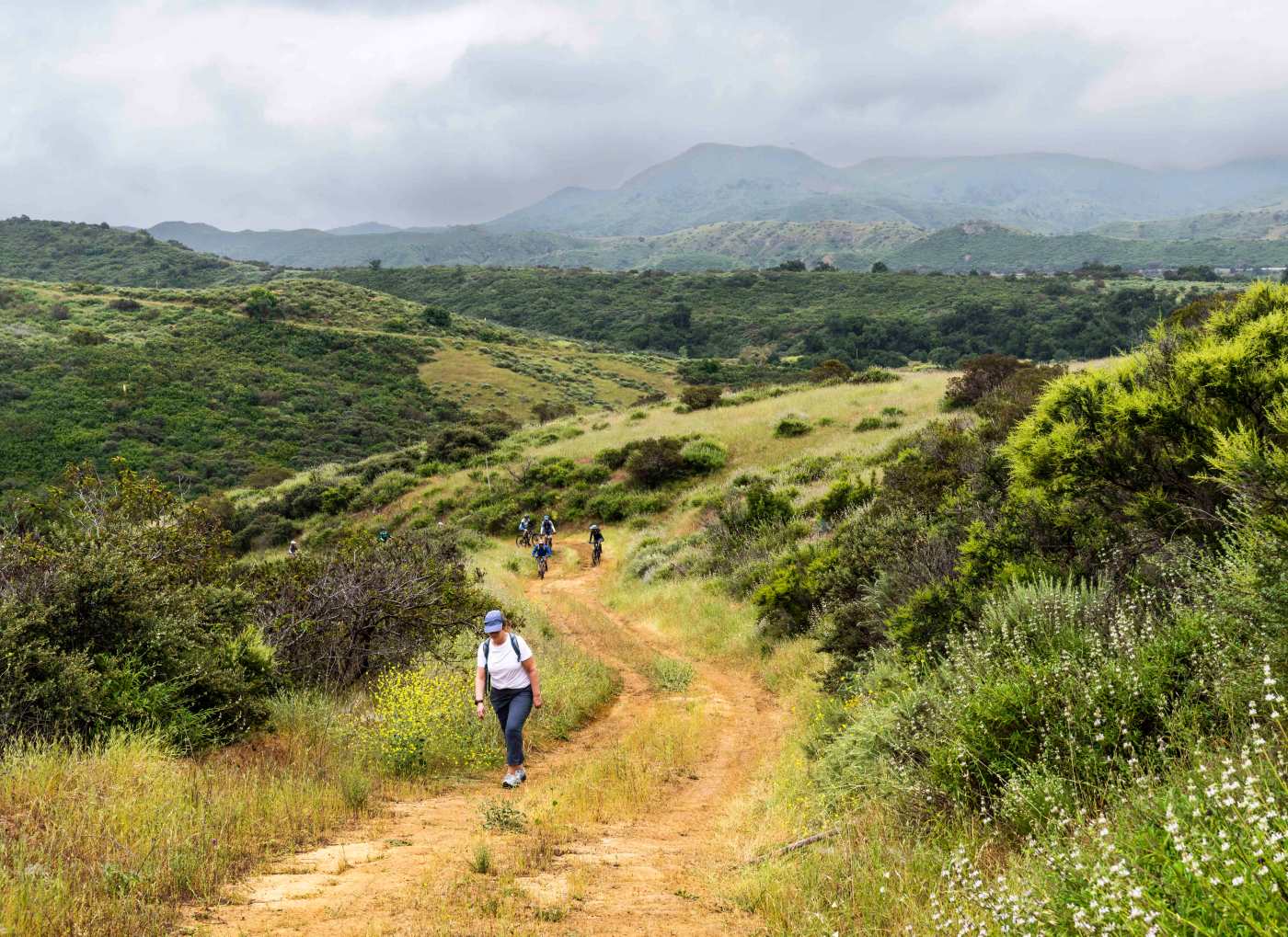
Today, the canyon is known as the Black Star Canyon Wilderness Park and is enjoyed by thousands of visitors each year for both its introductory trails for beginner hikers and families and more challenging routes for advanced trail users.
Due to its central location, Black Star Canyon acts as a wildlife corridor for larger animals such as bobcats, mountain lions and deer. The creeks within the canyon, including Santiago Creek, lure wildlife from the Cleveland National Forest and Limestone Canyon, providing animals with cover and fresh water.
OC Parks hosts Wilderness Access Days to explore the area with guided hikes, go to ocparks.com for more information.


2. Fossil Reef Park
The prehistoric wildlife in O.C. is a pretty wild story and the source of a park name in south Orange County.
Laguna Hills is home to Fossil Reef Park, and those fossils date back 17 million years, according to the city. It’s the only preserved portion of a fossil reef in Orange County, and some 48 species of marine fossil vertebrates, including shark teeth and Desmostylus, can be found, according to the city.
It’s a reminder that most of Orange County was at one time under the ocean, Jepsen said.
“It’s pretty literal,” he said of the name. “It’s amazing how far up if you get up the hills and mountains, if you’re digging, you can find marine fossils.”
When Lake Forest was graded in 1972, a very large limestone formation was uncovered. Many Pecten shells were found at the site, and thus the name “Pecten Reef” was given by local paleontologists, according to the city.
The site was destroyed by a housing project after only a limited period of research. A second section of the reef was discovered in 1973. The Natural History Foundation of Orange County and other groups helped to preserve a portion.
The exposed fossil ridge was recognized as a county prehistoric site by the Orange County Historical Commission, which dedicated the 1-acre Fossil Reef Park in Laguna Hills in 1982.
The grassy area with rock exposed is located on Via Lomas between Moulton Parkway and Alicia Parkway.

3. Barbara’s Lake
Did you know Laguna Beach touts the largest natural lake in Orange County, Barbara’s Lake?
Actually, there were once three lakes, well, more like ponds, up in the Laguna Coast Wilderness Park. One of the smaller bodies of water, Bubble’s Pond, has its own storied history, named after a female hippo that escaped from the Lion Country Safari across the way and decided to settle in for a bath, said longtime environmentalist Mary Fegraus.
People went crazy for the hippo, T-shirts saying “save Bubbles” were made as she refused to leave. Rescuers used tranquilizer darts, only Bubbles stopped breathing and died. To make matters worse, they later found out Bubbles was pregnant.
“If there was social media back then, it would have been something,” Fegraus said.
Ok, that was just too interesting a story not to tell – but back to Barbara.
Fergraus first met Barbara Stuart Rabinowitsch back in the 1970s, a petite ballerina from New York, a “dynamo” who had moved to the beach town in 1959, Fegraus recalled.
Along with helping to co-found the Ballet Pacifica, Rabinowitsch became a passionate environmentalist. She became friends with James Dilley, founder of the Laguna Greenbelt nonprofit, and she started hosting gatherings at her home.
“We would go through everything we were working on. Barbara was just an ardent supporter of it all, lots of spirit to her,” Fegraus recalled. “I call her a Laguna treasure.”
As the toll road was being built and development happened, Bubble’s and Barbara’s ponds combined to make one large lake — a third vernal pond still shows up when there’s enough rain, Fegraus said.
“Really, we have two lakes, both the only natural lakes in Orange County,” she said. “They are a delight. People are amazed.”
It was sometime in the early ’90s that a group lobbied the city to name the large body of water Barbara’s Lake. Rabinowitsch died in 1998.
But don’t show up with a bathing suit or fishing pole, the lake is more for the wildlife to enjoy.
“It’s a source of water for the animals that come to drink there,” Fegraus said. “I don’t think I’d swim in it. It’s not a recreation lake. It’s definitely for nature.”
Getting there is an easy trek from the James Dilley Preserve or Nix Nature Center just north of the 73 toll road.


4. Robber’s Peak
There is an area in Santiago Oaks Regional Park known as Robber’s Peak or Robber’s Roost, and while Jepsen said he’s not sure just how true the story is, the lore goes that a group of bandits used to go up there to watch for targets coming down the road.
“The idea was that robbers would watch for people traveling that they could swoop in on,” he said.
In 1973, the peak was shaved down as Anaheim Hills was being developed. But the robber’s cave is said to still be in Fremont Canyon.
“People love that kind of romantic of early California stuff, whether it’s true or not,” Jepsen said. “It is a great place to go hike.”
Santiago Oaks park, located in east Orange, is a spider web of 18 miles of trails and Robber’s Roost reaches the highest elevation at 1,979 feet, according to a 2018 story in The Orange County Register.
“Legend has it that bandits Joaquin Murrieta and Three Finger Jack used the vantage point to spot oncoming stagecoaches in the late 1800s,” the article reads.
Santiago Creek runs through the park. The main entrance is at 2145 N. Windes Drive in Orange. Parking is $3 on weekdays, $5 on weekends and an OC Parks annual pass can be used. Robber’s Roost gives a 360-degree view for miles.


5. China Cove
Corona del Mar in Newport Beach is home to several tucked-away coves – but ever wonder how “China Cove” got its name?
The name pays homage to a unique home dubbed the “China House” by locals that once sat just at the Newport Harbor entrance, a distinct architectural landmark that mariners would use in their navigation to enter the waterway.
The home was built in a pagoda-style in the 1920s, located on Shell Street in Corona Del Mar.
“The China House was a beloved and iconic landmark at the harbor entrance,” the Newport Beach Historical Society says in one social media post.
It was demolished in the late 1980s to make way for two new homes after a year-long preservation battle and an unsuccessful lawsuit. But the architect incorporated a few pieces of the roof into the new design, which was originally going to be entirely Cape Cod style.
“China House was a distinctive bright pink house with elaborate scrolling and curved Chinese architecture,” reads a summary by Laguna Friends of Architecture. “China Cove, where the house once stood, was named after the house.”
One of the residents who fought to preserve the China House kept a piece of the historic structure when it was torn down.
The pieces of the roof ended up being used on a little building just above his garage on Way Lane, about 50 yards from where the original China House stood. Underneath, a painted ceramic tile plaque reads: “This is the original roof of the China House, restored in memory of Barbara ‘B’ Renard (1914-1996). She was China Cove.”