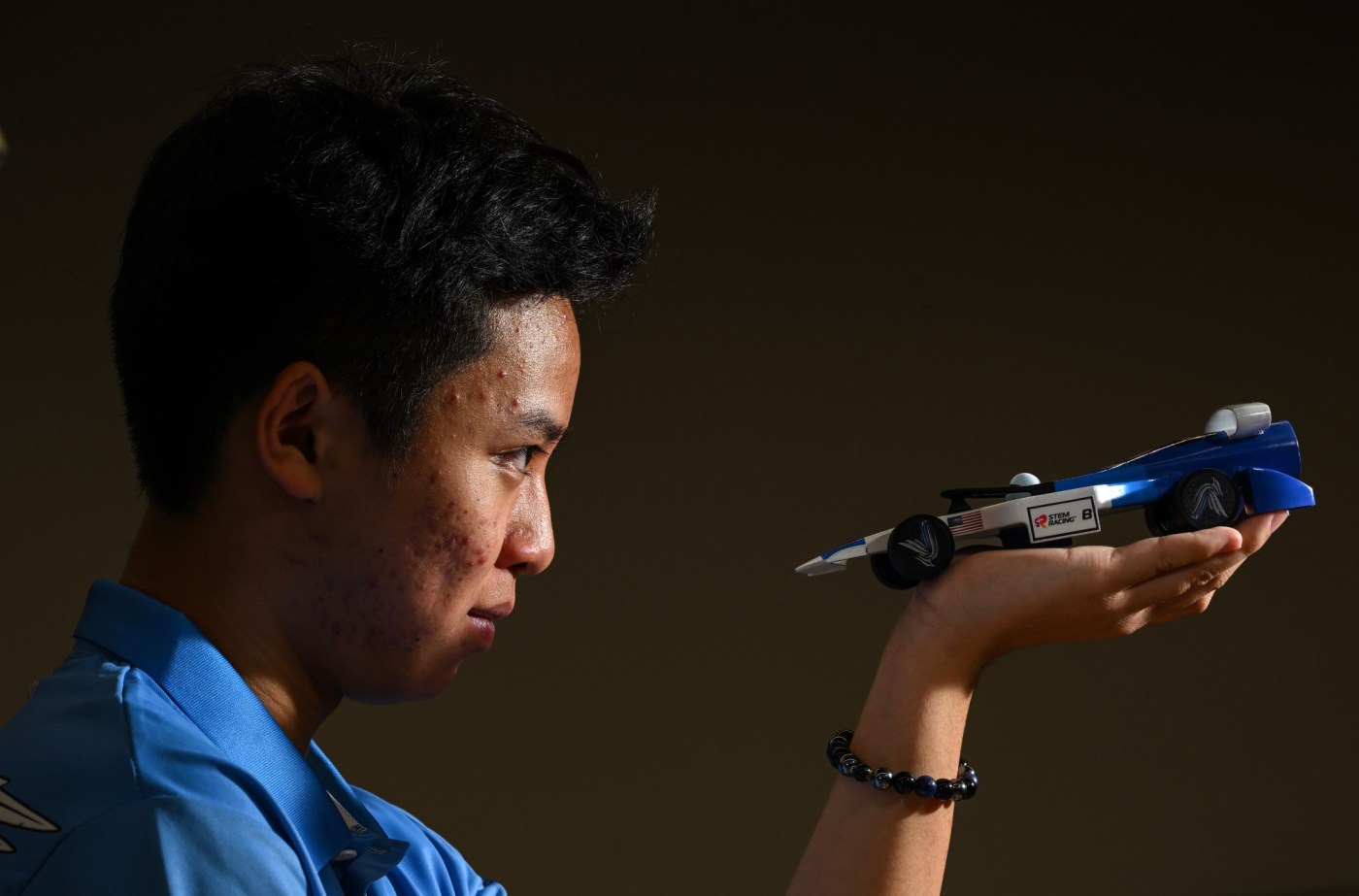
Charles Wu leans forward as the first set of red lights, hovering above the slim, glossy white race track, clicks on.
He breathes, waiting as the next four sets quickly follow suit, illuminating above the Aramco-branded track in Singapore, nearly 9,000 miles from his home in Irvine. He waits, staring at those red lights, not at the other three cars poised on the track, not at the hundreds of pairs of eyes congregated down the four-lane stretch, peering out behind recording phones.
The lights go out. The race is on.
Even now — a few months after the STEM Racing World Finals — Wu, 16, isn’t quite sure how his team made it to the pinnacle of the competition that features squads of young students from around the world who have designed, engineered, built, marketed — and then raced — miniature racing cars.
Related: Meet the 125 Most Influential People in Orange County for 2025
It is his own dream, one that was borne of his own ideas and his own tenacity. He wasn’t backed, as several other teams are, by years-long, institutional programs and mentors and money ingrained in the international competition supported by Formula 1.
But there he was, in Singapore — among more than 400 other participants from around the world who share engineering prowess but differ in customs and language — and Team Swift advanced as part of the top 32 out of more than 80 teams to race.
Wu is a junior at Beckman High in Irvine, where he set out on the engineering track. That’s where he was first introduced to the concept of STEM Racing, which used to be known as F1 in Schools.
His teacher taught the class how to use different machinery and 3D printers and CO2 cartridges and CAD (computer-aided design) software to build and power small race cars.
“I’m interested in STEM. I’m interested in cars. What else can I do out in this world?” said Wu, using the acronym for science, technology, engineering and mathematics.
That was August 2024 — just over a year before Wu and his Team Swift would find success in the World Finals competition in Singapore.


The design
The first step, Wu says, is designing the car.
And that involves a whole heck of a lot of research.
There are, of course, certain regulations and specifications set in place by the competition that Wu had to learn and be sure not to deviate from to be eligible for the competition.
But then come the questions.
How can he change the wing of the car to make it go faster? How can the sides be sharper, allowing air to flow better around it when it speeds down a track? What is best for aerodynamics?
And how can he turn this plain, sharp-cornered block into that race car?
It’s a form of art, this engineering.
Sure, Wu isn’t sitting with a block of clay, chiseling away until a bust begins to form.
But he molds science and design and math, teaching a machine to build a race car. One that, when inspected, will be exactly the right size, down to the millimeter. One that, at the press of a button, will shoot down a race track.
One that propels Team Swift into third place at the U.S. National Finals competition, securing them a ticket to Singapore.
The construction
Wu not only built the race cars, but his team as well, from the ground up.
He recalled seeing teams at the national-level competition — held in Charlotte in April — that had longtime structured STEM Racing programs at their schools with classes and teachers and mentorships and alumni, training the next generation. And, of course, money.
“We didn’t have any of that,” Wu said. “But I think that’s one of the biggest highlights for us, that we essentially started this from basically nothing.”
“We started from scratch.”
Part of Team Swift’s success can be attributed to the high schooler’s unwavering dedication to the project, no matter the obstacle, said Eva Zhang, Wu’s mother.
Wu started the team with some fellow classmates — picking up a few local community college students along the way — but by the time the World Finals came around, Team Swift was just comprised of two other members, both high school students in the Los Angeles area. Three, luckily, is the minimum for a team to be eligible for the competition.
There was the issue of funding, too.
Both of Wu’s parents contributed $1,000 each, Zhang said, but the team needed more. The teenager solicited sponsorships from businesses and groups, including the South Coast Chinese Cultural Center and Roland DGA locally.
Judges, Zhang said, talked to the team after the competition, asking, “How did you guys do so well?”
“It was a lot of failure,” said Zhang. “Whatever difficulty or problem, the team always comes together and finds a solution for it.”
Wu said it was realizing how much time and effort, how much energy and resources, went into getting Team Swift off the ground that propelled his motivation.
“It’s like, I don’t think I should just stop here because I’ve already made it this far,” said Wu. “I want to try to get the most out of this opportunity and try to reach the furthest that I can.”
“That makes them different from the other teams,” Zhang added.
The race
Team Swift’s blue and white car clocked in at a speed of 20.03 m/s down the 20-meter track in the World Finals knockout round, quicker than the other three cars representing teams from Germany, Ireland and Vietnam.
But Wu admits his reaction time — “drivers” press a handheld button quickly when all the lights above the track go out — needed a bit of work.
With a total time of 1.528 seconds, Team Swift had the slowest overall time of the four competitors. The Blue Wolves of Germany won that round, with a finishing time of 1.253 seconds.
Team Swift fared a bit better in the second round, with a grand total time of 1.437 seconds, in second place behind the Blue Wolves’ 1.335. But the team had also picked up some extra, penalty-related time.
Team Swift was knocked out.
Still, the World Finals was certainly a success for Wu and his inaugural team. Not only did they qualify among the 32 teams to participate in the knockout round, but the team was also nominated for multiple awards, winning an award for sponsorship and marketing from the MoneyGram Haas Formula 1 team. (David Croft, a Sky Sports F1 commentator, hosted the awards ceremony.)
And Wu was able to glean advice and ideas from the other teams. He still talks to competitors from other countries and credits a German team for some insight on how the primer he used in painting the car could actually weigh it down a bit.
Because Wu isn’t done competing.
Team Swift’s success at the World Finals automatically qualifies it for the national competition in Charlotte in the spring.
And as Wu prepares for that upcoming challenge, he is thinking about what his team means.
The name and color scheme of Team Swift — with a motto of “one flight to the top” — pays homage to Blue Moon, Wu’s pet bird that flew away.
“As the bird breaks through and soars to new heights and breaks boundaries, that’s what we’re doing as well. We’re overcoming our obstacles, breaking new boundaries.”
And so he continues to craft his car, his art. He’ll be ready the next time the lights go out.