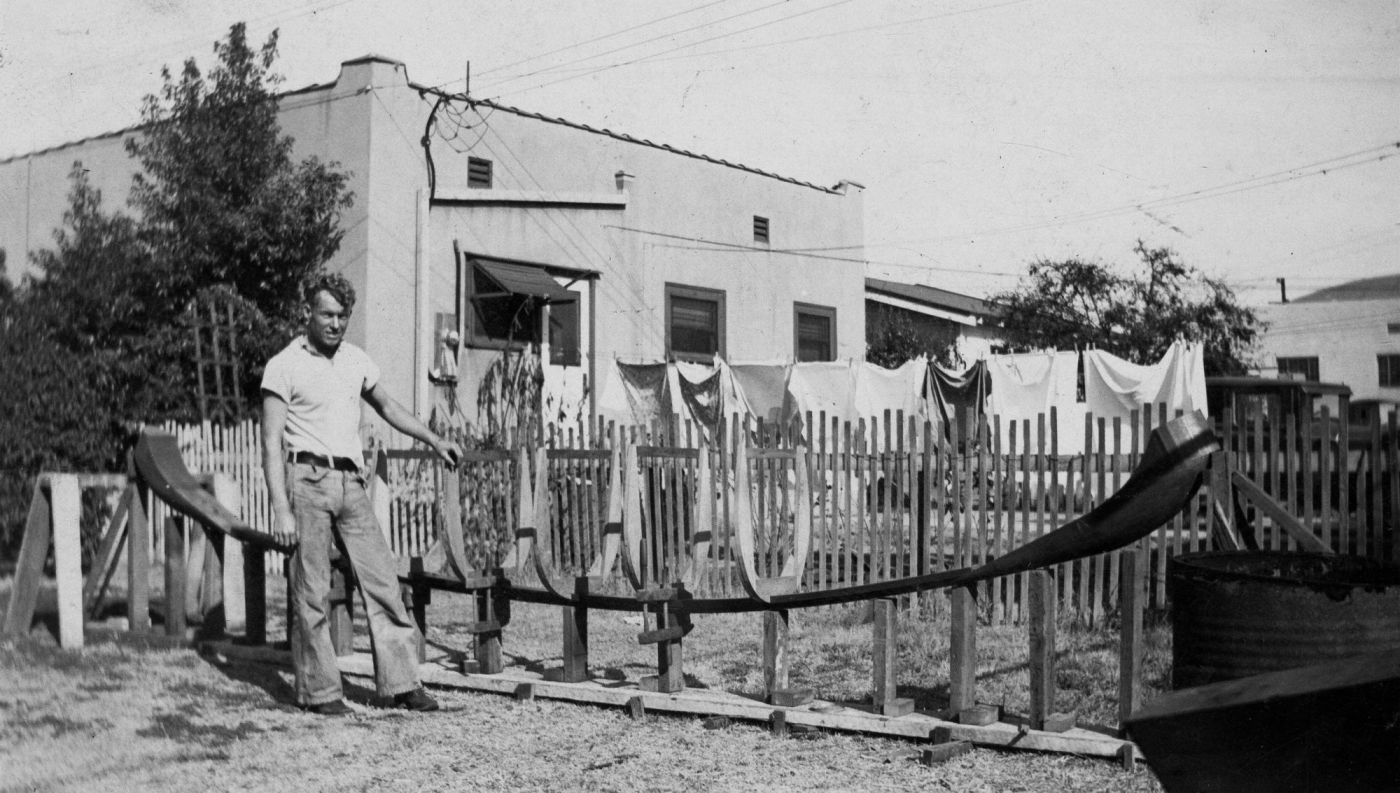
Lorrin “Whitey” Harrison is the next surfing icon to join Dana Point’s Watermen’s Plaza, where the community pays homage to influential wave riders who hail from the beach town with lifesize bronze statues.
Harrison began surfing in 1925 at age 12, and was among the first to ride waves at San Onofre Beach in the mid-1930s, city officials said in announcing the honor. He also won the Pacific Coast Surf Riding Championships in 1933.

An adventurer, Harrison stowed away on a cruise ship bound for Waikiki, but was discovered and returned to the mainland. Less than 24 hours later, he attempted again, and although initially apprehended, he was ultimately permitted to remain in Hawaii.
It was during a visit in the late 1930s that he was among the first to surf the North Shore of Oahu.
“He was the guy who first went to Hawaii and got to know the Hawaiians, brought the California boys over there,” said artist Bill Limebrook, who has created all of the lifesize bronze statues for Watermen’s Plaza.
Limebrook said Harrison got his nickname from the Hawaiians because he was the first white guy who was part of their surfing group.
“It’s really an amazing story, that was the guy who introduced them, the California friends to the Hawaiian friends,” he said.
Harrison brought the Hawaiian beach culture back to Dana Point and Southern California, building surf racks he saw at the Outrigger Canoe Club in Dana Point.
He also learned to dig out koa tree trunks and brought the craft of making the outrigger racing boats to the mainland, another water sport he became enthralled with on the islands.
Outrigger canoes are among the early forms of Hawaiian water transportation, dating back to 800 A.D. They were used for competition among royals in the 1800s.
The first official outrigger group was the Hawaiian Outrigger Canoe Racing Association, formed in 1951, which helped start the Molokai to Oahu race, the biggest outrigger race still going today.
Harrison, also a Santa Monica lifeguard who often did Hollywood stunt work, was tapped to help organize California’s first outrigger race in 1959 from Catalina Island to Newport Beach.
Popularity grew and a few outrigger clubs sprouted up around Orange County. By 1972, Harrison had formed the Dana Outrigger Canoe Club, holding the first Whitey Harrison Classic from Newport Beach to Dana Point. It was hosted as part of the opening ceremonies for the Dana Point Harbor and is still held to this day each August.
In an article published in The Orange County Register in 2022 marking the contest’s 50th anniversary, Harrison’s grandson, JP Van Swae, spoke about the iconic surfer.
“He enjoyed life outside like nobody else,” Van Swae said. “They just live differently. He was a true waterman. But he never saw himself that way. He just lived off the land and enjoyed life outside.
“The idea of stoke — that energy and love and excitement — he’s really given that to people,” Van Swae added.

Harrison and his wife lived in her historic adobe in San Juan Capistrano, one mile inland from Dana Point, where he worked as a surfboard shaper, lifeguard, dry cleaner and night watchman.
In 1990, Harrison was introduced to a national audience as a spirited senior surfer, appearing in a Nike advertising campaign, a Life magazine feature and as a guest on “Late Night with David Letterman.
Exhibitions honoring Harrison were held at the Surfing Heritage Foundation, in San Clemente, in 1997 and at Dana Point’s Ocean Institute in 2011.
Harrison joins other Dana Point icons in bronze at the Watermen’s Plaza, including “Endless Summer” filmmaker Bruce Brown, innovator Hobie Alter, legendary surfers Joyce Hoffman and Phil Edwards, Surfer magazine founder John Severson, tandem skateboard and surf team Barrie and Steve Boehne, and more.
Harrison’s statue will be added in 2027. Big-wave surfing pioneer Mickey Munoz’s bronze statue will be unveiled later this year.
The Watermen’s Plaza is on Pacific Coast Highway across from Doheny State Beach.