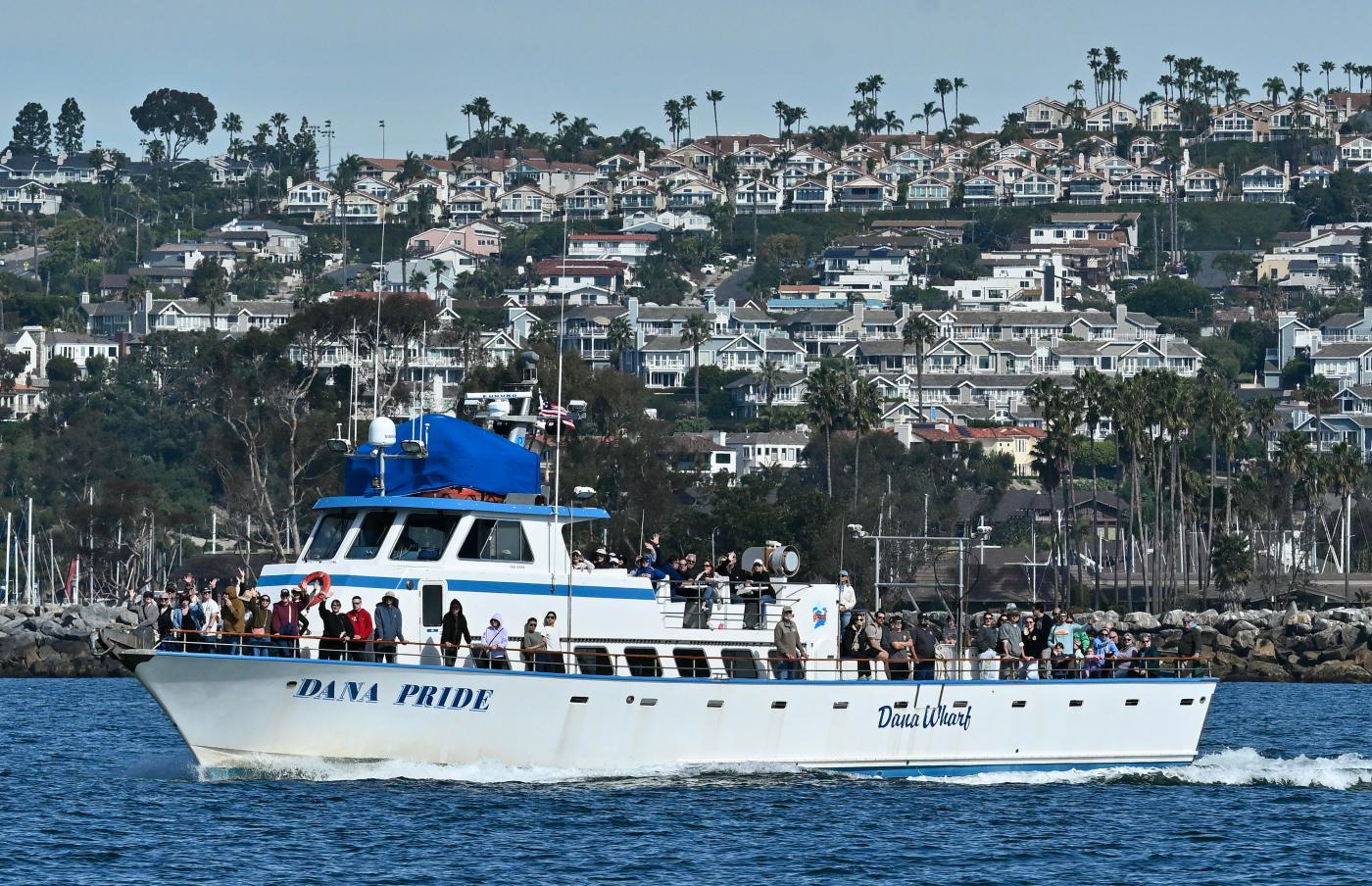
Local charters are reporting that gray whales — the celebrities of this weekend’s Festival of Whales in the Dana Point Harbor — are being seen on nearly each trip out.
In its 55th year, the three-day festival that starts Friday, March 6, is a tribute to the mammals’ 20,000-mile annual round-trip migration that takes them right past Dana Point as they trek between their feeding basins in the Arctic and the balmy lagoons of the Baja Peninsula, where they birth their young.
“We are now seeing multiple gray whales on almost every trip, with flukes rising high and close passes along our beautiful Dana Point coastline,” said Gisele Anderson, who operates Capt. Dave’s Dolphin and Whale Watching Safari, noting that in the last week of February, her team of naturalists and captains spotted 135 gray whales, compared to 28 at the same time last year.
“Gray whale season is in full swing, and the rebound from last spring has been remarkable,” she said. “These steady sightings have brought back that electric feeling on board.”
Still, researchers with the National Oceanic and Atmospheric Administration have concerns about the gray whale population and questions about the impacts of Arctic ice melt on the species’ future.

NOAA biologists count the whales annually on their migration south starting in January, and this is the seventh year the population has seen a decline in numbers. Last year, researchers reported one of the lowest counts of adults since the 1970s — which was not long after protections to ban the commercial whaling industry were put in place. The biologists also noted that the 85 calves counted were the lowest reported count since the 1990s, when the program to keep track of them started.
In 2019, NOAA had declared an “unusual mortality event” because a large number of whales had been washing ashore along the West Coast over multiple years, but in 2023, NOAA called that event over. The recent population counts suggest there has still been a continued decline since that event, said Aimee Lang, a research biologist with NOAA, who is among those conducting whale counts along the Big Sur coastline.
Now, just days after wrapping up the first count of the year, which lasted six weeks, Lang said she is “cautiously optimistic” that the results, once run through data modeling, might be better than last year.
She and other researchers, who perch themselves in a trailer just about 10 miles south of Carmel, do their best to track by eye and binoculars each passing whale on its southbound trip. Last year’s count estimated 11,700 to 14,200 whales. In 2016, experts estimated a peak of 27,000 gray whales.
So far, anecdotally, there is reason for a bit more optimism, said Lang, who has been studying gray whales for more than 20 years. “Our raw count was higher than last year.”
In tandem with the visual count, the group also flew drones to collect video of the whale groups, which also helps with evaluations of the population
Even more telling will be the results of the northbound mom-and-calf pairs count, which starts at the end of the month and continues until Memorial Day.
The calves are a good indicator of future trends, Lang said.
“Looking into the future, it may be that the environment can’t support as many gray whales as it used to,” she said. “While I’m cautiously optimistic we’re going to see a slightly higher abundance estimate this year, it’s not going to be indicative of, ‘Hey, gray whales have recovered to the level they were at in the mid 1990s.’”
Variation in numbers is not uncommon from year to year, she said, but researchers still have a lot of questions about what is going on.


Josh Stewart, an associate professor who heads up the Marine Mammal Institute at Oregon State University, said he’s waiting to see this year’s survey results, but he believes there are clear indications that the large numbers of whales seen a decade ago might not be seen again.
Before and after the whales go on their long and arduous migration along the West Coast, they fill up on very rich lipid-plumped crustaceans that are buried in the sediment of the seafloor in the Arctic.
But the supply of these fat-filled communities is dwindling as the ice mass melts, Stewart said. The amphipods feed on algae that grows on the underside of the ice, so less ice means less food to fuel the whales for their journey.
“It’s really no surprise that when the amount of food in those areas changes dramatically, the population of gray whales responds to that change,” Stewart said.
“We have a pretty good picture of where we’re at, and it’s not improving,” he said, adding that when NOAA closed down the unusual mortality event in 2023, it didn’t mean the whale population was recovering; it only meant that the population wasn’t crashing quite as quickly.
“Even though the deaths came down, the birth rate was still pretty low and so the population continued to decline,” he said. “Last year, the strandings were actually quite high again, and the population seems like it’s still declining.”
Now, with the compounding effects of climate change, Stewart said the Arctic basins where the whales feed are warming four times as quickly as the planet’s average, which is extremely disruptive to the whole ecosystem.
“This time is a little bit different than what we documented previously, because in previous years there was an impact for a couple of years and gray whales bounced back pretty quickly,” he said. “This is really different because it’s been this steady decline now in the seventh year. And birth rates have remained lower for longer than we’ve ever seen since they were first monitored.”
“What I don’t know is when this is going to bottom out and see the population stabilize,” he said, adding that he doesn’t believe the whales will go extinct because they have made it through previous cycles of climate change and periods of global warming.
“But, I don’t think the population is going to look anything like it did 10 years ago when we had 25,000,” he said. “I think we might live in a world with something closer to 10,000 gray whales being the maximum that the Arctic system can support.”
Stewart said the lesson for people who are heading out to the Festival of Whales — which includes a Saturday morning parade, fun events in the harbor, a lecture series, and, of course, whale watching opportunities — is to understand that while the ice is melting thousands of miles away, the effects are seen here in Southern California.
“We’re experiencing dead whales washing up on beaches, many thousands of miles away from ecosystems being impacted by climate change,” he said. “This is not a faraway problem; this is something affecting species we care about, culturally important, economically important to us, and what we’re seeing with gray whales will hopefully be a wake-up call that this is happening and is a today problem.”
Among those advocating for ocean health and paying homage to the gray whales is Donna Kalez, chair of the Festival of Whales Foundation and operator of Dana Wharf Sportfishing and Whale Watching, founded by her father, Don Hansen, and the oldest business in the Dana Point Harbor. Her father started the festival.
She and Anderson teamed up in 2021 to get Dana Point named North America’s only Whale Heritage site by the United Kingdom-based World Cetacean Alliance. The year before, the two trademarked the coastal town as the Dolphin & Whale Watching Capital of the World.
Kalez has been recording her charters’ whale sightings for 25 years and is also tracking an uptick this year. She said by last season’s end on April 30, there were 241 whales counted by her charters, while the year before there had been 400.
“Any shift in their behavior or what might be going on with them, we want to know about,” Kalez said, adding that she’s teamed up with the Pacific Marine Mammal Center in Laguna Beach to make observations of whale health. “We want to learn more about them, so anything I can do to help with research, I do it.”
Among those efforts is a program to educate more than 3,000 schoolchildren through the Gulf of Catalina Gray Whale Preservation & Education Foundation, started by Mike Hansen, Kalez’s brother. Through various programs, the foundation provides educational resources and opportunities to learn about gray whales, their migratory patterns and ocean health.
In partnership with the Pacific Marine Mammal Center, schoolchildren are taught to look at the gray whales and track whether they look healthy, are skinny, which is often indicated by an indentation behind their blowholes, or if the moms are pregnant.
Dr. Alissa Deming, who leads medical research at PMMC and is called when gray whales wash up on the sand, is compiling a health study. With the whale watch charters out every day, she and Kalez are collaborating on making use of what captains and passengers observe.
“We came up with a few basic questions to get the kids on the boat to start thinking about what it is like if these animals need doctor appointments,” she said. “We’re giving the kids an opportunity to evaluate the whales. Instead of just going out on the boat, which is an incredible experience, it starts connecting them with the whale as a living being and they can play being a veterinarian.”
By sparking the conversation, Deming said, it helps them become aware of the dangers the animals face and the conservation needs.
“I hate to put the burden on the next generation, but it is the lifestyle choices they make that can make this a better or worse situation,” she added. “Having them out on the water and making them recognize that their actions may or may not contribute to the whales being healthy or sick, really motivates their day-to-day actions.”
If you go
The 55th annual Festival of Whales is back in Dana Point with its popular parade in tow.
Last year, the annual celebration of the gray whale migration past the coast was missing the parade because of construction going on in the Dana Point Harbor. But this year, the Magical Migration Parade marches on.
The family-friendly three-day festival that starts Friday, March 6, will also include a carnival, a concert on the water, cardboard boat races, Wyland art lessons, a clam chowder cookout, and much more.
The parade will launch at 10 a.m. on Saturday at Golden Lantern and Dana Point Harbor Drive and travel along Dana Point Harbor Drive then Island Way, across the bridge and to the Richard Henry Dana Jr. statue. Dana Point Harbor Drive and the Island Way Bridge are prime viewing areas, organizers said.
Check online at festivalofwhales.com for the full schedule of activities.